
Used Dump Truck for Sale from China: Buyer’s Guide
Buying a used dump truck for sale from China comes down to three checks: the condition of the actual unit, the evidence the seller hands you before you pay, and the landed cost at your port. Get all three right and you’re making a normal equipment purchase. Get one wrong and the saving you thought you’d made disappears.
Here’s how fast that happens. An importer in East Africa asked two exporters to quote a used HOWO 6×4 tipper. Both trucks were described as the same model and the same year. One quote came back several thousand US dollars lower, and the buyer nearly took it.
The cheaper unit had a repaired frame rail, a repainted dump body, and no inspection file. The other came with a cold-start video, forty close-up photos, and a written report that listed two leaking hubs.
Same model. Different trucks. The story is illustrative, not a customer reference.
That gap is why this guide exists. The US search results for “used dump truck for sale” are mostly local dealer listings, and those pages can’t help you buy from China. What follows is the process we use with importers: how to read condition, which evidence to demand, how to build a landed cost, and how to check a seller before money leaves your account.
If you already know your application and your destination port, you can request a configured quotation and skip ahead. If you’re still working out what you’re buying, start with what “used” actually means.
Key Takeaways
- A used dump truck’s value sits in its inspection file, not in the model year on the badge.
- Ask for a cold-start video, a timed walkaround, and a written report before you pay a deposit.
- Budget the landed cost. Vehicle, preparation, freight, and destination charges are four separate lines.
- “Refurbished” describes a repair scope, not a grade. Ask which systems were rebuilt and what proof exists.
- Confirm emission standard, drive side, and destination documents before the unit is loaded.
What “used” means when you buy a dump truck from China
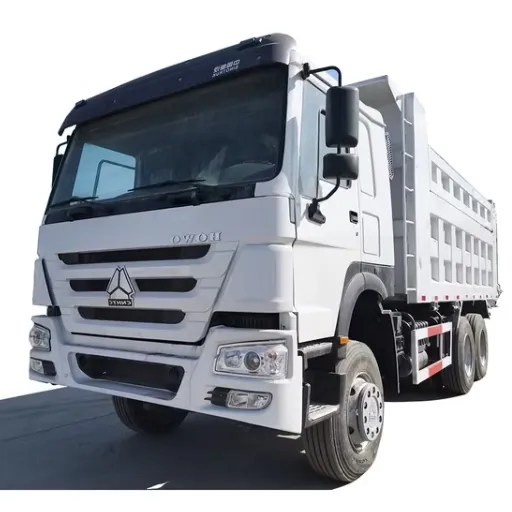
The word “used” covers everything from a 2019 quarry unit with 12,000 hours to a 2022 truck that spent its life on paved road haulage. Both are used. They are not comparable purchases, and a used dump truck for sale listing tells you the category, not the condition.
Used, refurbished, and “reconditioned”
A used truck is a truck that has worked. Its condition depends on hours, application, load cycles, maintenance, and how it was stored. A refurbished or reconditioned truck is one where the seller has repaired or replaced specific systems before sale. The problem is that no one standardizes that scope.
One seller’s “reconditioned” might mean new tyres, a fresh service, and a respray. Another’s might mean an engine rebuild and a new dump body. The word is identical.
Ask for the list of replaced parts, the invoices behind it, and photos taken during the work. If the seller can’t produce that, treat “reconditioned” as a paint job until proven otherwise.
Why the same model can carry two different prices
When two quotes for the “same” used HOWO differ by thousands of dollars, the money usually hides in six places: model year, engine hours, the work the truck did, frame and body condition, tyre life, and hydraulic service history. Documentation matters too. A unit with a complete service file and matching numbers is worth more than an identical truck with a missing history.
This is also why we don’t publish a condition grading scale. There isn’t an industry-wide one that buyers can rely on, and inventing our own would just add another vocabulary to decode. What we publish instead is an inspection scope and the evidence that comes with it.
What our inspection covers, and what it doesn’t
Every unit we supply goes through a pre-shipment inspection covering nine areas: engine, transmission, axles, cab, superstructure, brakes, lighting, ordered options, and documentation. You receive actual photos, video, and a written report. New and used trucks follow the same stated standard.
What the inspection does not provide is a warranty period, a condition grade, or a prediction of future reliability. We don’t publish those, so we won’t imply them here. If your purchase depends on a warranty, raise it early and get the terms into the sales contract. For background on model selection, the dump truck buying guides cover configuration in more depth, and service and parts support explains what happens after delivery.
Which used dump trucks are available and how they differ
The used export trade runs on a small group of brands, and a used HOWO dump truck is the unit most first-time buyers are shown. SINOTRUK’s HOWO line dominates volume, SHACMAN and FAW are close behind, and BEIBEN and XCMG appear in specific markets and applications. Parts availability at your destination should shape the shortlist as much as the badge does.
| Brand | Configurations that circulate | What buyers ask first | Parts consideration |
|---|---|---|---|
| SINOTRUK HOWO | 6×4 and 8×4 tippers, 371 hp and 380 hp common | Engine hours, frame condition | Widest parts network in most African markets |
| SINOTRUK SITRAK | 6×4 and 8×4, higher-spec cabs | Whether the premium is worth it on used units | Fewer independent stockists than HOWO |
| SHACMAN | F3000 and X3000, 6×4 and 8×4 | Body wear, chassis rust | Strong presence in West and East Africa |
| FAW | J6P-based 6×4 and 8×4 | Fuel system condition, cab electrics | Good coverage on common wear items |
| BEIBEN, XCMG | 6×4 and 8×4, construction-focused | Load rating, body reinforcement | Confirm local stock before ordering |
The dump trucks for export category shows the current range.
The brand pages go deeper: Sinotruk dump trucks and SHACMAN dump trucks list the configurations each one covers. For used SHACMAN trucks for sale, the F3000 to X3000 generation gap is the first thing to price in, because spares and resale follow the generation.
6×4 or 8×4: your first real decision
Most buyers frame this as a 6×4 vs 8×4 dump truck question, and payload is only half the answer.
A 6×4 carries less but turns tighter and costs less to run. The HOWO 6×4 tipper is a common reference point for this configuration. An 8×4 carries more per trip but needs wider access, better roads, and more tyre budget. The right answer depends on your bridge limits, site layout, haul distance, and gradient.
If your site has soft ground or sharp internal corners, the bigger truck can lose more time than it saves in payload. If your haul is long and paved and your weighbridge allows it, the 8×4 usually wins on cost per tonne. Our guide to truck specifications explains how GVW, tare weight, and payload interact.
Tipper or dump truck?
Same vehicle. “Tipper” is the common term in South Africa, Kenya, Tanzania, Nigeria, Ghana, and the UK. “Dump truck” is the common term in the US, the Philippines, and most of the Gulf.
If you’re searching for a used tipper truck for sale, you’re looking at the same category. The same holds for pre-owned dump truck listings and second hand dump truck ads: the label changes, the vehicle does not. Use both words when you brief a supplier so nothing gets lost in translation.
Mining and quarry units
Quarry and mining trucks live harder lives than road-haulage units. Expect more body wear, more suspension work, and more brake load for the same hours. Check the dump body floor and side plates for patched cracks, and look at the hoist cylinders for scoring. Our mining dump trucks page covers application-specific selection.
Here’s a manufacturer walkaround of a HOWO 6×4 tipper, useful for understanding the layout before you evaluate a specific unit:
Video: Sinotruk official YouTube channel. This is manufacturer content shown for configuration reference. It is not AMIGO TRUCK footage, and it does not imply endorsement.
What a used dump truck from China costs
There’s no public price list for a used dump truck for sale in China, and any supplier who answers “how much is a used dump truck” with one number before asking about the unit is guessing. Price depends on the specific truck, its year and hours, the preparation work included, the freight basis, and what’s bundled into the quote. What we can give you is the cost structure, so you can compare quotes line by line instead of comparing totals.
The four cost lines
- Vehicle price. The unit itself, as inspected and prepared. Two trucks of the same model and year can sit far apart here, and the inspection file is what explains the gap.
- Preparation. Tyres, body repairs, hydraulic service, paint, fluids, and any options you asked for. Ask for this itemized. A quote that folds preparation into the vehicle price hides the scope.
- Freight. Ro-Ro, container, or breakbulk, charged per unit or per shipment depending on the route and vessel.
- Destination charges. Duty, VAT, port handling, clearance agent fees, and inland transport to your site. These are yours to pay, but a good supplier will help you estimate them.
Why two quotes for the same model differ
Three reasons account for most of the gap. The trucks are different units. The preparation scope is different, even when both say “fully serviced.” Or the freight basis is different: one quote is FOB and stops at the Chinese port, the other is CIF and includes sea freight and insurance. The ICC’s Incoterms 2020 rules define exactly what each term covers, and it’s worth reading the two entries before you compare numbers.
Ask every supplier to state the Incoterm and the named port on the quote. Without that, you’re comparing a truck at a factory gate to a truck at your harbour.
Indicative freight bands
As a planning reference, our published indicative rates for heavy trucks to West and East Africa were about USD 1,800 to 3,800 per unit by Ro-Ro, and about USD 4,500 to 8,000 by container or flat-rack, including disassembly where required. Those figures were published on 17 November 2026. They are indicative only. Freight moves with fuel, vessel capacity, and season, so confirm the number in your own freight quotation.
For payment structure, our published terms are a 30% deposit with the balance against the bill of lading copy or a passing inspection report. Treat that as a starting point to confirm in your sales contract, not as a fixed policy. If you’re weighing used dump truck financing options, that page explains how deposits and balances are handled.
The pre-shipment inspection: what we check and what you receive
A pre-shipment inspection is the buyer’s main protection in a cross-border used purchase. This is the used dump truck inspection that matters: it happens after the unit is prepared and before it’s loaded, and it produces evidence you can review while the truck is still in China. Here’s what ours covers.
| Inspection area | What the inspector checks | What you receive |
|---|---|---|
| Engine | Cold start, idle quality, smoke colour, leaks, abnormal noise | Cold-start video with sound, close-up photos |
| Transmission | Gear engagement, operation under load, leaks | Driving video, report notes |
| Axles | Housings, differentials, hubs, seals, leaks | Photos of each axle, report notes |
| Cab | Structure, glass, instruments, controls, electrical | Interior and exterior photos, function check |
| Superstructure | Dump body, frame rails, hoist, tailgate, hinges | Full lift-cycle video, frame photos |
| Brakes | Air build-up, lines, chambers, adjustment | Pressure test notes, component photos |
| Lighting | Headlights, indicators, brake lights, work lights | Function video, photos |
| Ordered options | Configuration matched against the order | Checklist against your specification |
| Documentation | VIN, chassis, engine number, invoice, packing list, certificate of origin | Document photos and copies |
What the evidence package should contain
A written report on its own is easy to fake. Video is harder. Ask for a cold-start clip that shows the dash before the key turns, and a timed walkaround with the camera pointed at the frame rails and body floor. Then ask for close-ups of every defect the report mentions, a reading of the hour meter or odometer, and a full hydraulic lift and lower cycle.
Tyres deserve their own look. Ask for the DOT date codes on the sidewalls. A truck with “new tyres” and 2019 date codes has been sitting, and the rubber may be older than the truck’s last service.
What a remote inspection cannot prove
Be clear about the limits. A video inspection can’t measure internal engine wear, find a crack under fresh paint, or predict how the truck will behave after 2,000 hours in your conditions. It also can’t confirm your destination country will accept the unit. Those risks don’t vanish because you watched a video.
For larger fleet orders, a third-party inspection by a body such as SGS or Bureau Veritas can be arranged. Our published guidance puts the cost at roughly a few hundred US dollars per unit. Confirm the scope and the price for your specific order before you rely on it.
How to verify a used dump truck before you pay
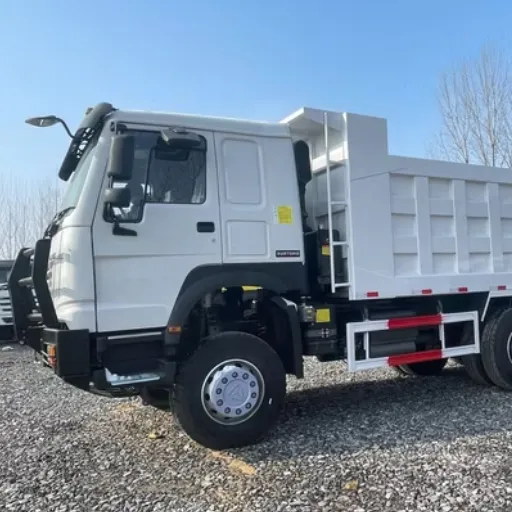
Verification is a sequence, not a single check. Work through it in order, and stop at any step where the seller stalls. Used dump truck dealers with a sound unit will move through these quickly.
- Confirm the seller’s legal entity and address. The company name on the contract, the invoice, and the bank account should match. Our how AMIGO TRUCK works page explains how we’re structured as an independent supplier and exporter.
- Request the unit’s identifiers. VIN or chassis number, engine number, model year, and hour meter reading. Write them down and compare them to every document you receive.
- Watch a cold-start video, not a warm idle. The engine should be cold when the camera starts. Listen for uneven cranking, prolonged smoking, or a fast idle that hides a problem.
- Request a timed walkaround with narration. Ten minutes of unedited footage tells you more than fifty selected photos. Watch for overspray on hoses and bolts, which suggests paint over repair work.
- Read the written report against the videos. Every defect in the report should be visible in the footage. If the report is cleaner than the video, ask why.
- Commission a third-party inspection for high-value orders. For a single unit it may not be worth the cost. For a fleet, it usually is.
- Match documents to the unit before the balance payment. The VIN on the invoice, the certificate of origin, and the bill of lading should all describe the same truck.
Questions that expose a weak seller
Ask these directly and watch how fast the answers come back.
- Can you send a cold-start video today?
- What’s the condition of the frame rails, and can you show them close up?
- Which systems were repaired before sale, and which parts were replaced?
- Can you photograph the VIN plate and the engine number stamp?
- Which company receives the deposit, and does the contract name the same entity?
- Which documents will be issued before the unit is loaded?
A seller who answers all six with evidence is worth continuing with. A seller who deflects on two or three is telling you something useful.
An illustrative example
A buyer we’ll call Daniel was sourcing a tipper for a quarry in Ghana. He asked for a cold-start video. The seller sent a clip of the truck already idling, warm, with the camera pointed at the body rather than the engine. Daniel asked again.
The second clip started cold, and the engine smoked heavily for about forty seconds before settling into a rough idle. He passed on the unit and found another.
That story is a composite we use to illustrate the check. It isn’t a named customer, and it isn’t a claim about any particular supplier. The point is simpler: the first video was designed to avoid the question.
If you’re at this stage and want a second opinion on a specific unit, talk to our export team and we’ll tell you what else to ask for.
Shipping a used dump truck from China
How you ship affects cost, preparation, and risk, which is why shipping a dump truck is a decision in its own right. Three methods cover almost every used dump truck export.
| Method | Best for | Vehicle preparation | Cost basis |
|---|---|---|---|
| Ro-Ro | Standard 6×4 and 8×4 units on regular routes | Drive-on ready, fluids set, battery checked | Per unit, lower for volume routes |
| Container or flat-rack | Smaller units, high-value units, routes without Ro-Ro | May need disassembly, bracing, and lashing | Per container, higher, includes packing |
| Breakbulk | Oversized or non-standard units | Lifting points, cradles, securing plan | Per shipment, quoted case by case |
Ro-Ro is usually the cheapest option for a standard tipper because the truck drives on and off under its own power. Container shipping costs more but protects the unit better and can reach ports without Ro-Ro service. Breakbulk exists for the trucks that fit neither category.
Preparing the vehicle
Before loading, the unit needs its fluids set to shipping levels, the battery secured or disconnected, loose items removed or packed, and the body and chassis clean enough for customs inspection. Fuel level matters too, since some carriers cap it. None of this is glamorous, but a truck that arrives with a flat battery and a missing tool kit starts your ownership with a problem.
Why transit time is a range
Schedules move. Vessels get rolled, ports get congested, and transshipment adds days. Our published port-to-port examples are Lagos and Tema at 28 to 38 days, Dar es Salaam and Durban at 30 to 42 days, and Mombasa at 25 to 35 days. Those exclude inland transport and customs clearance, which can add a week or more depending on the destination.
Total lead time, from order to arrival, is typically 45 to 90 days: 15 to 45 days for preparation depending on the unit and any refurbishment, then 28 to 35 days at sea. Treat it as a planning range, not a promise.
Export documents
The core set is a commercial invoice, packing list, bill of lading, and certificate of origin. Destination markets may require additional documents, and the rules change. The World Customs Organization publishes the HS classification system your broker will use, and China Customs covers export formalities on this side. Our shipping and delivery page lists what we coordinate.
Landed cost and import requirements by destination market
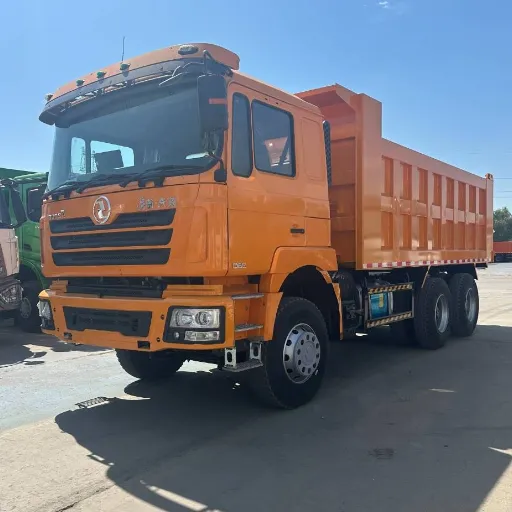
Landed cost is the number that decides whether a purchase makes sense, and for anyone planning to import a used dump truck to Africa, it is the figure most often underestimated. It’s the vehicle plus preparation plus freight plus insurance plus duty plus VAT plus port and clearance plus inland transport. Suppliers quote the first three or four lines. You own the rest, so build the full worksheet before you commit.
Confirm these before you order
- Emission standard. We list Euro II, Euro III, Euro V and above. Your country’s import rules decide which one you can register.
- Drive side. Right-hand drive for most of East and Southern Africa, left-hand drive for West Africa and the Gulf. Confirm before the unit is built or selected.
- Vehicle age limits. Several markets restrict the age of imported used vehicles. Check yours.
- Duty and VAT basis. Rates vary, and valuation method matters as much as the rate.
- Pre-shipment conformity schemes. Some markets require inspection and certification before shipment, through schemes such as SONCAP, PVoC, or SASO. Confirm whether yours applies and who pays.
- Port of entry and clearance agent. Name the port and the agent on the quote so freight is priced to the right place.
Why one country’s rules can’t be generalized
Customs authorities set their own valuation methods, age limits, and conformity requirements. A rule that applies in one market often doesn’t apply in the next one, and a blog post that states a duty rate as fact is usually out of date. Rather than assert rates we can’t verify, we’ll point you to the primary sources. The WTO tariff database is a starting point for applied tariff information, and your customs broker is the authority on your own shipment.
A document check that saves a container
Consider a buyer who ordered an 8×4 tipper and confirmed everything except the consignee name. The invoice carried the trading company’s name. The import licence was in the operating company’s name. The unit arrived, sat at port for eleven days while the paperwork was corrected, and the storage charges ate the margin on the deal.
That example is hypothetical, but the failure mode is common. Check the consignee name, the emission standard, and the conformity certificate before the truck is loaded. Fixing a document in China takes a day. Fixing it at your port takes a week.
Our truck export FAQ answers the document and lead-time questions buyers raise most often. The section below covers the ones specific to used trucks.
Common red flags in a used dump truck for sale
Most bad used-truck purchases show warning signs before money changes hands. These are the ones worth acting on.
- A price far below the market for that model and year, with no explanation of why.
- Fresh paint over structural work, with overspray on hoses, bolts, or frame rails.
- Refusal to send a cold-start video or a timed walkaround.
- An hour meter or odometer that doesn’t match wear on pedals, seats, and tyres.
- Document mismatches between the VIN, engine number, invoice, and bill of lading.
- Pressure to pay a personal account, or an account in a different name from the contract.
- A written report that lists no defects at all. Every used truck has some.
- A seller who can’t describe what was refurbished, or who changes the subject.
None of these proves fraud on its own. Together, two or three of them should end the conversation.
Used dump truck for sale: frequently asked questions
How much does a used dump truck from China cost?
There’s no published price list because price depends on the unit, its year and hours, the preparation included, and the freight basis. A used dump truck for sale quote should separate vehicle, preparation, and freight. Compare landed cost rather than sticker price.
Are used trucks from China reliable?
A well-inspected used HOWO, SHACMAN, or FAW can run for years in demanding conditions. Reliability depends on the specific unit’s history, the inspection standard applied, and the parts supply at your destination. The inspection file is the best available predictor.
What should I inspect before buying a used dump truck?
Start with a cold start, then the frame rails, dump body floor, hydraulic lift cycle, brake air system, and tyre date codes. Match the VIN and engine number to the documents. If you can’t inspect in person, request video evidence covering each of those points.
What is included in a pre-shipment inspection report?
Our report covers engine, transmission, axles, cab, superstructure, brakes, lighting, ordered options, and documentation, with photos and video to support the findings. It records condition as found. It isn’t a warranty, and it doesn’t guarantee future performance.
Can I buy a used HOWO or SHACMAN dump truck from China?
Yes. Both brands circulate widely in the used export trade, in 6×4 and 8×4 configurations. Availability changes with stock, so send your specification, destination port, and budget range and we’ll confirm what’s currently available.
How long does shipping a dump truck take?
Preparation usually takes 15 to 45 days, and sea transit 28 to 35 days, for a total of roughly 45 to 90 days. Port-to-port transit to East and West Africa runs about 25 to 42 days depending on the route. Customs clearance and inland transport are additional.
What documents do I need to import a used dump truck?
At minimum, a commercial invoice, packing list, bill of lading, and certificate of origin. Your destination may also require a conformity certificate, an import licence, or a pre-shipment inspection. Confirm the full list with your customs broker before the unit ships.
Can I arrange a third-party inspection?
Yes, for larger fleet orders. SGS or Bureau Veritas can be engaged, and our published guidance puts the cost at roughly a few hundred US dollars per unit. Confirm the scope, the timing, and the price for your order before you commit.
Next step
If you’ve read this far, you’re ready to brief a supplier properly. Send us six things: your application, required payload, destination port, budget range, preferred brand or configuration, and whether you want new or used. With those, we can match available units to your operation instead of sending you a generic list.
We publish a quotation turnaround of about 24 hours, subject to how complete your requirements are. That’s a response target, not a delivery promise.
Request a configured quotation and tell us what the truck needs to do. If you’d rather ask a question first, contact our team and we’ll answer it before you commit to anything.
Conclusion
A used dump truck for sale from China is a good buy when you treat it as three decisions, not one. Check the unit through evidence you can review. Check the seller through documents and payment routing. Check the landed cost line by line, because the vehicle price is only the first of four.
According to the company, AMIGO TRUCK has more than 15 years of vehicle export experience and has served more than 5,000 international customers across 100+ countries. What that history translates to for you is a process: an inspection covering nine named areas, photos and video of the actual unit, and a written report before shipment. Not a promise that the truck will never break. Evidence that you know what you’re buying.
Start with the inspection file. Everything else follows from it. A used dump truck for sale is only as good as the evidence behind it, so when you’re ready, tell us what the truck has to do and we’ll build the numbers around your operation.