
DRY BULK POWDER · PNEUMATIC DISCHARGE
Cement Semi Trailers The Tonnes Decide the Tank
A cement semi trailer carries dry powder in a tank and empties it with air.
A compressor fluidizes the cement until it flows like a liquid, and tank pressure pushes it up a pipe into the receiving silo. Most buyers open with volume — 35 m³ or 40 m³ — but that number is a tank size, not a payload.
- Cement Bulk powder, pneumatic discharge
- Fly Ash Power-station by-product haulage
- Mineral Powder Lime, slag and dry bulk materials
CEMENT SEMI TRAILER RANGE
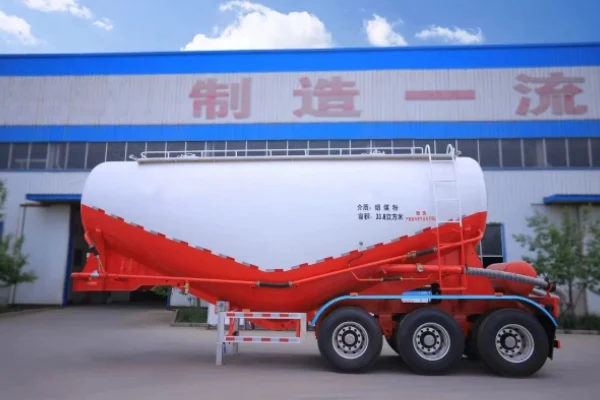
Cement / Fly Ash / Mineral Powder
Specified by payload and market
Payload-First Specification
Tank size follows the tonnes, not the other way round
Pneumatic Discharge
Compressor fluidizes the powder into the silo
Axle-Legal Payload
No three-axle unit may carry a full 40 m³ tank
Cement weighs roughly 1.2–1.4 t/m³, so a 40 m³ tank holds 48–56 t. The capacity is real; the payload it implies is not. Confirm axle limits and final specifications in your offer.
Bulk Density Decides the Payload, Not the Volume
Bulk density is the weight of the powder per cubic metre as it sits loose in a tank, not the density of the solid it was made from. It converts the tank you are being sold into the cargo a cement semi trailer can legally carry.
Density
LOOSE, NOT SOLID
What Bulk Density Is
It is the weight of the powder per cubic metre as it sits loose and aerated in the tank — not the density of the solid it was made from.
- Best fit Cement, fly ash, lime, barite and mineral powders.
- Consideration Cement varies by grade and by aeration.
Typical cement density
1.2–1.4 t/m³
Calculate
VOLUME × DENSITY
From Tank to Tonnes
Multiply usable tank volume by bulk density, then compare the result with the payload your axles and the destination’s weight law allow. The lower figure is your load.
- Best fit Any powder with a known loose density.
- Consideration Usable volume is lower than nominal volume.
The load is
the lower figure
Compare
CEMENT VS BARITE
Read the Rows Together
The same cement semi trailer is legal with one powder and impossible with another, and nothing on the tank changes. The tank is a volume; the road is a weight limit.
- Best fit Cement is axle-limited; barite is weight-limited.
- Consideration Fly ash and lime are often volume-limited.
Barite density
2.0–2.4 t/m³
From Cubic Metres to Tonnes, in One Table
| Powder | Bulk Density | 32 m³ Tank | 40 m³ Tank | What Limits the Load |
|---|---|---|---|---|
| Cement, OPC | 1.2–1.4 t/m³ | 38–45 t | 48–56 t | The axle limit, at every volume |
| Fly ash | 0.9–1.1 t/m³ | 29–35 t | 36–44 t | Volume on a short tank, weight on a large one |
| Hydrated lime | 0.9–1.2 t/m³ | 29–38 t | 36–48 t | Volume |
| Barite | 2.0–2.4 t/m³ | 64–77 t | 80–96 t | Weight, long before the tank is full |
*Read the cement row against the barite row. The same cement semi trailer is legal with one and impossible with the other, and nothing on the tank changes. The tank is a volume, the road is a weight limit, and bulk density is the exchange rate between them. Confirm it with the Portland Cement Association or the plant, because cement varies by grade and by aeration.
V-Shape, W-Shape, and How Many Compartments
The tank shape on a cement semi trailer sets how much product stays behind, how high the load sits, and how the powder behaves as the tank empties.
Shape Sets the Trade-off
A V-shape tank has one steep cone, or a short slide feeding a central trough, so powder runs downhill to one discharge point. A W-shape tank has two or more hoppers under a flatter shell.
Same shell length, more volume — at a cost.What Each Shape Costs You
A V-shape must be taller for a given volume, which raises the centre of gravity. A W-shape gains volume without height, but hoppers must be emptied in sequence.
Neither is better — the route and product decide.Compartments Buy Part Loads
Two compartments are typical, three is common, four on the largest tanks. They do not add capacity — they divide it and add steel, buying you a part load.
A compartment you never use is tare weight on every trip.V-Shape vs W-Shape at a Glance
| Comparison | V-Shape | W-Shape |
|---|---|---|
| Usable volume | 30–45 m³ | 50–65 m³ |
| Centre of gravity | Higher for the same volume | Lower |
| Clean-out | Best: one steep run to one point | Good, depends on valve sequencing |
| Discharge | Straightforward | Each hopper blown in sequence |
| Best for | Mixed cargoes, frequent changes | High volume, one product, long runs |
Most buyers over-specify compartments and under-specify the air system. Match both to the product and the route before you order.
Explore Cement Trailer TypesMatching the Discharge to Your Silo
Discharge rate is usually quoted between 1.2 and 1.8 tonnes per minute on a bulk cement trailer, and the range is wide for a reason.
-
Discharge Rate Falls as the Tank Empties
The quoted 1.2–1.8 t/min is a starting figure. As the tank empties and pressure drops, the rate falls — so the last tonnes take longer than the first.
-
Silo Height Sets the Pressure
A taller silo inlet needs more pressure at the tank to push the powder up. The height is not on any specification table, and it decides whether the air system is adequate.
-
Pipe Run Sets the Resistance
Every metre of lift and every bend in the line adds resistance. A long pipe run needs a larger air system than a short one, for the same silo height.
-
Inlet Size Sets the Hose and Valve
The silo inlet diameter decides the discharge hose and valve size. A mismatch here restricts flow even when the compressor is capable of more.
-
A Worked Example
A 32-tonne load at 1.5 t/min is roughly 21 minutes of blowing, before setup. Add a silo inlet 20 m above the trailer and a 25 m pipe run, and the same load takes longer and needs more pressure. Treat any discharge figure as a maximum for a good day, not an average.
Get a Discharge Spec for Your Silo
Send your silo height, pipe run, inlet size and powder. Receive a tank, air system and discharge specification, typically within about 24 hours.
Buying a Used Cement Trailer
A used cement semi trailer is worth what its shell and air system are worth. The chassis is repairable at local cost — a corroded shell or a worn-out compressor is not.
The Shell and Its Consumables
Open every manhole and inspect the shell and stiffeners for pitting, patch welds and product left to set. A tank not cleaned before storage tells you how it was kept.
- Shell and stiffeners — pitting, patch welds, set product
- Fluidizing pads — intact, flexible, not hardened
- Safety valve — test by hand with the tank empty
- Compressor — hours, output, oil, drive type
- Discharge line and valves — bend wear, full opening
- Pressure test and discharge test
Six checks before you commit
A pad that has gone hard is a replacement, and pads are consumables. A tank can hold air and still not empty.
Compressor, Valves and Parts
A power take-off compressor needs a suitable tractor to test, so arrange one before inspection. Look for a valve that does not fully open and a gauge that reads zero when it should not.
- Compressor Test
- Valves & Gauges
- Wear Parts Lead Time
Ask for a pressure and discharge test
Parts for the wear items are covered under after-sales support. Ask the pad and valve lead time to your market before you buy.
-
Confirm Powder and Volume
Cement, fly ash, lime or barite.
-
Inspect Shell and Air System
Pads, compressor, valves and safety valve.
-
Test, Then Ship
Pressure test, discharge test and parts lead time.
Practical Support. From Tank Sizing to Delivery.
Get the right tank volume, shape and air system, review your trailer before shipment, and plan the transport with a clear scope.
Sized by Tonnes, Not Litres
Match tank volume and shape — V-shape or W-shape — plus the compressor and discharge line to your powder density, silo height and pipe run, not to a headline cubic metre figure.
Your axle limit comes firstSee the Trailer Before Shipping
Review photos, video and an inspection report covering the tank shell, hoppers, aeration bed, compressor, discharge valves and running gear.
Pressure test and discharge test on videoClear Export & Shipping Support
Cement is not a dangerous good, so there is no ADR or DOT approval and no dangerous-goods surcharge. Confirm the shipping method, freight scope and export paperwork for your port.
Plan delivery before orderingParts & Maintenance Planning
Arrange air filters, aeration pads, discharge valves, gaskets and compressor service parts, and check local support before you buy.
Support beyond the shipment
YOUR QUESTIONS, ANSWERED
Cement Semi Trailer FAQ
Compare tank shapes, payload limits, unloading rates, powder types and shipping requirements.
Discuss Your Requirements1 What is a cement semi trailer?
A semi-trailer with a pressure tank that carries dry powder and discharges it with air. A compressor fluidizes the cement through a porous bed, and tank pressure blows it up a pipe into a silo.
2 How many tonnes can a cement semi trailer carry?
The lower of two numbers: tank volume multiplied by bulk density, or the legal payload your axles and destination allow. A 40 m³ tank holds 48–56 tonnes, which no three-axle cement semi trailer may carry, so the axle limit decides.
3 How long does it take to unload a bulk cement trailer?
At 1.2–1.8 tonnes per minute, a 32-tonne load is roughly 18–27 minutes of blowing, before setup. The rate falls as the tank empties and as silo height and pipe run rise.
4 What is the difference between a V-shape and a W-shape cement trailer?
A V-shape has one steep cone that cleans out best but must be taller for the same volume. A W-shape has two or more hoppers that add volume at a lower centre of gravity, but they must be discharged in sequence.
5 Can a cement trailer carry fly ash or barite?
Yes, with different settings. Fly ash is light, so the tank is volume-limited. Barite is heavy at 2 t/m³ and above, so it is weight-limited, and it wears the discharge line faster.
6 Is a cement tanker trailer dangerous goods for shipping?
No. Cement is not a dangerous good, so there is no ADR or DOT approval, no gas-free certificate, and no dangerous-goods surcharge. Confirm the destination’s pressure equipment and conformity rules.
7 How much does a cement semi trailer cost?
It depends on tank volume and shape, material and shell thickness, compressor and drive type, compartment count, axles and destination. Two trailers of the same volume can differ substantially on the air system. We quote against a written powder and destination specification.
SPECIFY IN THE RIGHT ORDER
Get Your Cement Semi Trailer Specified for Your Powder
The question is not how many cubic metres the tank holds. It is how many tonnes of your powder will legally leave it, and how quickly.
- Powder & Bulk Density
- Silo Height & Pipe Run
- Air System & Compressor
- Axle Limits & Destination
YOUR SPECIFIED OFFER
Cement
Fly Ash
Powder
Tank size, shape and air system · Matched to your silo
Request a Cement Trailer QuotationTypically within about 24 hours
Pre-shipment inspection with a pressure test
and a discharge test on video.