
HOWO 6×4 Tipper Truck
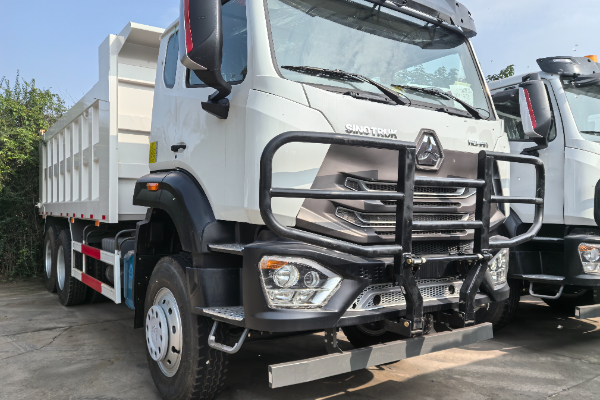
The three-axle, rear-drive workhorse of the SINOTRUK HOWO dump range.
Supplied with engines from roughly 266 to 440 HP for construction, quarry, and mining haulage. In most markets it is the dump truck configuration buyers start with, because it balances payload, traction, and a tight turning circle better than any other axle layout in the range.
Choosing the right 6×4 tipper comes down to three inputs: the payload you haul each trip, the grade and surface of your haul road, and the emission standard your destination market requires. Get those right and the specification follows.
- 266–440 HP
- Engine power range
- 6×4
- Drive configuration
- 3 axles
- Rear-drive layout
- Up to ~25 t
- Typical GVW
Typical configuration: three axles with drive at the rear pair, balancing payload, traction and a tight turning circle. Specifications vary by build — confirm local axle limits and emission requirements.
What the HOWO 6×4 Tipper Truck Is
A heavy dump truck built by SINOTRUK with drive to the rear pair of a three-axle chassis. The “6×4” notation counts wheel ends: six wheels, four of them driven. That layout gives the truck its working character — enough traction for unpaved haul roads and enough maneuverability for confined sites.
| Factor | Typical Build |
|---|---|
| Notation | 6×4 — six wheel ends, four driven |
| Chassis | Three axles, drive at the rear pair |
| Range Position | Middle of the HOWO range |
| Payload Advantage | More legal payload than 6×2 or 4×2 |
| Maneuverability | Tighter turning circle than 8×4 |
| Typical Work | Standard construction, quarry, site haulage |
| Available Models | T7H, A7, TX, and NX/HOHAN |
| Build Grades | Different grades and engine ratings across models |
Typical values only. The 6×4 is not a single fixed truck — the same axle layout is supplied across several HOWO models at different build grades and engine ratings.
01
The Default Choice
Within the HOWO range, the 6×4 is the middle of the road, and that is exactly its strength. It hauls more legal payload than a 6×2 or 4×2 and turns tighter than an 8×4.
- Payload: more than a 6×2 or 4×2.
- Turning circle: tighter than an 8×4.
02
Why Buyers Start Here
This is why it remains the default answer to the most common question we hear from buyers: “which HOWO dump truck should I start with?” For most standard construction, quarry, and site work, the answer is the 6×4.
- Standard construction: the natural starting configuration.
- Quarry and site haulage: traction and maneuverability in balance.
03
Not a Single Fixed Truck
One point worth getting clear early: the 6×4 is not a single fixed truck. The same axle layout is supplied across several HOWO models — T7H, A7, TX, and NX/HOHAN — at different build grades and engine ratings.
- HOWO models: T7H, A7, TX, NX/HOHAN.
- Variables: build grade and engine rating differ by model.
Get the Specification Sheet for Your Build
Send your payload and destination port. Receive a configured offer, typically within about 24 hours.
Typical 6×4 Export Configuration
Representative specifications for the current HOWO 6×4 export line. The exact build — engine rating, axle ratio, body steel, and emission standard — is confirmed against your payload and destination market before quotation, not ordered from a fixed sheet.
| Specification | Typical Build 6×4 Export Configuration |
|---|---|
| Drive configuration | 6×4 — three axles, drive at the rear pair |
| Engine | WD615/WD615.47 inline-six, roughly 266–440 HP; 371 HP most common |
| Displacement | about 9.726 L |
| Transmission | HW19710, 10 forward + 2 reverse |
| Front axle | about 9–9.5 tonnes |
| Rear axles | 2 × about 16,000 kg |
| Gross vehicle weight (GVW) | about 25–31 tonnes |
| Dump body length | about 5.2–6.0 m |
| Dump body volume | about 16–22 m³ (options to about 28 m³) |
| Body steel | floor about 8 mm, side about 6 mm |
| Tires | 12.00R20 |
| Emission standard | Euro II–Euro V, market-dependent |
Engine & Transmission
The most common HOWO 6×4 tipper build uses the WD615.47 inline-six at about 371 HP — the rating that has become the standard answer for general quarry and site haulage because it balances pulling power against fuel consumption. Across the range, engines run from roughly 266 HP up to about 440 HP.
The transmission is the HW19710, a 10-speed manual with two reverse ratios, matched to the engine rating and the axle ratio. A ratio tuned for flat highway work feels sluggish on a steep quarry ramp, and one tuned for grades limits your top speed on long flat runs.
Axles, GVW & Payload
The 6×4 chassis runs a front axle of about 9–9.5 tonnes and a rear tandem of about 2 × 16,000 kg. Gross vehicle weight sits in the region of 25–31 tonnes, depending on the build and your market’s legal limits.
Payload is the difference between gross vehicle weight and the truck’s own weight. On a 6×4 HOWO tipper that works out to a rated payload in the order of 15 to 20 tonnes once you subtract curb weight. What you can legally run depends on local axle-load rules.
Dump Body & Dimensions
The dump body is usually the first component to wear in quarry and construction work, so it deserves the same attention as the engine. The HOWO 6×4 tipper is supplied with a body of about 5.2–6.0 m in length and roughly 16–22 m³ in volume, with options up to about 28 m³.
Floor steel runs about 8 mm and side steel about 6 mm. Body steel grade and floor thickness should be matched to the material you haul — abrasive rock and repeated loading cycles wear a light body quickly.
Specification Is Set by the Job
The right combination is set by your haul profile, not by a headline number. For a buyer running short, frequent cycles, a lower-rated engine that is not overworked will usually cost less to run per tonne than a higher-rated engine lugging a light load.
Axle ratio is the detail that most often gets a truck wrong for a site. The choice changes both climbing ability and road speed, so we specify the ratio against your steepest grade and your typical route.
LIGHTER SPEC
Lower-rated engine for muck-shifting and short, frequent cycles where fuel cost per tonne matters more than headline power.
HEAVIER SPEC
Higher-rated engine and reinforced body for loaded haul roads, abrasive rock and sustained grades.
What the “Actual Load” Number Really Means
The section most sellers leave out — and the one that protects your money when you buy a 6×4 tipper.
01
The “Actual Load” Trap
You will see listings advertising an “actual load” of 30 or even 40 tonnes. On a chassis rated to 25–31 tonnes GVW, that figure is overload territory, not a specification.
- 30–40 t claim Advertised “actual load” on listings.
- 25–31 t GVW The rated chassis limit on paper.
- Overload Running past design rating.
02
The Honest Arithmetic
Legal payload is gross vehicle weight minus curb weight. The working figure is lower again once you subtract body and fuel.
- GVW about 31 tonnes.
- Curb weight roughly 12 tonnes.
- Legal payload in the order of 19 tonnes.
03
What It Means for Buyers
A truck loaded to 30–40 tonnes is illegal to register in most markets, hard on the axles and drivetrain, and unsafe on the road.
- Registration Overload figures fail in most markets.
- Mechanical wear Hard on axles and drivetrain.
- Safety Unsafe on the road.
HOWO 6×4 Model Variants — T7H, A7, TX, NX
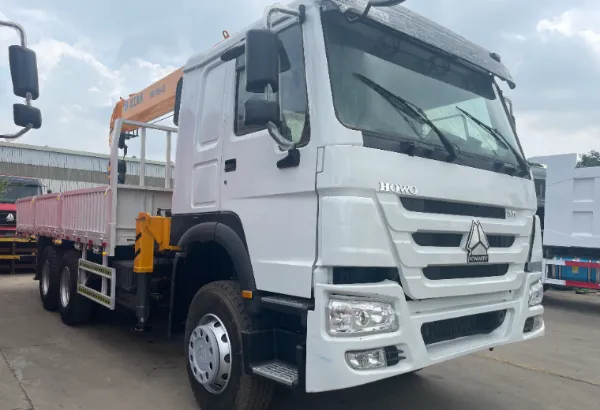
The same 6×4 layout comes in several HOWO build grades. The choice is about how hard you work the truck and how much comfort you want for the driver.
-
T7H 6×4 — Premium, MAN-derived
Top of the range: higher torque, a reinforced build, and an air-suspension cab built for long shifts under sustained load. Best for sustained heavy hauling.
-
A7 6×4 — Heavy-duty mid-range
Heavy-duty mid-range with D10/D12 engine options. Suited to general quarry and site work.
-
TX 371 6×4 — Standard workhorse
Built around the 371 HP rating. The standard workhorse for high-volume, standard loads.
-
NX / HOHAN 6×4 — Cost-effective
The value end of the range for budget-first buyers and lighter duty. A genuine HOWO 6×4 at a lower entry price.
Choose the Variant by the Job, Not the Badge
A TX 371 running standard loads will outwork a T7H bought for a duty cycle that never arrives — and an NX/HOHAN asked to run sustained quarry work will wear out faster than a heavier build.
6×4 or 8×4 — Which Configuration Fits Your Job
The axle configuration is the most consequential choice in the build, because it sets your payload ceiling, your traction, and how the truck behaves on the road.
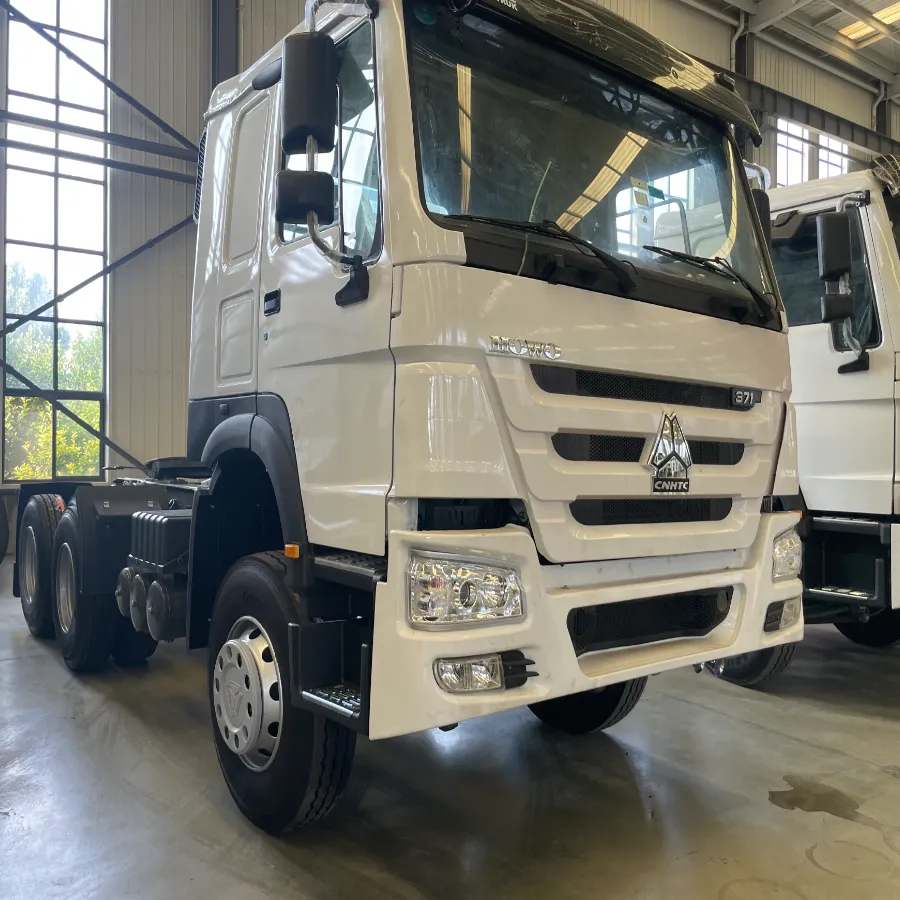
6×4 — Three Axles
Drive at the rear pair. This is the workhorse for general construction and quarry haulage. It balances payload and traction with a tighter turning circle, which matters in confined sites and narrow pit roads.
8×4 — Four Axles
Drive at the rear pair. It adds payload capacity and spreads the load across more axles, which helps where legal axle limits are strict and where you want the highest payload per trip on firm, level ground.
Built for Construction, Quarry and Demanding Sites
The HOWO 6×4 tipper is configured around your material, haul road, climate and destination market — not a stock build.
Construction & Site Hauling
Built for aggregate, muck and earthmoving on sealed and unsealed site roads. Its balance of payload and maneuverability matters over short, frequent cycles.
Built for short, frequent cyclesQuarry & Mining
Handles loose aggregate and overburden when axle ratio, cooling and body steel are specified for the grade and material. For sustained high-payload mining, a heavier build is usually better.
Specified for grade and materialEmission Standard & Market
Higher-standard trucks may run poorly on high-sulfur fuel; lower-standard trucks may not register in strict markets. We configure Euro II–V to match your destination and fuel.
Euro II–V matched to market and fuelHOWO 6×4 Tipper Truck FAQ
Answers to common questions about payload, specifications, shipping, and spare parts. Need help with your configuration?
1 What is a HOWO 6×4 tipper truck?
A HOWO 6×4 tipper truck is a SINOTRUK heavy dump truck with three axles and drive to the rear pair, supplied with engines of roughly 266–440 HP and a dump body of about 16–22 m³. It is the workhorse HOWO dump configuration for construction, quarry, and mining haulage.
2 How much does a HOWO 6×4 dump truck cost?
There is no fixed price, because the figure is built from the vehicle, its configuration, options, preparation, and freight to your destination port. Price is quoted per configuration and per route — request a quotation with your payload, road conditions, and destination, and we will come back with a concrete figure.
3 What is the payload capacity of a HOWO 6×4 dump truck?
A HOWO 6×4 tipper runs to about 25–31 tonnes gross vehicle weight, and rated payload is the difference between that and the truck’s curb weight — in the order of 15 to 20 tonnes depending on the build. What you can legally run depends on your market’s axle-load rules, so the final payload is confirmed against your destination before quotation.
4 What is the difference between a 6×4 and an 8×4 tipper truck?
A 6×4 has three axles with drive at the rear pair; an 8×4 has four axles, also driven at the rear pair but carrying more load across more axles. The 6×4 turns tighter and suits standard site and quarry work; the 8×4 adds payload capacity for the heaviest legal loads on firm ground.
5 Which HOWO 6×4 model is best—T7H, A7, TX, or NX?
There is no single best model, only the right build for your job. The T7H suits sustained heavy hauling, the A7 and TX are general workhorses, and the NX/HOHAN is the cost-effective option. Choose by duty cycle and payload, not by badge.
6 Can I buy a HOWO 6×4 tipper truck from China?
Yes. Amigo Truck supplies the HOWO 6×4 configured to your market, with 100% pre-shipment inspection, export documentation, shipping to your destination port, and parts support after delivery. Start with a quotation request and your site details.
CONFIGURED FOR YOUR JOB
Request Your HOWO 6×4 Tipper Quotation
The HOWO 6×4 is a specification decision first. Send your payload, grade, and emission needs — receive a configured quotation within about 24 hours.
Review your truck on video before shipment.
15+ years, 100+ countries, 5,000+ customers served.
Request a Quotation
Start with your specification.