
Used HOWO Dump Truck: Models, Codes and What to Check
A used HOWO dump truck is almost always a 6×4 or 8×4 tipper sold out of China, and in November 2026 the live export listings ran from about EUR 13,671 to 29,166 for 6×4 units and EUR 14,100 to 27,885 for 8×4 units. Those are asking prices at a Chinese yard, before freight, and they’re the least useful numbers here until you know which truck sits behind them.
That’s the problem with this market. Two listings can both read “HOWO 371 dump truck, 6×4, good condition” and describe trucks built more than a decade apart, with different engines, cabs, axles, and almost no shared parts.
This guide decodes the chassis number, maps each HOWO generation to the parts that follow it home, and adds the checks that matter on a HOWO rather than any used tipper. If you already know the unit you want, request a configured quotation and skip ahead.
Key Takeaways
- “HOWO 371” names a horsepower rating, not a model. The chassis code is the only reliable identifier.
- Sinotruk dates the HOWO series to 2004, the A7 to 2008, the T7H to 2013, the TH7 to 2020, the MAX to 2021 and the TS7 to 2024.
- The engine family changed across those generations, and that decides whether parts stay available and affordable.
- Asking prices in November 2026 overlapped heavily between 6×4 and 8×4, so configuration alone doesn’t explain the price.
- A used HOWO needs the general checks plus hub-reduction axle oil, hoist and PTO condition, and frame checks around the hinge.
What a used HOWO dump truck listing is really telling you
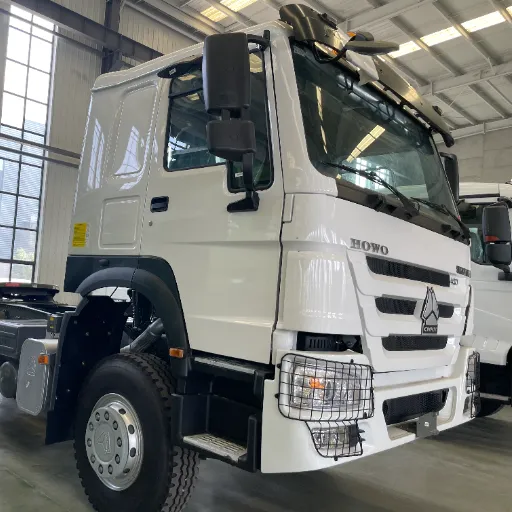
The word HOWO covers three different things: a manufacturer, a brand, and a model family. Sinotruk is the manufacturer, China National Heavy Duty Truck Group. HOWO is one of its brands, launched with the first HOWO heavy truck in 2004, and it is not the only Chinese name a used buyer will meet, since used shacman trucks for sale appear in the same export listings.
Within the brand sit series names such as A7, T7H, TH7, TX and NX, and within each series sit dozens of chassis codes. Sellers compress all of that into a title.
“371” is a rating, not a model
The number in “HOWO 371” is the engine’s rated output in horsepower. It isn’t a trim level, a series, or a year. Sinotruk has built that rating for well over a decade, and a 2024 unit with 371 hp still appears in current listings. A rebuilt engine or a replacement power unit can also change what the badge says.
You’ll see the same number on a 2008 truck and a 2024 truck. When a seller quotes it as though it settles the specification, ask for the chassis code and a plate photo.
The three names that actually identify the truck
A used HOWO is pinned down by the series name, the chassis code, and the drive configuration together. Any two of the three is a partial answer. All three, checked against the plate, is a specification.
How to read a Sinotruk chassis number
Published decoders agree on the broad shape of the code and disagree on its tail. Two independent dealer tables describe a string that starts with ZZ, then a category digit, a weight code, a 7 for HOWO, a power-band letter, digits that usually read as wheelbase in decimetres, a drive digit, and finally a series and emission suffix.
Sinotruk’s own HOWO brand page publishes no public decoder, so treat any table as a guide to structure.
| Code segment | What it usually signals | How far to trust it |
|---|---|---|
| ZZ | Sinotruk group company code | Reliable. Both decoders and the plate agree. |
| Third character | Vehicle category. The tables read 3 as the dump-truck family. | Broad agreement, but read the plate, not the listing. |
| 7 | HOWO brand code | Broad agreement. This is the character that makes it a HOWO. |
| Power letter | Engine power band. One decoder gives N as 319-384 hp, V as 384-460 hp. | Directional. The letter narrows the engine, it doesn’t name the rating. |
| Digit run after the letter | Wheelbase in decimetres | Plausible and consistent, but neither decoder states positions explicitly. |
| Drive digit | 4 for 6×4, 6 for 8×4 | Agree, and easy to cross-check against the axles in a photo. |
| Final characters | Series code and emission stage. Some tables map trailing letters A to F onto Euro II to Euro VI. | Weak. The decoders contradict each other here, so verify on the plate and the emission label. |
The practical version is simple. Ask for a clear photo of the chassis plate and the frame stamp, then compare both to the listing. A code that doesn’t match is the fastest reason to walk away, and it costs nothing to check before you discuss money. The CamaMach decoder is a reasonable starting point if you want to read the string yourself.
Which HOWO generation you’re buying, and why parts care
Sinotruk publishes its own timeline, and that’s the only version worth building a purchase decision on. The first HOWO heavy truck came off the line on 28 October 2004. The HOWO-A7 followed in 2008, the HOWO-T7H in 2013 on the MAN technology platform, the TH7 on 28 October 2020, the MAX on 18 August 2021, and the TS7 alongside the two-millionth unit on 30 June 2024.
The English-language Sinotruk International history adds the 2009 MAN agreement and the 2012 localisation of MC engines.
Sinotruk’s current site lists TH7, MAX, TX7, MATE and NX, but older series still circulate in the used market.
| Generation and official date | What it usually means in a used listing | Parts note |
|---|---|---|
| HOWO series, 2004 | Original HOWO cab and chassis, most often with WD615-family engines | Long production runs mean used and aftermarket parts are widely available; condition varies enormously |
| HOWO-A7, 2008 | A7 cab, still common in export stock, frequently badged 371 or 375 | Same engine family as the earlier series, so many wear parts cross over |
| HOWO-T7H, 2013 | First HOWO on the MAN technology platform, with the associated cab and driveline change | A different engine family; don’t assume parts interchange |
| HOWO-TH7, 2020 | Later cab and electronics generation | Higher parts cost, more electronics to inspect |
| HOWO-MAX, 2021 | Heavy-haulage positioning within the later generation | Check the rating on the plate, not the badge |
| HOWO-TS7, 2024 | Current top of the range | Closest to new-truck parts and pricing |
Engine family is the part that follows you home
The WD615 is the engine most used HOWO buyers will actually meet. It’s an inline six of 9.726 litres, and AMIGO TRUCK’s HOWO 6×4 tipper page describes export builds in the roughly 266 to 440 hp band, with 371 hp the most common rating and the HW19710 10-speed as the typical transmission.
From 2012, Sinotruk localised the MAN-derived MC engine family in China, and the T7H arrived on that platform the following year. That’s a genuine break in the parts chain. A rebuilt WD615 and an MC-series engine share a brand and a cab shape, not a parts catalogue.
So ask the question most listings won’t answer: which engine family is in this truck, and can you photograph the engine plate? The answer changes what you can fix locally, what you have to import, and what a breakdown costs in weeks rather than dollars. AMIGO TRUCK sources original spare parts for SINOTRUK vehicles.
Emissions label versus destination fuel
The chassis plate and the engine’s emission label are two different documents. Used trucks often carry a label the destination no longer wants or a fuel grade it can’t supply. AMIGO TRUCK configures export builds across Euro II to Euro V depending on the market, but don’t assume a used unit’s label matches your country’s current rule.
Confirm the requirement with your own broker or regulator before you shortlist. A Euro III truck can be the right answer in one market and unsellable in another.
6×4 or 8×4: what the used market actually offers
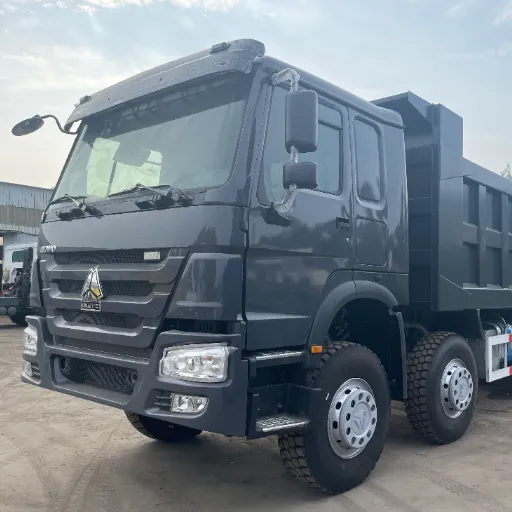
On 23 November 2026, one China-focused marketplace carried 128 SINOTRUK HOWO 6×4 Euro 3 offers against 271 HOWO 8×4 results, with the two price ranges overlapping almost completely. Read those counts carefully: the 6×4 page was filtered to Euro 3 only, so it understates how many 6×4 units are actually listed. The 8×4 units spanned model years 2019 to 2025, mileage from 4,500 to 222,500 km, and ratings from 365 to 430 hp.
The wider 6×4 vs 8×4 dump truck question is worth settling before you shortlist, because it decides the haul cycle and the axle loadings you are shopping for, not just the price. Both a HOWO 6×4 dump truck and a HOWO 8×4 dump truck are plentiful in the same listings, and neither commands a premium by configuration alone. Condition, year, mileage and preparation drive the price, which is why a 2020 6×4 and a 2024 8×4 can sit within a few thousand euro of each other.
Ten wheels, twelve wheels, and the payload question
A “HOWO dump truck 10 wheeler” is a 6×4: two tyres at the front and eight at the rear, run as duals on both rear axles. An 8×4 carries twelve. The question behind the search is almost always payload, and payload is where listings mislead most.
AMIGO TRUCK’s HOWO 8×4 dump truck page gives a gross vehicle weight around 50,000 kg and a legal load of 25 to 30 tonnes, while the 6×4 page gives a GVW of roughly 25 to 31 tonnes. Those are build figures, not a permit for your road. The gap between what a tipper can carry on site and what it may carry on a public road is set by your jurisdiction.
Buy the configuration your haul profile needs, then confirm axle loadings against your own rules. Don’t let a seller’s payload claim decide it.
What the body tells you about the previous owner
Body volume is the most visible clue to how a used HOWO spent its life. AMIGO TRUCK’s published export builds run about 16 to 22 cubic metres on the 6×4 and 25 to 30 on the 8×4, with a floor plate around 8 mm and sides around 6 mm. A truck with a taller body than the chassis was designed for has usually been worked hard.
Measure the floor. If the plate says 8 mm and your gauge reads 5 mm, that’s wear about to become a repair. If the body has been re-plated, ask for photos of the work and the date.
What a used HOWO costs in the export market
The honest answer is a range with a basis attached. Every figure below is a third-party asking price or a seller-published range, dated, and not an AMIGO TRUCK price. None is a transaction record.
| What the figure is | Published range | Date and source |
|---|---|---|
| Asking prices for HOWO 6×4 Euro 3 units in China, 128 offers | EUR 13,671-29,166 | Truck1 listings, captured 23 November 2026 |
| Asking prices for HOWO 8×4 units, 271 results, 2019-2025, 4,500-222,500 km | EUR 14,100-27,885 | Truck1 listings, captured 23 November 2026 |
| Refurbished HOWO dump truck, seller-published FOB range | USD 17,000-28,000 FOB | Qingdao Alston export guide, 11 September 2026 |
| Nigerian classified asking prices for used HOWO tippers | about NGN 22,450,000 to NGN 58,000,000 | Classified ads in the Nigeria search results, 23 November 2026 |
The spread within the 6×4 band is instructive. A 2024 HOWO 375 with 30,000 km was asking EUR 16,378, and a 2022 Howo NX 6×4 with 15,000 km was asking EUR 16,861. A 2024 HOWO TX with 15,000 km was asking EUR 21,838.
Same nominal configuration, three different answers. The gap is generation and preparation, not size.
The seller-published refurbished range needs a caveat. It states USD 17,000 to 28,000 FOB and then lists what it excludes: tyres, repairs, parts, inland transport and ocean freight. Read those exclusions as part of the price.
So treat any HOWO dump truck price you’re quoted as a claim to test rather than a number to compare. For the full method, including landed cost, duty and the worksheet, use our guide to how much a used dump truck costs. This page only needs to get you to a shortlist.
What to check on a used HOWO dump truck that a generic list misses
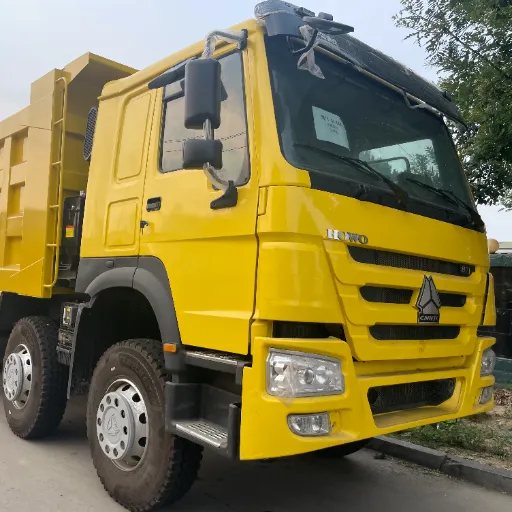
Start with the general procedure. Our used dump truck inspection guide covers the full sequence, and you should follow it. These are the HOWO-specific additions.
The chassis plate is the only identity document
Ask for the plate, the frame stamp, and the engine number in one set of daylight photos, with the listing visible in the same frame. Check that the code matches the listing, that the drive digit matches the axles you can see, and that the emission label is the one described. Mismatches are usually clerical, and occasionally not.
Hub-reduction rear axle oil and the HC16 rear end
AMIGO TRUCK’s 8×4 page lists the HC16 rear axle as a hub-reduction unit rated at 2 × 16,000 kg. Hub reduction puts a gear set in each wheel end, and those ends have their own oil. Check the level, look for weeping at the hub seals, and ask for the magnetic drain plug to be photographed. On a hard-worked tipper, hub oil tells you more about the rear end than a road test does.
The hoist, the PTO, and the frame around the hinge
A tipper’s working life shows up behind the cab. The 8×4 build uses the HW19710 with a power take-off, so check PTO engagement, the pump, and the hoses for chafe. Then raise the body and look at the frame rails around the hoist hinge and the rear crossmember for cracks, plating and fresh weld. Fresh paint over a weld isn’t a repair report, so ask when it was done and by whom.
Brakes, tyres, and the cold start
Check the air system for leak-down time, the slack adjusters for travel, and the tyres for matching sizes and even wear across the drive axles. Then insist on a cold start video, shot before the seller has run the engine, showing the exhaust, any blow-by at the breather, and the oil pressure gauge as it comes up.
Four things make a shortlisting decision easy. Walk away when:
- the chassis code doesn’t match the listing;
- the engine family turns out to be one your local parts network can’t support;
- the frame has fresh weld around the hoist hinge with no record;
- the seller won’t shoot a cold start or a plate photo.
The numbers sellers publish, and why you ask for the standard
One exporter’s 2026 guide gives inspection targets: compression 26 to 28 bar, warm idle oil pressure around 0.2 MPa, hydraulic pump 18 to 20 MPa, tyre tread 8 mm, and unladen braking from 40 km/h in 12 metres. It doesn’t say which standard or test method those numbers come from, and it’s written by a company that sells the trucks it inspects.
That doesn’t make the numbers wrong. It makes them unverifiable until someone names the source. A buyer who treats a published target as a pass mark can accept a unit at the bottom of the range without learning what the number meant.
A fleet buyer learned this the expensive way. He measured compression against a figure he’d read online and accepted a truck that sat just inside it. Only later did he find that figure had no stated method behind it.
Ask for the method first, then the measurement. That example is illustrative.
How AMIGO TRUCK inspects a used HOWO before shipment
Every vehicle AMIGO TRUCK supplies, new or used, goes through the same pre-shipment inspection. It covers nine areas: engine, transmission, axles, cab, superstructure, brakes, lighting, ordered options, and documentation. You receive photos of the actual unit, video, and a written report before it ships.
For larger fleet orders, inspection by SGS or Bureau Veritas can be arranged, with indicative cost around a few hundred US dollars per unit. Ask on any order where the value justifies a second opinion.
The video below is Sinotruk’s own material, not AMIGO TRUCK footage. It’s useful for seeing how a HOWO tipper is laid out before you look at a specific unit.
If you’re shortlisting now, send us the listings and we’ll tell you which questions to put to each seller. Request a configured quotation with your payload, road conditions, fuel quality, and destination port.
Used HOWO dump truck: frequently asked questions
Are HOWO and Sinotruk the same?
Sinotruk is the manufacturer, China National Heavy Duty Truck Group. HOWO is a brand within it, launched in 2004, and the name now covers several series across two decades. Every used HOWO is a Sinotruk truck; not every Sinotruk truck is a HOWO.
What does “HOWO 371” mean?
It means the engine is rated at about 371 horsepower. It doesn’t identify the series, the year, or the specification. Ask for the chassis code and a plate photo, because the same rating appears on trucks built more than a decade apart.
Which used HOWO is best for a quarry or mine?
One whose chassis code, engine family and drive configuration match the haul cycle, and whose inspection evidence supports the condition claim. An 8×4 with a hub-reduction rear axle suits heavier, shorter hauls. A 6×4 suits lighter work and is easier to keep in parts. Neither is universally better.
How much is a used HOWO dump truck?
In November 2026, China export listings asked about EUR 13,671 to 29,166 for 6×4 units and EUR 14,100 to 27,885 for 8×4 units, before freight. A seller-published refurbished range was USD 17,000 to 28,000 FOB, excluding tyres, repairs, parts, inland transport and freight. These are asking prices, not transactions, and not AMIGO TRUCK prices.
How much is a used HOWO dump truck in Nigeria?
Classified ads in the Nigeria search results on 23 November 2026 asked about NGN 22,450,000 to NGN 58,000,000, with several sellers based in China. A local asking price includes freight, duty and clearance that an FOB quote excludes, so compare them only after you add those lines.
Is a refurbished HOWO as good as an original?
That depends on what “refurbished” covers and who did the work, and no listing can answer it. Ask for an itemised refurbishment record, then have the unit inspected against it. Treat any claim without a document as a claim only.
What should I check first on a used HOWO?
The chassis plate against the listing. It costs nothing, takes one photo, and tells you whether the rest of the conversation is about the truck you think you’re buying. Then check the engine family, the hub oil, and the frame around the hoist hinge.
Next step
A used HOWO is a good truck to buy when you know which one you’re looking at. The same discipline applies across the wider used dump truck for sale market, where model names hide the same gaps.
Narrow your options to two or three units, get plate and engine photos for each, and compare them on the chassis code, the generation, and the engine family. Send that shortlist of used HOWO trucks for sale to us with your application and destination, and we’ll help you build the question list. Go straight to the Sinotruk dump truck range if you’re also weighing a new unit.
The second hand HOWO dump truck market rewards the buyer who reads the plate. Everything else on a listing is a seller’s summary of it.