
Used Dump Truck Financing: Payment Terms for Importers
For an importer, used dump truck financing is mostly a question about how you pay, not about who lends you money. You’re buying a machine you haven’t stood beside, from a supplier in another country, and the real risk isn’t the interest rate. It’s releasing money before you have evidence of what you bought.
That distinction matters. The phrase gets searched by two different people. One is a US owner-operator shopping for a loan on a truck parked forty minutes away. The other is a buyer in Lagos, Nairobi, Dar es Salaam or Jakarta, moving USD 25,000 to Shandong, who wants to know what happens if the truck that arrives isn’t the truck in the photos.
This guide is written for the second reader. It covers the three payment instruments an importer actually uses. It also covers how to stage payment against inspection evidence, where a loan fits and where it doesn’t, and the checks that stop a transfer going wrong. Every figure that isn’t our own published term carries its source and date.
If you’re still choosing the unit, start with the used dump truck for sale guide and come back here when the quotation arrives.
Holding a quotation already? Ask us to set out the payment stages in writing.
Key Takeaways
- For a cross-border purchase, “financing” usually means payment structure. A loan is a separate arrangement with your own bank.
- Three instruments cover almost every import: bank transfer, letter of credit, and staged payment. They protect different things and they are not interchangeable.
- The strongest protection available to a buyer who cannot borrow at all is staging: deposit, inspection, balance, shipment.
- AMIGO TRUCK’s published starting terms are a 30% deposit with the balance against the bill of lading copy or a passing inspection report, to be confirmed in your sales contract.
- A payment to an account that is not the contracting company’s is the most common way an import buyer loses money, and it is entirely preventable.
What used dump truck financing means for an importer
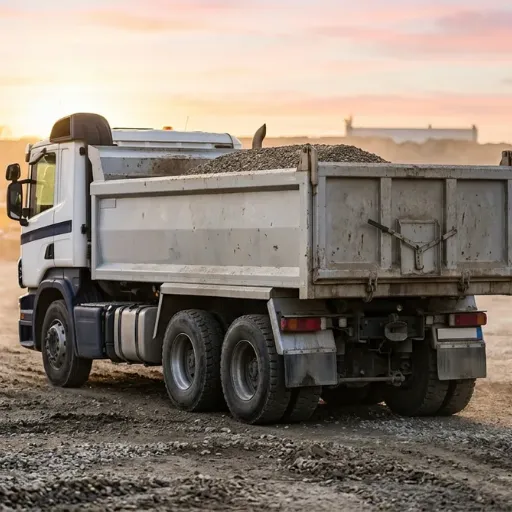
Two questions wearing one word
Search the phrase in the United States and you get lenders. Search it in Nigeria or Kenya and you get hire purchase adverts and Facebook groups. Both sets of results answer a domestic question: where do I borrow money against a truck I’ll drive myself, in my own country, in my own currency?
An import asks something else. Used dump truck financing here is a cross-border payment. The truck is in China, the seller is a company you’ve never met, and the money leaves in a currency that isn’t yours. There’s a gap of weeks between payment and delivery, and a further gap before you can inspect anything.
That gap is where importers lose money, and no loan closes it. A payment structure does.
Why a loan is not the whole answer
A loan changes where the money comes from. It doesn’t change when the money leaves, who receives it, or what evidence exists at the moment it leaves. That gap is the whole risk.
This is why the export payment question is separate from the credit question. It is also why a supplier who is honest about it is more useful than one who isn’t. AMIGO TRUCK states its position on the financing and payment page: “We do not offer loans, interest rates, or financing products. If you need a loan, arrange it with your own bank.”
Read that as a boundary, not a limitation. You shouldn’t expect a credit decision from a truck exporter, and the company’s advice on payment isn’t a sales pitch for a financial product. What an exporter can do is structure the payment so the money and the truck stay aligned.
The US down payment figures you’ll find elsewhere, often 10% to 25% depending on credit and the age of the unit, describe domestic equipment lending. AMIGO TRUCK publishes no such offer.
The three instruments of used dump truck financing
Almost every used dump truck financing deal settles through one of three routes. The US International Trade Administration describes international payment as a spectrum of risk. It puts the importer’s end of that spectrum bluntly: “any payment is a donation until the goods are received.” So the instrument you choose decides how much of that donation you’re making on trust.
| Instrument | How the money moves | What it protects | What it costs you | When it suits |
|---|---|---|---|---|
| Bank transfer (T/T) | Your bank sends funds directly to the supplier’s account | Nothing on its own. The transfer is final once made | Bank charges, currency spread, and your own timing risk | Repeat orders with a supplier you have already verified, and as the mechanism for the deposit and balance stages |
| Letter of credit (L/C) | Your bank promises to pay when the supplier presents the documents the credit names | Payment moves onto documents rather than trust. You do not pay until the goods have shipped as specified | Bank fees, arrangement time, and a strict document set | Larger or first-time orders, where you want a bank between you and the delivery |
| Staged payment | A deposit, then an inspection you review, then the balance | Your money arrives in two parts, and the second part waits for evidence | Two transfers instead of one, and the discipline of writing the trigger down | Any order where you want to see the unit before paying in full |
Bank transfer (T/T)
A telegraphic transfer is a direct payment from your account to the supplier’s. It’s the most common method for a truck purchase because it’s fast and simple. It’s also how the deposit and the balance in a staged flow are paid.
Its weakness is that it carries no protection of its own. Once the funds clear, they’re gone. Everything that protects you has to be built around the transfer, not into it. That means a verified beneficiary, a written trigger, and a document that must exist before the second payment goes out.
A supplier’s real bank account and a fraudster’s look identical in an email.
Letter of credit
A letter of credit is a commitment by a bank on behalf of the buyer, payable to the supplier once the supplier presents the documents the credit specifies. The International Trade Administration’s guide puts the mechanism in one line: the buyer’s bank pays once the exporter ships the goods and presents the required documentation as proof.
It’s one of the most secure instruments available to a trader, and it’s also the fussiest. The same source notes that credits are “labor-intensive and relatively expensive due to bank fees” and that the required documents are “detailed and prone to errors and discrepancies”. Documentary credits are governed by the ICC’s UCP 600 rules, and the ICC publishes guidance on their recommended usage.
For a truck import, an L/C is worth its cost when the order is large or the relationship is new. Its value depends on how carefully the document list inside the credit was drafted. A credit that calls for “a certificate of origin” without saying who issues it can be refused at the counter for a technicality.
Staged payment against evidence
The third route isn’t really a different instrument. It’s a way of splitting the first one.
A deposit confirms the order and secures the unit. The unit is then inspected and documented, and the balance is released only after you’ve reviewed the evidence.
The financing and payment page calls staged payment the option that “best protects the buyer”. It describes the flow as standard for a single truck or a fleet order.
Its advantage is that it works for a buyer who can’t get credit at all. You don’t need a bank to approve you. You need a contract that names the trigger, and a supplier willing to write it down.
Most importers use this version.
A buyer we’ll call Emmanuel, in Tanzania, did the opposite. An exporter offered a discount for half the price up front, and he took it.
The truck arrived four months late, with a body floor rusted through and an hour meter reading that didn’t match the video he’d been sent. By then he had no balance to withhold and no inspection report to point at. The discount was smaller than the repair.
That example is illustrative, but the mechanism isn’t: the money left before any evidence arrived, and nothing could call it back.
Ready to see the actual unit before you commit? Request a quote with your vehicle and destination, and ask for the payment stages in writing.
How to stage payment against inspection
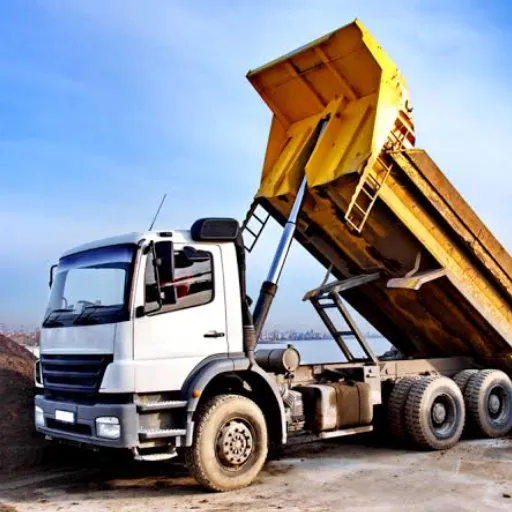
The stages are the part worth writing into the contract, because they decide what you hold at each moment.
| Stage | What happens | What you pay |
|---|---|---|
| Quotation | The configuration and landed cost are set | Nothing yet |
| Deposit | The order is confirmed and the unit secured | A deposit to secure the unit |
| Inspection | The unit is checked and documented | Nothing. You review the report |
| Balance | You confirm the unit against the inspection | The balance, after inspection |
| Shipping | The unit is loaded and shipped | Nothing. The documents travel with it |
What “the balance after inspection” actually requires
The phrase is easy to write and easy to hollow out. To mean anything, three things have to be true.
First, the inspection has to happen on the actual unit and identify it. A report that describes “a 2021 HOWO 6×4” isn’t evidence; a report that names the chassis number is. The used dump truck inspection guide sets out the nine areas we check and the evidence package that goes with them.
Second, you have to receive the evidence before the balance is due, not after. Our published position is a single sentence. You receive photos, video, and the inspection report for the actual unit before the balance is due, according to your agreed payment terms.
Third, the balance trigger has to be in the contract. Not in an email, not in a WhatsApp message, not in a promise made on a call. If the trigger isn’t written, the stage doesn’t exist.
The document set that travels with the money
An import settles against paper. Four documents do most of the work, and each one answers a different question.
| Document | What it is | What it proves at your end |
|---|---|---|
| Commercial invoice | The seller’s statement of what’s being shipped and its value | The basis your customs uses to assess the shipment |
| Bill of lading (B/L) | The carrier’s receipt and the document of title | That the goods are on board, and where they’re going |
| Certificate of origin | A statement of where the goods were made | The origin your customs may need to apply the right duty |
| Packing list | The itemised contents of the shipment | That what arrived matches what was ordered |
The sequence matters, because the documents and the payments have to line up. A common and expensive mistake is to pay a balance against an invoice that names a different chassis number from the inspection report. You then discover the mismatch at the port, where fixing it costs far more than it would have in the yard.
Our published terms, and how to read them
AMIGO TRUCK’s published starting terms are a 30% deposit to secure the order, with the balance paid against a bill of lading copy or a passing inspection report. They’re published on the support pages and restated in the pillar guide.
Treat that as a starting point to confirm in your sales contract, not as a fixed policy. The percentages, the trigger and the document list for your specific order belong in the quotation and the contract, in writing, before the first payment moves.
Where a loan fits in used dump truck financing
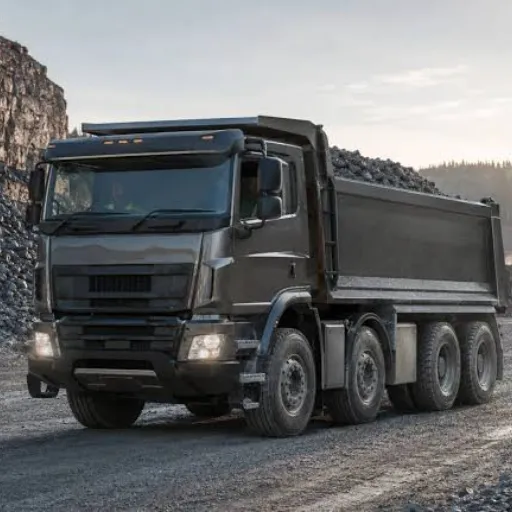
Borrowing at home against a truck in China
A loan can sit inside this structure without disturbing it. The common pattern is for a buyer to arrange asset finance or a business loan locally, for part of the cost, and to fund the rest from working capital. The local lender pays out against documents, and the supplier’s staged flow continues exactly as it would have.
Two things change when a bank is involved. The lender will want its own evidence, which often overlaps with what the staged flow already produces. And the lender may want to control the payment, which means your supplier’s balance trigger and your lender’s disbursement condition have to be the same event.
| What has to line up | Supplier’s side | Your lender’s side |
|---|---|---|
| The trigger for the final payment | The inspection report and the B/L copy | The disbursement condition in the facility letter |
| The documents that release money | Invoice, B/L, certificate of origin, packing list | The document list the lender’s compliance team accepts |
| The beneficiary | The account named in the contract | The payee the lender is willing to remit to |
| The amount | The balance on the invoice | The approved facility amount and its currency |
What your bank will ask you for
Expect questions about the supplier’s legal identity, the contract, the invoice, and the shipping documents. A beneficiary name that doesn’t match the contracting company is the first thing a compliance team will stop. That isn’t bureaucracy for its own sake; it’s the same check that protects you, run by someone with practice at it.
A buyer we’ll call Wanjiru, in Kenya, arranged local finance for most of the cost of two tippers and paid the rest from savings. Her bank disbursed against the bill of lading and certificate of origin.
Because the supplier had staged the balance after inspection, the inspection report became a document her bank wanted too, and one piece of evidence satisfied both. That example is illustrative; the arrangement depends on your lender, and this page doesn’t describe a finance product.
Five checks that stop a payment going wrong
Before any transfer, work through these in order.
- Match the beneficiary to the contract. The account name on the invoice must be the company that signed the contract, character for character.
- Confirm any change of bank details independently. If details change mid-order, verify by a channel you already had, not by the channel that told you about the change.
- Match the amount to the invoice and the stage. A deposit is a percentage of the invoice, not a round number someone suggested.
- Record the currency and the rate date. A quote in USD, EUR, NGN or ZAR carries an exchange-rate date whether the seller states it or not.
- Keep one file. Signed specification, payment terms, unit identification, inspection evidence, and bank records, together, in the order they were created.
Five checks. Five minutes. Do them before the money moves, not after.
Our own published red flags are short: “50–100% upfront, payment to a personal account, or prices far below market with no explanation.”
Any one of those three should stop the transfer while you ask questions. The used dump truck dealers guide covers supplier verification in more depth.
What the money covers: total landed cost
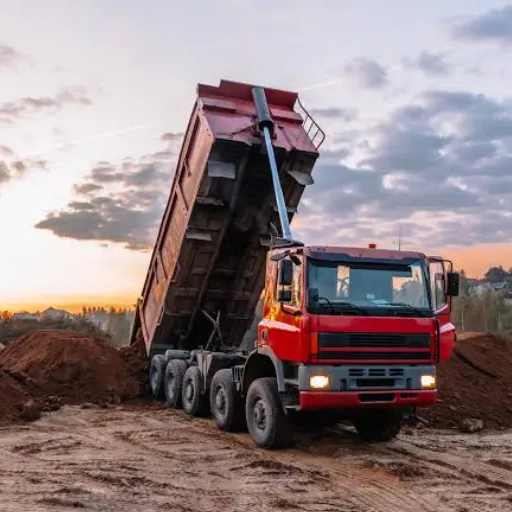
Payment structure and cost are the same question asked twice. In used dump truck financing, a deposit is a percentage of something, and that something is the landed cost, not the sticker price.
There are five components: the vehicle and its configuration, shipping and documentation, and the destination charges. Six things move the number: the vehicle, the configuration, the shipping method and route, the documentation, the destination charges, and order volume. A fleet order can be quoted as one project scope.
Where the truck crosses a border, the delivery term decides which of those you’re paying for. The ICC’s Incoterms 2020 rules define eleven three-letter terms. The difference between FOB and CIF alone can move more of the total onto your side of the ledger than any negotiation on the truck itself.
Because the components move with the unit and the route, no page can publish a number that would be true for your order. The cost breakdown guide shows how to build the full line-by-line figure, and why the vehicle price is only the first of several.
Questions importers ask about used dump truck financing
These are the questions that come up most often once a buyer has a quotation in hand.
Can I get a loan from the truck supplier?
Not from AMIGO TRUCK, and we’d rather say so than imply otherwise. The company is an export supplier and doesn’t offer loans, interest rates, or financing products. What it does is structure the payment so your money isn’t fully at risk before you’ve seen the unit.
If you need credit, arrange it with your own bank. The staged flow still protects you on the supplier side.
How much deposit is normal on a used truck import?
Our published starting point is 30% to secure the order, with the balance against the bill of lading copy or a passing inspection report. Treat that as a starting point to confirm in your sales contract rather than a fixed policy, because the figure depends on the unit, the configuration and the route.
Is a letter of credit worth the cost?
It depends on the size of the order and how new the relationship is. An L/C moves payment onto documents, which is valuable when you can’t assess the supplier’s credit. It also adds bank fees, arrangement time and a document set that’s easy to get wrong. So it earns its cost on large or first-time orders.
For a single unit from a supplier you’ve verified, staged payment often does more for less.
What if the inspection report is clean but the truck is not?
The report is only as good as the evidence behind it. Ask for three things. A cold-start video that shows the dash before the key turns. A timed walkaround covering the frame rails and body floor. Close-ups of every defect the report mentions, and a reading of the hour meter. The inspection guide sets out what a remote inspection can and can’t prove.
Can I pay in my own currency?
That’s one for your bank and the contract. Insist that the currency and its exchange-rate date appear on the quotation, so a later movement in the rate is visible rather than absorbed silently into the price.
Do I pay for shipping separately?
Shipping is one of the five components of the landed cost, and the delivery term decides whether it sits inside the quoted price or outside it. Confirm the Incoterm and the named port on the quotation, then confirm which destination charges remain yours. The truck export FAQ covers the document side of the same question.
The structure is the product
Used dump truck financing looks like a credit question and behaves like a sequencing question. The instrument matters less than the order in which the money leaves and the evidence arrives.
The video below is about paying a Chinese supplier in general rather than about trucks, and it’s third-party content from a cross-border payments provider. The mechanics it covers are the same ones in the instruments section above.
Three things are worth carrying away. A loan changes where your money comes from; it doesn’t change what protects it. Staging does, and staging works whether or not you can borrow.
The cheapest protection in the whole transaction is refusing to send money to an account that isn’t the contracting company’s.
Everything else is detail you can settle in a contract, one stage at a time. That is what used dump truck financing comes down to for an importer: the order the money leaves in, and the evidence that arrives before each stage.
Next step: send us your vehicle, your destination port, and your preferred payment option. We’ll lay out the payment stages and the landed cost, and you can decide how much of the structure you want to use. Start with a quote, or read the export support pages first if you want the terms in front of you.