
Used Dump Truck Dealers: Verify a Supplier Before You Pay
A used dump truck dealer is only as good as the documents it will send before you pay. Six checks settle the question.
Start with the legal entity and its business licence. Then come the address, the people at the yard and the product range. Next is the individual truck’s evidence chain and the dealer’s export records. Last is the name on the bank account.
Search “used dump truck dealers” in the United States and you get a map with three dealerships on it. Search it from Lagos or Nairobi and you get a different picture. Importer directories, classified ads, Facebook groups, and China-based sellers posting straight into your market.
That gap is the whole problem. If you can drive to the yard, you can look at the truck. If you’re importing, the dealer is a company you will never visit, and paperwork carries every promise.
This guide gives you the six checks in order and the document that answers each one. It also gives you the scripts that expose a dealer who can’t produce them. Then it runs the same six checks against AMIGO TRUCK’s own public pages, including what they don’t publish.
Key Takeaways
- “Used dump truck dealers” covers three different businesses: a manufacturer or authorised distributor, a marketplace listing, and an export-service supplier. Each one can prove a different set of things.
- A Chinese business licence proves registration, not capability. It’s one link in a chain that has to end at your bank account.
- The company name on the licence, the contract, the invoice and the bank account should match. When the account name doesn’t, stop.
- A used truck needs a unit-level evidence chain, not a gallery photo: plate, stamp, engine number, hour meter, and a refurbishment record.
- Ask any dealer for the file. That includes us, and it includes the three things our public pages don’t publish.
What “used dump truck dealers” means when you cannot visit the yard
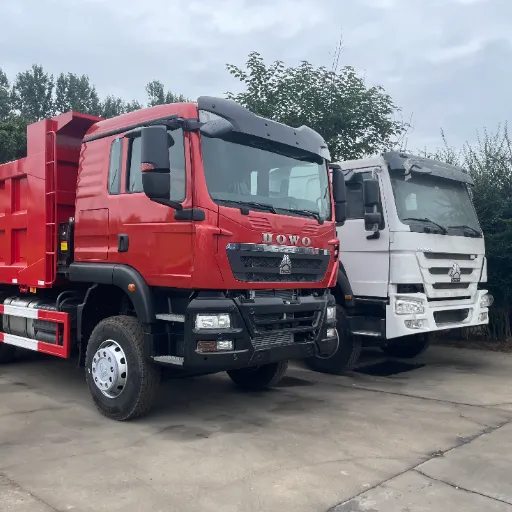
The phrase covers three businesses, and the difference decides what you can verify.
| Seller type | What they do | What their paperwork proves |
|---|---|---|
| Manufacturer or authorised distributor | Builds trucks or holds a brand appointment for a territory | Product origin and, if you ask for the letter, the appointment itself. Rarely relevant to a used export unit |
| Marketplace or listing site | Hosts other people’s listings | Nothing about the unit. The seller behind the ad is the party you’re vetting |
| Export-service supplier | Sources, inspects, documents and ships a unit for a buyer abroad | The whole chain, if they will share it: licence, inspection report, export documents, payment route |
AMIGO TRUCK’s own About page uses the same split, and places the business in the third group. Most used dump truck exporters in China sit there too: independent suppliers and exporters, rather than manufacturers or authorised dealers.
That distinction is not a technicality. A factory can show you a production line. An exporter has to show you a licence, a purchase record, an inspection report and a bill of lading. Those are the things it actually handles.
Ask for the wrong set and you learn nothing.
Then there is the local search. Type “dump truck dealers near me” and you get a map, not a guide. The search engine interprets the query as a domestic purchase within driving distance. That buyer wants a title, a local warranty and a yard they can visit.
An exporter in Jinan cannot serve that search honestly, and any page that pretends otherwise wastes your time.
If you are importing a used dump truck for sale from China, the dealer is a company you’ll probably never see. That’s exactly why the documents matter more, not less.
Six checks that separate real used dump truck dealers from brokers
Work through these in order. Truck supplier due diligence is a document exercise, not a character judgement. Each check produces a document, and each document either matches the last one or breaks the chain.
- The legal entity and its business licence. Ask for the licence. Then match the company name on it to the name on the contract, the invoice and the bank account. Four documents, one name.
- The address, the yard, and the people. A registered address and a storage yard are often different places. Ask how they relate, and ask for a dated photo or live video of your specific unit at the yard.
- Product range consistency. A dealer that lists every vehicle category and every brand is usually a broker. That isn’t automatically bad, but it changes who owns the unit and who answers for it.
- The unit-level evidence chain. Plate, frame stamp, engine number, hour meter, tyres and a refurbishment record, all tied to the chassis number in the listing.
- Export records you can check. A bill of lading or a certificate of origin from a shipment the dealer has already made. A dealer who has never exported cannot produce one.
- The bank account. The beneficiary name has to be the licence-holding company. This is the check that outranks the other five, because it’s the last one before your money leaves.
The order matters. Entity first, because everything else is unverifiable if the company is not real. Money last, because by then you either have a file or you have a reason to walk.
A buyer we will call Daniel found this out with a deposit already drafted. The proforma invoice named one company. The bank details named another, with an extra word in it. The dealer called it “our collection agent” and promised a letter.
The letter never came, and Daniel stopped. That story is an example, not a named case, but the pattern is common enough to check every time.
How to read a Chinese business licence
If you’ve read a generic guide on how to verify a chinese truck supplier, you’ve seen the licence step before. Most used dump truck dealers will send it without being asked twice. China publishes company registration through the National Enterprise Credit Information Publicity System, usually shortened to GSXT. It’s operated by the State Administration for Market Regulation, and it’s the closest thing to a primary source a foreign buyer can reach.
The licence carries a company name, an 18-character unified social credit code, a legal representative, a registered address, an establishment date and a business scope. The registry entry adds penalties and abnormal-operation listings.
However, two limits matter before you rely on it. The system is published in Chinese, with no official English interface, and it’s often out of reach outside mainland China. A direct request from our own network returned an error page.
So ask the dealer to run the search and send a screenshot with the credit code visible. A provincial mirror also works, or a sourcing agent in China. Then check the code against the licence.
The business scope, read line by line
The scope line lists the activities a company registered for. Vehicle sales, vehicle import and export, and general trade can each appear, and the wording varies by registration.
Read it as a question, not a verdict. A scope with no vehicle activity at all is worth asking about. It may mean the company is brokering outside its registered business.
For example, a scope that lists both manufacturing and trading suggests a hybrid. Neither one proves anything on its own. It tells you what to ask next.
Registered capital is not paid-in capital
The registry shows registered capital, and Chinese company law treats that figure as a subscribed commitment. It is not a bank balance, and it is not evidence that the company has the money to source your truck.
One supplier-vetting guide reviewed for this article lists registered capital as a check and gives no threshold. That’s the honest position. There’s no reliable public number that tells you a dealer is solvent.
Treat the licence as proof of identity. Ask separately for proof it can deliver.
What used dump truck dealers should be able to show you
A new truck has a build sheet. A second hand dump truck has a history, and the dealer either has the evidence or doesn’t. This is where most used dump truck dealers are separated. Generic supplier guides skip this part.
| The claim | The document that answers it | What a weak answer looks like |
|---|---|---|
| “This is a 2021 unit with 180,000 km” | Plate, frame stamp and odometer in one uncut photo, with the listing visible | Separate photos, different lighting, no plate in frame |
| “The engine is original” | Engine number photographed against the same chassis number | A verbal assurance, or a photo with the number ground off |
| “Low mileage” | Hour meter and pedal, seat and tyre wear in the same set | An odometer photo with the ignition off and no context |
| “Fully refurbished” | A dated record naming what was replaced, with before and during photos | “New paint” and nothing else |
| “We export to your region” | A redacted bill of lading or certificate of origin from a past shipment | A logo wall and a list of countries |
| “Inspected before shipment” | A report tied to this VIN, signed and dated, with photos and video | A generic checklist with no unit details |
Plate, stamp and engine number in one frame
Ask for one set of daylight photos. It should show the chassis plate, frame stamp and engine number together, with the listing or a handwritten date in the same shot. It costs the dealer five minutes and it settles identity.
If the numbers do not match the listing, stop. If the dealer will not take the photo, that’s also an answer.
The hour meter against the wear
An odometer can be disconnected, replaced or rolled back. Wear cannot be faked as cheaply. For instance, pedal rubber, seat bolster, steering wheel, door handles and tyre date codes tell you whether the hours are plausible. Ask for all of them in one unedited video, and compare what you see with what the listing claims.
What a refurbishment record has to contain
“Refurbished” is a word, not a document. A record worth reading names the date, the work, the parts replaced, who did it, and where the unit was stored. Photos from before, during and after are the difference between a record and an advertisement. If the dealer cannot say which parts were replaced, assume the paint is the refurbishment.
The bill of lading history
Ask for one shipment the dealer has completed, with the commercial details redacted. What you’re looking for is simple. A bill of lading shows a real shipment happened, and the shipper name shows which company made it.
A certificate of origin does the same job from the other direction. In China it’s issued by CCPIT and its branches in their statutory role.
A used dump truck supplier that can’t show either document hasn’t exported. However, that isn’t an automatic disqualification. It’s a different risk, and you should price it. The full procedure for checking a specific unit is in our used dump truck inspection guide.
Red-flag scripts: what you hear, and what to ask instead
Most weak used dump truck dealers don’t refuse outright. They deflect, and the deflection has a shape. These are the lines worth recognising.
| What the dealer says | What it usually means | What to ask instead |
|---|---|---|
| “Pay the deposit to my colleague’s account” | The beneficiary is not the contracting company | A written payment instruction on company letterhead, in the licence-holding name |
| “The licence is being renewed, I will send it later” | No verifiable entity today | A registry screenshot with the credit code, before any money |
| “We cannot do a live video tour” | No yard, or no unit in it | A live call at the yard, twice. Two refusals is a published walk-away rule |
| “The bill of lading shows our partner company” | Shipper and seller are different entities | The relationship in writing, plus a certificate of origin naming the seller |
| “We do not give references for privacy” | No track record to show | Two or three buyers in your region, contacted directly |
| “Shipping is included, do not worry about documents” | The scope is vague | An itemised document list in the contract, before the deposit |
| “The price is well below the others, but keep it quiet” | Something in the comparison is not like for like | What is excluded, and what preparation is included |
The two-refusal rule comes from a published buyer guide reviewed for this article, not from AMIGO TRUCK’s own experience. Nevertheless, it’s a fair threshold.
Price is a separate question from trust. Our guide to how much is a used dump truck covers what a fair number looks like, which is the other half of judging a quote.
Four things end the conversation on the spot:
- An account name that doesn’t match the licence.
- No business licence after two requests.
- No live video of the yard after two requests.
- A bill of lading shipper that nobody will explain.
A dealer we will call Sarah asked for a live video of the yard with her unit in frame. She got a photo gallery, then a video of a different truck with a different body.
She asked once more. The replies stopped. Two refusals, and the conversation was over. That example is made up, but the pattern isn’t.
Payment is the check that survives every other failure
A used dump truck dealer can answer every document request and still lose your money at the last step. Treat payment routing as a check in its own right.
The rule is short. The beneficiary name on the bank account must be the company on the licence, the contract and the invoice. Not a similar name, not a trading name, not an individual, and not a “collection agent” with a letter that never arrives.
AMIGO TRUCK’s own support pages publish the same rule and go further. Their listed red flags are “50-100% upfront, payment to a personal account, or prices far below market with no explanation.”
| Method | How it works | Best for | What to confirm |
|---|---|---|---|
| Bank transfer (T/T) | Buyer pays the supplier’s account directly, usually in stages | Standard orders and repeat buyers | Account name, currency and transfer fees |
| Letter of credit | The buyer’s bank pays once the supplier presents the documents the credit names | Larger or first-time orders | The document list inside the credit |
| Staged payment | Deposit, then inspection, then balance | Every order, single truck or fleet | The deposit percentage and the balance trigger |
The payment terms page explains the trade-offs. Its published default is a deposit to confirm the order, an inspection you review, and the balance only after the unit is verified.
AMIGO TRUCK’s published structure is a 30% deposit with the balance against a bill of lading copy or a passing inspection report. Confirm the exact terms in your sales contract, because the deposit percentage and the balance trigger are commercial terms, not industry constants. The ICC’s Incoterms 2020 rules govern the delivery terms that sit alongside them. What shouldn’t vary, whether you pay in stages or arrange used dump truck financing, is the name on the account.
If you want that structure priced for your market, request a configured quotation with your destination port and unit requirement.
How AMIGO TRUCK answers these six checks
Here’s the same framework applied to us, including where the public pages fall short.
What we publish
AMIGO TRUCK describes itself as “an independent supplier and exporter, rather than a manufacturer or authorized dealer.” The registered office is listed on the Contact page. It reads: Room 2407, Building 10, Ligao International Garden, No. 1222 Aoti West Road, Lixia District, Jinan City, Shandong Province, China. The company states 15+ years of exports, 100+ countries and 5,000+ international customers.
What the inspection covers
Every unit, new or used, goes through the same pre-shipment inspection across nine areas: engine, transmission, axles, cab, superstructure, brakes, lighting, ordered options and documentation. You receive photos of the actual unit, video and a written report before the balance is due. The FAQ states that the evidence is tied to the chassis and engine numbers of the vehicle you are buying. For larger fleet orders, SGS or Bureau Veritas can be arranged, at a few hundred US dollars per unit.
What we don’t publish
There’s no company registration number on this site, no certification list and no named customer. Those are three things you should ask any dealer for, including us. If a supplier won’t put a registration number in writing, that is the same signal as a licence that never arrives.
The video below is a third-party factory tour of the Sinotruk plant in Jinan, published by China Matters. It isn’t AMIGO TRUCK footage, and it isn’t an endorsement. It’s here because it shows what a real production line looks like, which is useful when a seller claims to be a factory.
Used dump truck dealers: frequently asked questions
How do I verify a used dump truck dealer before paying?
Work through six checks in order: business licence and entity name, address and yard, product range, the unit’s evidence chain, past export documents, and the bank account. Each one produces a document, and the account name matching the licence company is the check that matters most.
Is a Chinese truck dealer the same as the manufacturer?
No. A manufacturer such as Sinotruk builds the truck. A dealer or exporter sources, inspects and ships it, and the two roles carry different paperwork.
In addition, ask who signs the contract and who appears as shipper on the bill of lading. AMIGO TRUCK states that it is an independent supplier and exporter, not a manufacturer or authorised dealer.
Can I check a Chinese company’s registration myself?
Yes, through the National Enterprise Credit Information Publicity System, operated by China’s market regulator. It is published in Chinese and is often out of reach outside mainland China. So ask the dealer for a screenshot showing the unified social credit code, then verify that code against the licence.
What documents should a used truck dealer send before payment?
Before the deposit, used dump truck dealers should send the business licence, a proforma invoice naming the entity, and a specification sheet with the chassis number. Before the balance: the inspection report for that unit, a draft bill of lading, the certificate of origin and the packing list. Confirm the full list in the sales contract, because the timing of each document is a commercial term.
Should I ever pay a deposit to a personal account?
No. The account must belong to the licence-holding company. AMIGO TRUCK’s published red flags include 50-100% upfront and payment to a personal account. Both are worth treating as a stop sign, whatever the dealer promises.
Is a third-party inspection worth it on a single used truck?
That depends on the value of the unit and the scope of the report. AMIGO TRUCK arranges SGS or Bureau Veritas inspection for larger fleet orders at a few hundred US dollars per unit.
On the other hand, a single truck may not justify the fee. Compare it with the cost of being wrong. Read the report’s scope before you treat it as a guarantee.
Next step
Verification is a short file, not a long process. Licence, address, unit evidence, export record, bank account. Ask for all five in one email, and see which ones come back complete.
If you’re shortlisting dealers now, send us the listings and we will tell you which questions to put to each one. Go straight to a configured quotation with your destination port, payload and unit requirement.
Conclusion
Used dump truck dealers are not hard to find. They are hard to check, because the good ones and the weak ones use the same words and show the same photographs. What separates them is a paper trail that survives contact.
Start with the entity and the licence. Follow the unit through its plate, its numbers and its inspection report. Finally, check the name on the bank account, which is where every other promise either holds or fails.
Used dump truck dealers who answer all six checks are worth your deposit. A dealer who deflects on two or three has told you something useful, and it cost you nothing to find out.