
Toyota HiAce Minibus for Sale
What Is a Toyota HiAce?
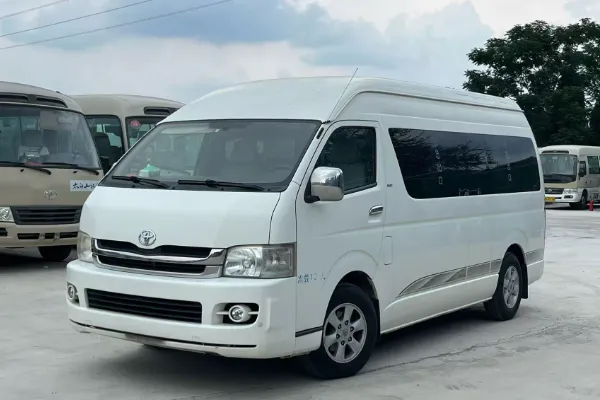
A van-derived minibus with a monocoque body and rear-wheel drive, seating between 10 and 17 passengers depending on the build. The same vehicle is sold as the Toyota Quantum in South Africa and the HiAce Commuter in parts of the Gulf and Southeast Asia.
Toyota is a Japanese brand, and Amigo does not manufacture Toyota vehicles. We source new and used HiAce minibuses, inspect them, prepare the export documentation, and ship them to your port.
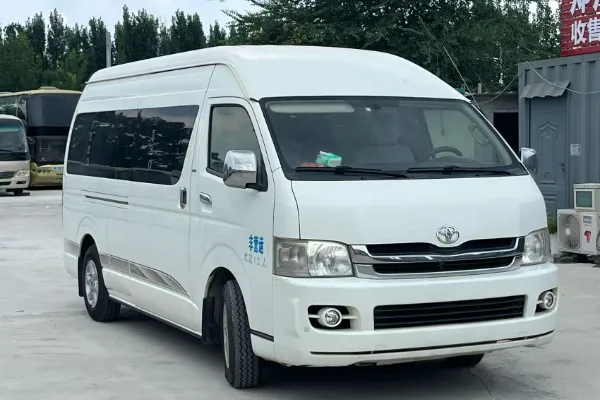
- 10–17
- Seat count
- 70 L
- Fuel tank
- RWD
- Drivetrain
- 2.5–3.5L
- Engine range
Typical export configurations. Specifications vary by engine, transmission, trim, and seat count. Confirm local import rules before ordering.
Toyota HiAce Specifications
Typical export builds. Individual units vary by engine, seat count, trim, and destination market — every quotation is prepared per configuration.
| Specification | Typical Export Build |
|---|---|
| Seating | 10–17 seats (13, 14, 15, 16 common) |
| Engine — Diesel |
2.5L 2KD-FTV (~102 hp) 2.8L 1GD-FTV turbo (~161–177 hp) 3.0L 1KD-FTV (earlier) |
| Engine — Petrol |
2.7L 2TR-FE (~151 hp) 3.5L V6 (~277 hp, Gulf spec) |
| Transmission | 5-speed manual / 6-speed manual / 6-speed automatic |
| Drivetrain | Rear-wheel drive |
| Overall Length | ~4,700–5,915 mm by variant |
| Width / Height | ~1,780–1,970 mm / ~1,980–2,285 mm |
| Wheelbase | ~2,570–3,860 mm by variant |
| Fuel Tank | 70 L |
| Safety | ABS, vehicle stability control, traction control, hill-assist, 2–8 airbags by trim, reverse camera |
| Emission Standard | Euro IV / Euro V |
| Warranty | 3 years / 100,000 km on new units |
Figures reference Toyota South Africa and Toyota Motor Philippines HiAce ranges. Treat them as a reference point, not a final build sheet.
01
Body & Drivetrain
A monocoque van body with rear-wheel drive and a low floor for easy passenger access. The layout suits shuttle, staff, and school work where manoeuvrability and access matter.
- Layout: van-derived monocoque, rear-wheel drive.
- Market names: Toyota Quantum in South Africa; HiAce Commuter in the Gulf and Southeast Asia.
02
Seat Count & Dimensions
Seat count ranges from 10 to 17 passengers, with 13, 14, 15, and 16 seats the most common builds. Length and wheelbase vary by variant, from around 4.7 m to nearly 5.9 m.
- Transfer work: a 14–15 seat layout suits shuttle and airport transfers.
- Staff and school work: a 16–17 seat layout maximises capacity.
03
Safety, Trim & Warranty
Depending on trim, the HiAce carries ABS, stability control, traction control, hill-assist, and up to 8 airbags, plus a reverse camera. New units carry a 3-year / 100,000 km warranty.
- Trim ladder: DX, GL, DLX, Deluxe, Super GL, Grandia, and the Ses-Fikile build common in South Africa.
- Warranty: new units only; confirm used-unit coverage per vehicle before ordering.
Get the Specification Sheet for Your Build
Send your seat count, drive side, and destination port. Receive a configured offer, typically within about 24 hours.
Toyota HiAce vs KING LONG Kingo vs Toyota Coaster
The HiAce sits between two choices, and the right one depends on what matters more to your operation. The KING LONG Kingo wins on new-vehicle price and modern safety kit; the Toyota Coaster steps up to 17–30 seats. The HiAce wins on brand, resale, and parts depth.
| Factor | Toyota HiAce Benchmark Minibus | KING LONG Kingo Value New Minibus | Toyota Coaster Larger Coach Body |
|---|---|---|---|
| Seat Count | 10–17 | 14–18 | 17–30 |
| Body Type | Van-derived minibus, monocoque | Rear-wheel-drive minibus | Coach-bodied bus |
| Brand & Parts | Deepest parts and service network in class | Newer parts support | Established Toyota network |
| Resale Value | Strongest in class | Below HiAce | Steady |
| Upfront Price | New or used; wide price band | Lower new-vehicle cost | Higher entry cost |
| Warranty | 3 years / 100,000 km (new) | New-vehicle warranty | Per build |
HiAce vs Kingo
Both are rear-wheel-drive minibuses. The HiAce wins on brand recognition, resale value, and parts depth; the Kingo wins on new-vehicle price and modern safety kit.
HiAce vs Coaster
The HiAce is a 10–17 seat minibus; the Coaster is a 17–30 seat coach. For a shuttle, staff, or school run, the HiAce is the right size — step up only for a larger group.
Parts and Service
Toyota’s service and parts network is the strongest in the class. Do not assume Kingo and HiAce parts are interchangeable — confirm local support for whichever line you choose.
Total Cost View
Compare purchase price, resale value, and parts lead time together. A lower sticker price is not a lower cost if the vehicle is hard to support locally.
CONSIDER THE HIACE
When resale, parts depth, and a proven shuttle platform matter most — for taxi, staff transport, and airport transfer work.
CONSIDER THE KINGO OR COASTER
Choose the Kingo when new-vehicle cost and safety kit lead; choose the Coaster when 17–30 seats are genuinely required.
Which Engine for Your Fuel Quality
The engine decision comes before the price decision, because the wrong diesel on the wrong fuel is the fastest way to park a good van.
01
2.5L / 3.0L Diesel
The simpler, robust options. Tolerant of the diesel commonly sold in many African and Middle Eastern markets.
- Engines 2KD-FTV 2.5L; earlier 1KD-FTV 3.0L.
- Fuel tolerance The conservative choice where fuel quality is uncertain.
- Best for Rough routes with variable fuel quality.
02
2.8L 1GD-FTV Turbo Diesel
The efficient modern option, but it carries a diesel particulate filter that needs clean fuel and regular longer runs.
- Engine 1GD-FTV 2.8L turbo, ~161–177 hp.
- Fuel requirement Low-sulphur diesel; sensitive injectors.
- Best for Markets with reliable fuel quality and longer routes.
03
2.7L / 3.5L Petrol
The low-maintenance option for light-duty and short-route work. No DPF, lower repair risk — at the cost of higher running fuel cost on heavy passenger loads.
- Engines 2TR-FE 2.7L (~151 hp); 3.5L V6 (~277 hp, Gulf spec).
- Fuel system No DPF, no diesel after-treatment risk.
- Best for Light-duty, short-route, and school work.
New vs Used: Price and Import Age Rules
Most HiAce buyers are deciding between a new unit and a used Japanese or Gulf import — and the honest answer depends on your market’s import rules as much as on price.
-
New Unit Price Band
A new Africa-spec HiAce runs roughly USD 26,000 to 54,000 depending on engine, trim, and drive side. Reference points only — your quotation is per configuration.
-
Used Unit Price Band
Used 2016–2023 commuter units run roughly USD 8,000 to 15,000 before shipping. The final figure depends on model year, engine, condition, and destination port.
-
Import Age Rules
Kenya applies an 8-year rule, so in 2026 the oldest unit you can clear is around 2018. Nigeria applies a 10-year limit and requires SONCAP certification.
-
Destination & Compliance
A used unit that looks cheap can be impossible to register if it falls outside your country’s age window. We confirm the model year against your destination’s rules before you pay.
Get a Quote for Your Configuration
Send your seat count, drive side, fuel quality, model-year window, and destination port. Your offer will detail the vehicle, options, preparation, and transportation.
Right-Hand Drive, Trim, and Import Documentation
Three practical points decide whether the unit you receive is the unit you can actually operate and register.
Confirm Drive Side, Trim, and Unit
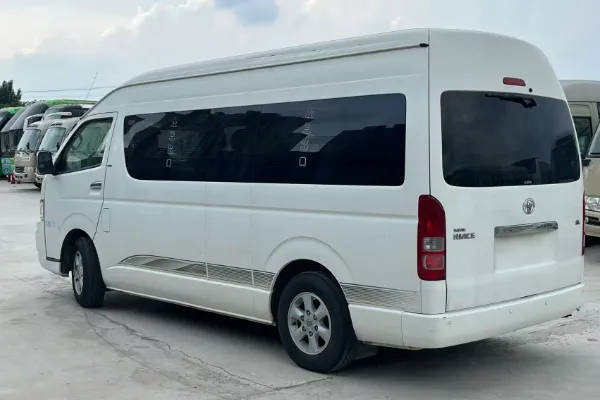
Right-hand drive is standard for Kenya, Uganda, Tanzania, Zambia, and South Africa; left-hand drive for the Gulf, Saudi Arabia, and the Philippines. The drive side is confirmed at order and checked in the pre-shipment inspection.
- Right-hand vs left-hand drive
- Trim level and ordered options
- Engine and transmission
- Body and safety equipment
- Model year against import rules
Export Documentation
A cross-border HiAce order needs a certificate of origin, bill of lading, commercial invoice, and packing list, plus SONCAP for Nigeria. We prepare these as part of the export service.
- Documents
- Certificate of origin, bill of lading, commercial invoice, packing list, and SONCAP (Nigeria) where required.
- Inspection
- Photos, video, and a written report are in your hands before the unit is sealed.
Buying a Toyota HiAce Through an Export Partner
What exactly are you getting, and how do you know the unit in the shipment is the one you approved? The answer is the same process we run on every vehicle.
Consultation & Configuration
You tell us the seat count, drive side, fuel quality, destination port, and model-year window. We match the engine and emission standard to your fuel and local rules.
Your route and fuel come firstCustomized Quotation
We return a configured offer covering the minibus, options, preparation, and transportation — with no hidden line items and no fixed price guessed from a spec sheet.
Price quoted per configurationPre-Shipment Inspection
Every unit is inspected before shipment. You receive photos, video, and a report covering the engine, transmission, body, brakes, lighting, drive side, ordered options, and documentation.
Review the unit before you payShipping & Tracking
The minibus ships by Ro-Ro or container depending on the vehicle and port, with tracking through to your destination and export paperwork prepared for your market.
Nothing ships until you approveToyota HiAce FAQ
Answers to common questions about price, seating, engines, drive side, and import rules. Need help with your configuration? Contact our team.
1 How much does a Toyota HiAce cost?
There is no fixed price. As a reference, new Africa-spec units run roughly USD 26,000 to 54,000, and used 2016–2023 commuter units run roughly USD 8,000 to 15,000 before shipping. Your quotation is prepared per configuration — send your seat count, drive side, fuel quality, model-year window, and destination port for a figure, typically within about 24 hours.
2 What is the difference between a Toyota HiAce and a Toyota Coaster?
The HiAce is a van-derived minibus seating 10 to 17 passengers. The Coaster is a larger, coach-bodied unit seating roughly 17 to 30 passengers. For shuttle, staff, and school work the HiAce is the right size; for a larger group, step up to the Coaster rather than overloading a minibus.
3 How many seats does a Toyota HiAce have?
Between 10 and 17, depending on the build, with 13, 14, 15, and 16 seats the most common. The right count depends on your route and whether you carry luggage — a 14–15 seat layout suits transfer work, while a 16–17 seat layout maximises capacity for staff and school transport.
4 Which Toyota HiAce engine is best for poor fuel quality?
The 2.5L and 3.0L diesels are the more tolerant choice where fuel quality is uncertain. The 2.8L 1GD-FTV turbo diesel is efficient but carries a diesel particulate filter that can clog on high-sulfur diesel or short routes, and its injectors are sensitive to poor fuel. On bad diesel, the simpler engines — or petrol — are the safer choice.
5 Is the Toyota HiAce available in right-hand drive?
Yes. Toyota builds the HiAce in both left-hand and right-hand drive. Right-hand drive is standard for markets such as Kenya, Uganda, Tanzania, Zambia, and South Africa. The drive side must be confirmed at order, and it is checked in the pre-shipment inspection.
6 Can I import a used Toyota HiAce to Kenya or Nigeria?
Yes, within each country’s age limit. Kenya applies an 8-year rule, so in 2026 the oldest unit you can clear is around 2018. Nigeria applies a 10-year age limit and requires SONCAP certification. We confirm the model year against your destination’s rules before you pay.
SPECIFICATION FIRST
Request Your Toyota HiAce Quotation
The HiAce is a specification decision before it is a price decision. The engine you choose has to match your fuel quality, and the model year has to fit your market’s import rules. Send us your seat count, drive side, fuel quality, model-year window, and destination port — and we will return a configured quotation, typically within about 24 hours.
Review your unit on video before shipment, with the
drive side confirmed in writing and export paperwork
prepared for your destination.
Request a Quotation
Start with your specification.