
PORT · DEPOT · HIGHWAY
Container Skeleton Trailers 20ft, 40ft & 45ft Chassis
Lightweight open-frame chassis with forged twist locks.
Choose the container sizes you haul, the axle configuration your route requires, and the twist-lock quality that keeps the box on the frame.
- 20ft Short haul & depot
- 40ft Highway workhorse
- 45ft High-cube routes
CONTAINER SKELETON RANGE
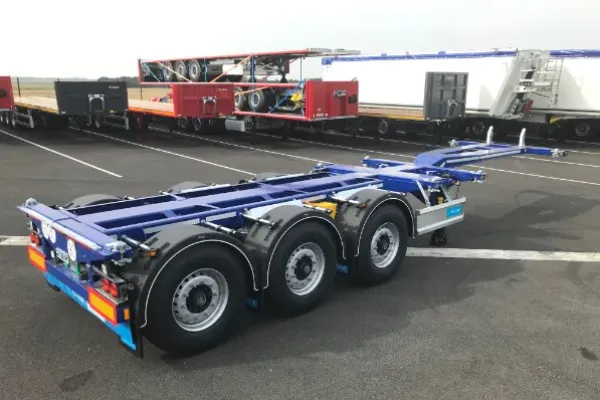
20ft / 40ft / 45ft
Configured to your container mix
Three Container Sizes
20ft, 40ft, and 45ft on one chassis
Axles Matched to the Load
2-, 3-, or 4-axle running gear
Inspect Before Shipment
Photos, video, and report before balance payment
Every trailer is quoted by configuration. Confirm container mix, destination axle-load limits, and final specifications in your offer.
Container Sizes and Twist Locks
A skeleton trailer is defined as much by its twist-lock layout as by its length. The locks stop a container from sliding under braking or lifting off on rough roads.
20ft
SHORT HAUL
Single 20ft Container
Four twist locks at the ISO positions for one 20ft box. Suited to yard shuttles and short regional runs where a lighter chassis is enough.
- Twist locks 4 locks at the 20ft corner-casting spacing.
- Consideration Pair with a combination chassis if you also haul 40ft boxes.
Axle options
2 or 3
40ft
HIGHWAY WORKHORSE
Single 40ft Container
The mainstream chassis for port-to-depot and long highway runs. A 12-lock layout lets it switch between one 40ft box and two 20ft boxes.
- Twist locks 12 locks spanning the 40ft corner castings.
- Consideration Confirm lock spacing at roughly 11,990 mm.
Axle options
3
45ft
HIGH-CUBE
45ft High-Cube Container
The 45ft high-cube layout, common on European and some Asian routes. Usually built on a dedicated or extendable chassis to keep overall length compliant.
- Twist locks 12 locks covering 40ft and 45ft positions.
- Consideration Check local overall-length and height limits.
Axle options
3
Container Combinations
| Container Combination | Twist Locks | Typical Chassis |
|---|---|---|
| 1 × 20ft | 4 | 20ft dedicated or combination |
| 2 × 20ft | 8 | Combination |
| 1 × 40ft | 4 | 40ft fixed or combination |
| 1 × 45ft | 4 | 45ft or extendable |
| 20ft / 40ft / 45ft | 12 | Combination chassis |
Twist-Lock Quality and Rating
This is where cheap trailers fail. Under hard braking, an ISO corner casting can exert a vertical load of about 25 tonnes through a single lock. Cast-steel locks rated below 30 tonnes have been known to shear under that load, and a dropped container is a serious incident, not a minor repair.
Specify forged 45# steel twist locks rated 35 tonnes per corner — comfortably above the ISO 668 requirement. Spring-loaded locks are adequate for ordinary port-to-depot work, but a semi-automatic lock with a locking indicator is worth the small upcharge when operators load and unload in poor light or at speed.
Before you order, confirm the lock spacing matches your container mix: roughly 5,850 mm for 20ft and 11,990 mm for 40ft corner castings. The right chassis is the one whose lock layout maps exactly to the containers you actually run.
Axle Configuration and Load Capacity
The axle decision is the single most important line on the specification sheet. It sets legal and safe payload, ride quality, and maintenance cost.
2-Axle (Tandem)
The lightest and cheapest option, with a tare weight around 5,000–7,000 lbs. It suits lighter container routes and yard shuttle work.
On a 40ft container it is typically limited to standard loads.3-Axle (Tri-Axle)
The mainstream choice for heavy loads and long highway runs. Tare rises to roughly 7,000–10,000 lbs, but payload headroom and load distribution are better.
The default for anything beyond light yard work.4-Axle or More
Reserved for especially heavy or oversized loads. Each extra axle adds tires, components, and maintenance, so it only pays when the loaded weight genuinely requires it.
Match axle count to load, not to trailer length.Axle Count at a Glance
| Axle Layout | Tare Reference | Best For |
|---|---|---|
| 2-axle Tandem | 5,000–7,000 lbs | Light routes, yard shuttle |
| 3-axle Tri-axle | 7,000–10,000 lbs | Heavy loads, highway runs |
| 4-axle + Specialist | 10,000 lbs and up | Overweight or oversized loads |
Axle Brand and Spare Parts
FUWA 13-tonne axles are the standard value option, widely understood and easy to source parts for across Africa, the Middle East, and Southeast Asia.
BPW 14–16-tonne axles are the premium upgrade — roughly USD 1,500–2,000 more per axle, but widely cited as averaging around 40% fewer brake-system repairs over three years on trailers running 80,000 km or more per year on rough roads.
Parts availability is the deciding factor for most buyers. An axle you cannot source brake linings and seals for locally is a parked trailer. Ask which axle brand has service and parts support in your market before you specify.
How Many Axles Do You Need?
- What container sizes do you haul, and what is the actual loaded weight of each — not just the length?
- What axle-load and gross-combination-weight limits apply in your destination country?
- What does the road look like — paved highway, rough regional road, or terminal yard?
- Which axle brand has local parts and service support?
The answer usually lands on a 3-axle chassis for anything beyond light yard work. A 2-axle chassis earns its place only when the loads are light and the route is short.
Container Skeleton Trailer Specifications
Typical figures for current Chinese-built container skeleton trailers. Treat them as reference points for comparison, not as a fixed price — each quotation is prepared to your configuration.
| Specification | 20ft Skeleton | 40ft Skeleton (3-axle) | 45ft Skeleton |
|---|---|---|---|
| Overall dimensions (mm) | 7,000 × 2,500 × 1,500 | 12,500 × 2,500 × 1,500 | 14,000 × 2,500 × 1,500 |
| Axles | 2 or 3 | 3 | 3 |
| Tare weight (approx.) | 4.5–5.5 tonnes | 6.2–6.8 tonnes | 7.0–7.8 tonnes |
| Typical payload | 20–27 tonnes | 29–30 tonnes | up to 30 tonnes |
| Twist locks | 4 | 12 | 12 |
| Main beam | Q345B steel | Q345B / Q460C high-tensile | Q345B / Q460C |
| Kingpin | 2 in bolt-on | 2 in bolt-on | 2 in bolt-on |
| Suspension | Mechanical leaf | Mechanical leaf or air | Mechanical leaf or air |
| Tires | 12R22.5 | 12R22.5 | 12R22.5 |
Tare Weight and Payload
Tare weight is the trailer’s empty weight. A lower tare means more legal payload on the same axle limit. A standard 40ft 3-axle chassis runs about 6.2–6.8 tonnes; specifying high-tensile Q460C or QSTE700 main beams can cut that to 5.5–6.0 tonnes, which translates directly into extra container weight you can carry legally.
Steel Grade and Finish
Steel grade matters for fatigue life, not just weight. Q345B is a solid baseline. For maximum-weight containers run daily, Q460C or QSTE700 reduces frame weight by 8–12% and holds up better over years of cyclic loading. In a coastal or humid market, specify a three-coat finish — zinc-rich primer, epoxy mid-coat, and polyurethane topcoat.
Specification figures are indicative and vary by build. Confirm dimensions, rated payload, and destination compliance in your configured quotation.
What a Container Skeleton Trailer Costs
Amigo Truck does not publish fixed prices, because a skeleton trailer is built to order. The ranges below are typical FOB China market references and are useful for budgeting before you request a quotation.
| Configuration | Typical FOB China Range (USD) |
|---|---|
| 20ft skeleton, 2-axle | 5,000–6,500 |
| 40ft skeleton, 3-axle, FUWA | 7,000–9,000 |
| 40ft skeleton, 3-axle, BPW | 10,500–13,500 |
| 45ft skeleton, 3-axle | 8,500–11,000 |
| Extendable 40–53ft, 3-axle | 12,500–16,000 |
These are FOB prices at a Chinese port. They do not include ocean freight, insurance, destination-port charges, or customs duties, which together make up your total landed cost. A BPW-axle chassis costs more up front, but the lower repair frequency over three years of hard running can more than offset the difference for a fleet logging 80,000 km or more annually.
Compare Quotations on the Build, Not the Headline
Ask for the axle brand, the steel grade, the twist-lock rating, and the tare weight on every quotation, then compare those against the price. A USD 1,000 saving on the chassis is quickly eaten by a dropped container or a brake failure the premium axle would have avoided.
Pre-Shipment Inspection and Shipping
This is where the buying process either protects you or leaves you exposed. Review the unit being supplied, confirm your specification, and prepare delivery to your destination port.
See the Chassis Before It Ships
Before a container skeleton trailer ships, Amigo Truck inspects it and supplies the evidence — so the chassis that arrives at your port is the chassis you approved, not a different unit.
- Frame welds
- Twist-lock condition
- Twist-lock spacing
- Axle & suspension
- Brakes & tires
- Kingpin & documentation
Your inspection evidence
Photos, video, and an inspection report sent before the container is sealed and balance payment is released.
Shipping & Export Documentation
A skeleton trailer often ships on a flat rack or as breakbulk because its open frame does not always suit a standard container. Ro-Ro is an option where the route supports it. The method changes the landed cost, so it is confirmed with your quotation rather than assumed.
- Flat rack
- Breakbulk
- Ro-Ro
Documents for your customs broker
Commercial invoice, bill of lading, certificate of origin, and packing list.
-
Confirm the Configuration
Agree on the chassis and ordered options.
-
Review Inspection Evidence
Check photos, video, and the report.
-
Arrange Export & Shipping
Confirm transport and paperwork for your port.
Chassis Types and Market-Specific Specifications
Not every skeleton trailer is a fixed-length highway chassis. The right type depends on how the trailer is used and where it is registered.
Fixed 40ft Chassis
The cheapest and lightest option, with a tare often under 4.5 tonnes. Buy this if the vast majority of your loads are 40ft containers.
Lowest cost per unit of payload20/40ft Gooseneck Chassis
A lowered deck that improves stability and reduces overall height. It suits markets with strict overall-height limits.
Better stability and lower deck heightExtendable / Telescopic Chassis
Stretches from 40ft to 45ft, or 20ft to 45ft. It adds weight and cost but removes the need for a second trailer when your container mix varies.
One chassis for a mixed container fleetTerminal / Port Chassis
A cheaper, simpler unit built for short-distance yard moves only. It is not a highway trailer and should not be specified as one.
Yard and terminal duty onlyMarket-Specific Axle-Load Regulation
A chassis that is legal in one country may not deliver the same legal payload in another, because each market sets its own limits on axle load and gross combination weight. Tell your supplier the destination country and the regulation that applies, and the axle configuration should be matched to it — the same way you would match the emission standard on the tractor truck. This is where a one-size-fits-all listing goes wrong, and where a configured quotation earns its value.
YOUR QUESTIONS, ANSWERED
Frequently Asked Questions
Compare chassis types, axle configurations, pricing, shipping, and spare-parts support.
Discuss Your Requirements1 What is a container skeleton trailer?
A container skeleton trailer is a lightweight open-frame semi-trailer with twist locks, built to carry 20ft, 40ft, and 45ft ISO shipping containers. It has no floor or sides — just a steel frame, axle assembly, and the twist locks that hold the container in place.
2 How many axles does a skeleton trailer need?
Most skeleton trailers use a 3-axle configuration for heavy and long-haul work, while a 2-axle chassis suits lighter loads and yard shuttle. More axles are only justified when the loaded container weight genuinely requires them, because each extra axle adds weight and running cost.
3 What is the difference between a skeleton trailer and a flatbed trailer?
A skeleton trailer is an open frame with twist locks for ISO containers only. A flatbed trailer has a continuous deck that carries containers plus general cargo such as steel, timber, and machinery. The flatbed is more versatile but heavier and more expensive.
4 What size container does a skeleton trailer carry?
A combination chassis typically accepts one 20ft, one 40ft, one 45ft, or two 20ft containers, depending on its twist-lock layout. A fixed 40ft chassis carries a single 40ft container, while a dedicated 20ft chassis carries one 20ft container.
5 How much does a container skeleton trailer cost?
Typical FOB China prices run about USD 5,000–6,500 for a 20ft 2-axle chassis and USD 7,000–13,500 for a 40ft 3-axle unit depending on axle brand and steel grade. Ocean freight, insurance, and destination charges are additional.
6 How are twist locks rated for container transport?
Under hard braking, an ISO corner casting can exert roughly 25 tonnes of vertical load through a single lock. A forged 45# steel lock rated 35 tonnes per corner sits comfortably above the ISO 668 minimum and is the standard to specify for heavy or overloaded containers.
7 How is a skeleton trailer shipped from China?
A skeleton trailer typically ships on a flat rack or as breakbulk because its open frame does not always suit a standard container, with Ro-Ro as an option on some routes. The method is confirmed with the quotation and affects the landed cost.
CONFIGURED TO YOUR APPLICATION
Ready to Specify Your Container Skeleton Trailer?
A container skeleton trailer is a specification decision before it is a price decision. Get the container sizes, loaded weights, and destination axle-load limits down first — the rest of the specification follows from those three facts.
- Container Mix
- Loaded Weights
- Axle-Load Limits
- Destination Port
YOUR CONFIGURED OFFER
20ft
40ft
45ft
2- or 3-axle · Matched to your route
Request a QuotationTypically within about 24 hours
Review photos, video, and inspection evidence
before shipment.