
HEAVY EQUIPMENT TRANSPORT
Low Bed Trailers for Sale
Lowboy & low loader semi-trailers. 40–100 ton payload across 2–5 axles.
A low bed trailer — also called a lowboy or low loader — is a low-deck semi-trailer built to carry tall, heavy equipment such as excavators, bulldozers, and cranes under legal height limits. Every unit is specified for your equipment and your roads, and inspected before anything ships.
- 2–5 Axles Configured to your equipment
- Fixed / RGN / Hydraulic Choose your loading method
- Q345B / ST52-3 High-strength steel frame
LOW BED TRAILER RANGE
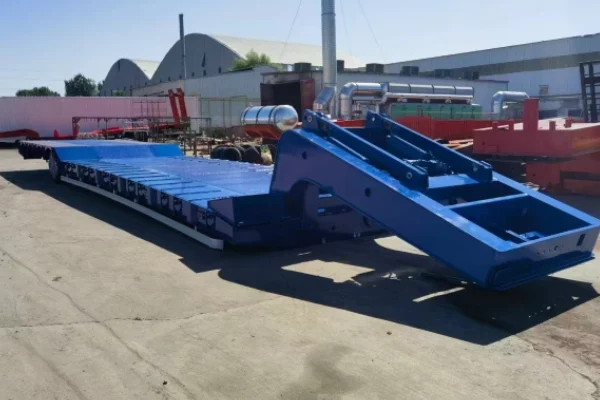
2 / 3 / 4–5 Axles
Configured to your equipment
Low Deck Height
Keeps tall equipment under legal limits
40–100 Ton Payload
2 to 5 axle configurations
100% Pre-Shipment Inspection
Photos, video, and report before balance
The workhorse configuration is 3 axles with a 40–80 ton payload. The gooseneck type (fixed, removable, or hydraulic) is the loading decision that matters most. Confirm rated payload and local axle limits in your quotation.
Low Bed vs. Flatbed Trailer
A flatbed and a low bed look similar from a distance, but they solve different problems. Here is the honest comparison.
0.45–0.6 m
LOW DECK
Deck Height
A low bed drops its load platform to about 0.45–0.6 m in the well. A standard flatbed sits roughly 1.3–1.5 m high. That difference is what lets tall equipment travel under the legal height limit.
- Low bed Keeps tall machines under the limit.
- Flatbed Tall cargo often breaks the limit.
Height advantage
~0.8 m lower
40–100+ t
HEAVY HAULING
Payload
A low bed carries 40–100+ tons depending on axle count. A flatbed usually handles lighter loads, around the 40,000 lb class or less.
- Low bed Excavators, bulldozers, cranes.
- Flatbed Steel, pipe, timber, palletized cargo.
Typical payload
40–100+ t
Drive-on
LOADING
Loading Method
A low bed loads by ramps, crane, or drive-on (RGN). A flatbed loads by forklift, crane, or side loading. If your equipment is tracked and self-propelled, an RGN saves you a crane every time you load.
- Low bed Ramsp, crane, or drive-on (RGN).
- Flatbed Forklift, crane, or side loading.
Best for tracked machines
RGN
Low Bed vs. Flatbed at a Glance
| Factor | Low Bed Trailer (Lowboy / Low Loader) | Flatbed Trailer |
|---|---|---|
| Deck height | Low, roughly 0.45–0.6 m in the well | High, roughly 1.3–1.5 m |
| Best for | Tall, heavy equipment — excavators, bulldozers, cranes | General freight — steel, pipe, timber, palletized cargo |
| Height limit | Keeps tall machines under the legal limit | Tall cargo often breaks the limit |
| Loading | Ramps, crane, or drive-on (RGN) | Forklift, crane, or side loading |
| Payload | 40–100+ tons | Usually lighter, around 40,000 lb class or less |
| Cost | Higher | Lower |
If your cargo is tall, heavy, or needs to drive on under its own power, a low bed is the right machine. If you move palletized freight or material that fits under the height limit, a flatbed is simpler and cheaper. The step deck sits between the two and suits cargo too tall for a flatbed but not heavy enough to justify a low bed.
How to Spec a Low Bed for Your Equipment and Market
This is where most buyers go wrong: they buy a generic export build, and it fails the local axle-load limit or cannot load the machine it was bought for.
Axle-Load Limits by Country
Every country enforces its own limits on axle load and overall dimensions. A 3-axle trailer legal in one market may be over-limit in another. Tell us the destination country and the regulation that applies, and we will configure the axle count, deck length, and gross vehicle weight to match.
Confirm local axle limits before choosing axle count.Gooseneck Type for Your Loading Method
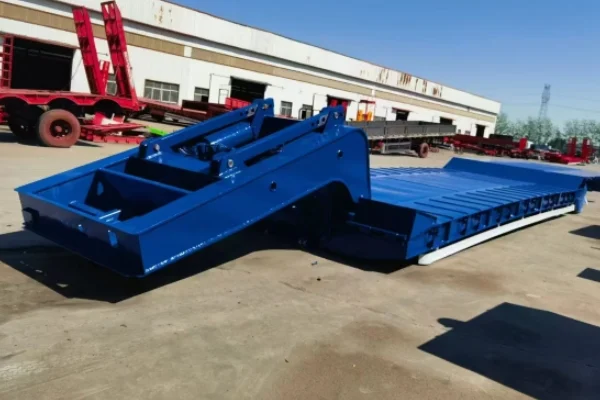
The gooseneck must match how you load. If your machines are tracked and self-propelled, a removable gooseneck lets them drive on and off without a crane. If you always load by crane or ramp, a fixed gooseneck costs less. Match the loading method to the equipment you actually run.
RGN saves a crane every load; fixed costs less.Matching a 6×4 Tractor Truck
A low bed does not work on its own — it needs a tractor unit with enough traction and power for the loaded weight. Match the trailer to a 6×4 tractor truck, and check the kingpin size (50 mm or 90 mm) and the fifth-wheel height before you commit.
Order the tractor and trailer as one working set.Axle Configuration Quick Reference
| Configuration | Payload | Best For |
|---|---|---|
| 2 Axle Lighter duty | ~40 t | Lighter equipment, regional moves |
| 3 Axle Workhorse | 40–80 t | Excavators, bulldozers, wheel loaders |
| 4–5 Axle Heavy hauling | 80–100+ t | Cranes, large mining machines |
More axles spread the load across more wheels and keep you inside local axle-load limits, but they add tare weight and cost. Start with your heaviest machine and your legal axle-load limit, then let the axle count follow from those two numbers.
Explore Vehicle CustomizationWhat to Consider Before Buying a Low Bed Trailer
The specification still matters more than the headline price. Gooseneck type, axle count, and beam steel decide how safely the trailer carries your equipment and how long it survives your haul roads.
-
Axle Configuration & Payload
Payload rises with axle count. Start with your heaviest machine and your legal axle-load limit, then let the axle count follow from those two numbers.
-
Beam Steel & Main Frame
Specify the beam for the heaviest, most concentrated load you will carry — not the average. Q345B or ST52-3 high-strength steel is the difference between a trailer that lasts and one that bends.
-
Gooseneck & Loading Method
If your equipment is tracked and self-propelled, a removable gooseneck saves you a crane every time. If you always load with a crane or ramps, a fixed gooseneck costs less.
-
Suspension & Brakes
Mechanical leaf suspension survives rough, unpaved roads; air suspension rides smoother on surfaced routes. Dual-line pneumatic brakes with WABCO valves, with ABS as an option.
-
Deck Dimensions & Tare Weight
A typical deck runs 12,500–16,000 mm long and 2,500–3,500 mm wide, with tare weight of roughly 8.5–13 tons depending on configuration.
Get a Quotation for Your Configuration
Send your equipment type, weight, and destination port. We will return a configured offer covering the trailer, options, preparation, and transportation — typically within about 24 hours.
Inspection, Documentation, and Shipping
The biggest risk in buying a trailer thousands of kilometers away is receiving a unit that is not the one you saw. Amigo Truck removes that risk.
100% Pre-Shipment Inspection
Every low bed passes 100% pre-shipment inspection before it ships. Our inspection covers the main frame and gooseneck, the deck and welds, the suspension, axles, brakes, lighting, landing gear, kingpin, hydraulic ramps, and the ordered options.
- Main frame & gooseneck
- Deck & welds
- Suspension & axles
- Brakes & lighting
- Landing gear & kingpin
- Hydraulic ramps & options
Your inspection evidence
Photos, video, and a written inspection report of the actual unit before you pay the balance.
Export Documentation & Shipping
We prepare the export documents your customs broker needs and ship by the method that fits the trailer and your port. Containers, Ro-Ro, and breakbulk each suit different situations.
- Container
- Ro-Ro
- Breakbulk
Documents for your customs broker
Commercial invoice, bill of lading, certificate of origin, and packing list.
-
Confirm the Specification
Agree on the trailer and ordered options.
-
Review Inspection Evidence
Check photos, video, and the written report.
-
Arrange Export & Shipping
Confirm transport and paperwork for your port.
Practical Support. From Specification to Delivery.
Get the right configuration, review your trailer before shipment, and plan delivery with a clear scope.
Configured for Your Equipment
Match the gooseneck to how you load, the beam steel to your heaviest machine, and the axle count to your local limits.
Your equipment comes firstSee the Trailer Before Shipping
Review photos, video, and a written inspection report covering the frame, gooseneck, deck, axles, brakes, and ordered options.
Review the actual unit being suppliedClear Export & Shipping Support
Confirm the shipping method, freight scope, expected timeline, and export paperwork for your port.
Plan delivery before orderingParts & After-Sales Support
Arrange spare parts and consumables, and get after-sales support after the trailer reaches your port.
Support beyond the shipment
YOUR QUESTIONS, ANSWERED
Low Bed Trailer FAQ
Compare definitions, specifications, loading methods, shipping, and after-sales support.
Discuss Your Requirements1 What is a low bed trailer?
A low bed trailer is a low-deck semi-trailer that carries tall, heavy equipment such as excavators and bulldozers under the legal height limit. In North America it is called a lowboy, and in other markets a low loader or low bed semi trailer.
2 What is the difference between a low bed trailer and a flatbed trailer?
A flatbed has a high, single-level deck for general freight, while a low bed drops its deck to about 0.45–0.6 m so tall equipment clears bridges and overhead lines. A low bed carries heavier, taller loads at a higher cost.
3 How many tons can a low bed trailer carry?
A 3-axle low bed semi trailer typically carries 40–80 tons, while 2-axle units carry about 40 tons and 4–5 axle units carry 80–100+ tons, depending on the beam and the local axle-load limit.
4 What trailer do I need to transport an excavator?
For a tracked excavator, a low bed with a removable gooseneck (RGN) is usually the best choice, because the machine can drive on and off under its own power. The exact axle count depends on the excavator’s weight.
5 What is the difference between a fixed and a removable gooseneck?
A fixed gooseneck is permanently attached, so loading is by rear ramps or crane. A removable gooseneck detaches and drops to ground level so tracked equipment can drive on and off without a crane.
6 Can I ship a low bed semi trailer in a container?
Some low beds ship by container and others by Ro-Ro or breakbulk, depending on dimensions and your destination port. We confirm the shipping method and expected timeline with your quotation.
7 Can I see the trailer before I pay?
Yes. Every unit passes pre-shipment inspection, and you receive photos, video, and a written report of the actual trailer before you pay the balance.
CONFIGURED TO YOUR EQUIPMENT
Get Your Low Bed Trailer Configured
A low bed trailer is a specification decision before it is a price decision. Match the gooseneck to how you load, the beam steel to your heaviest machine, and the axle count to your local limits.
- Equipment Type & Weight
- Haul Roads
- Loading Method
- Destination Port
YOUR CONFIGURED OFFER
2 Axle
3 Axle
4–5 Axle
Fixed / RGN / Hydraulic · Matched to your equipment
Request a QuotationTypically within about 24 hours
Review photos, video, and inspection evidence
before shipment.