
LIQUID · GAS · POWDER
Tanker Semi Trailers The Cargo Decides the Specification
A tank is a regulated vessel, not a container with wheels.
Volume is the last decision. The cargo sets tank material, compartment count, baffles and discharge system — and the destination market sets the certificate that decides whether the trailer can be registered, loaded and paid for.
- Fuel Diesel, petrol, multi-compartment
- Cement Bulk powder, pneumatic discharge
- Chemical Stainless or lined, ADR options
TANKER SEMI TRAILER RANGE
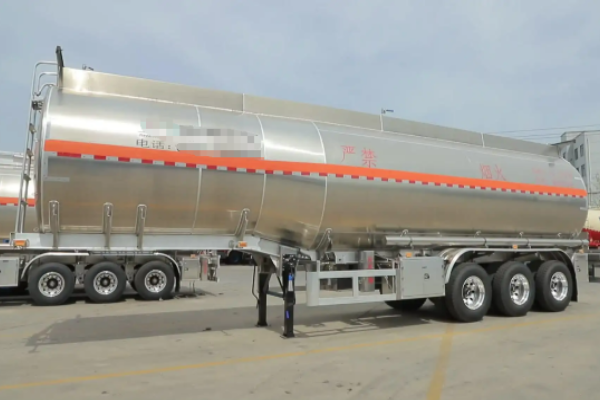
Fuel / Cement / Chemical
Specified by cargo and market
Cargo-First Specification
Tank material, compartments and baffles follow the load
Discharge Matched to Product
Bottom loading, vapour recovery or pneumatic
Certified for the Market
ADR, DOT or local approval decided by destination
Each trailer is quoted by cargo and market. Confirm tank material, certificate and final specifications in your offer.
Three Ways to Carry a Tank
A rigid tank truck, a tanker semi trailer and an ISO tank container all carry a tank — and buyers confuse them constantly. They are not interchangeable.
Rigid
SHORT HAUL
Rigid Tank Truck
The tank sits on the truck’s own chassis with the cab. Suits short routes, urban delivery and tight access, but one breakdown idles the whole unit.
- Best fit Short haul, urban delivery and tight access.
- Consideration One breakdown idles the whole unit.
Tank capacity
8,000–30,000 L
Semi
BULK LONG HAUL
Tanker Semi Trailer
The tank rides on a trailer pulled by a tractor unit. Wins on bulk: one tractor pulls several trailers, so the power unit keeps earning while a tank waits.
- Best fit Bulk movement, long haul and terminal loading.
- Consideration Capacity depends on cargo class and axles.
Tank capacity
25,000–60,000 L
ISO
INTERMODAL
ISO Tank Container
A tank inside a 20-foot ISO frame, stackable and intermodal. It moves cargo between sea, rail and road rather than building a tanker operation.
- Best fit Sea freight, rail and short road legs.
- Consideration Smaller volume and a different operating pattern.
Tank capacity
20,000–26,000 L
Vehicle Comparison at a Glance
| Vehicle | Tank Capacity | How It Works | Where It Fits | Key Trade-off |
|---|---|---|---|---|
| Rigid tank truck | 8,000–30,000 L | Tank on the truck’s own chassis, with a cab | Short haul, urban delivery, tight access | One breakdown idles the whole unit |
| Tanker semi trailer | 25,000–60,000 L | Tank on a trailer, pulled by a tractor unit | Bulk movement, long haul, terminal loading | One tractor serves several trailers |
| ISO tank container | 20,000–26,000 L | Tank inside a 20-foot ISO frame, stackable | Sea freight, rail, short road legs | Moves cargo rather than building a tanker operation |
*Capacities overlap, so volume alone does not decide the vehicle. The operating pattern does. A rigid tank truck suits short routes and small deliveries; a tanker semi trailer wins on bulk and lets one tractor serve several tanks; an ISO tank container moves cargo between modes. Confirm capacity, cargo class and local rules in the model specification.
Five Cargo Classes, and What Each One Changes
The word “tanker” covers five tanker trailer types that share a shape and little else. The class is the first decision, because it determines the tank, the fittings and the certificate.
Cargo Class Comes First
A fuel tanker trailer and an oil tank trailer are the same class under two names. Before volume, decide whether the cargo is fuel, chemical, gas, bitumen or powder.
The class sets the tank, fittings and certificate.Pressure Vessel vs Atmospheric
Gas (LPG) is a pressure vessel at roughly 1.6–2.5 MPa, built and tested to a different standard from an atmospheric fuel tank.
A fuel tank failure leaks; a pressure vessel failure does not.Powder Is a Different Page
A bulk cement trailer discharges by air rather than by pump and has its own sizing logic. We cover it separately under cement tanker trailer.
Confirm any figure against the builder’s drawing.Which Tank Fits Your Cargo?
| Cargo Class | Tank, Discharge & Typical Volume |
|---|---|
| Fuel & Oil Diesel, gasoline, kerosene, crude | Carbon steel or aluminium, atmospheric, baffled; pump or gravity, often bottom loaded; 25,000–55,000 L. |
| Chemical Acids, caustic soda, solvents | Stainless steel 316L or lined carbon steel; pump with lined valves; 20,000–35,000 L. |
| Gas (LPG) Propane, butane, ammonia | Pressure vessel at roughly 1.6–2.5 MPa; pump or compressor, never gravity; 25,000–60,000 L. |
| Bitumen Asphalt, heavy fuel oil | Insulated tank with heating coils; heated discharge by burner or element; 30,000–45,000 L. |
| Powder Cement, fly ash, lime | Carbon steel with conical or V-shaped hopper; pneumatic, using an air compressor; 35,000–65,000 L. |
Confirm any figure against the builder’s drawing. A pressure vessel and an atmospheric fuel tank are built and tested to different standards.
Explore Tank Trailer TypesThe Tank Material Decides More Than the Price
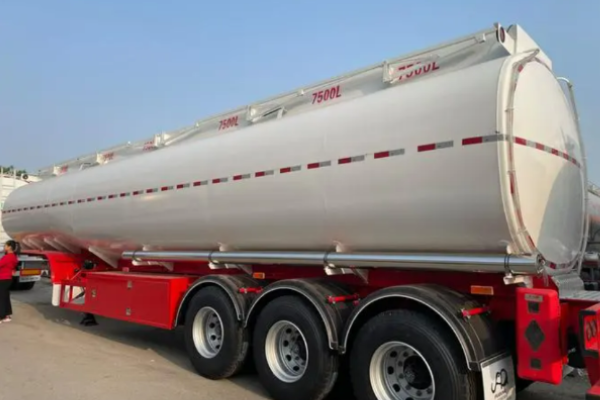
Almost every tanker semi trailer uses carbon steel, aluminium or stainless steel. The cargo picks the material, not the budget line.
-
Carbon Steel (Q235B / Q345B)
The default for diesel and gasoline. Cheapest to buy and easiest to repair, but heavier, and the shell corrodes from inside when water or aggressive additives sit in the fuel.
-
Aluminium (5083 / 5454)
Cuts tare weight and resists corrosion, at a higher price and with welders qualified for aluminium. Not the right tank for acids or caustics.
-
Stainless Steel (304 / 316L)
For chemicals and food-grade cargo. Resists corrosion that would destroy a carbon steel shell, and cleans to the standard edible oil and milk require.
-
Tare Weight & Payload
A 45,000 L, 3-axle fuel tanker commonly tares around 9 t in carbon steel and 6.5–7 t in aluminium. The saving becomes payload only where the axle limit binds.
-
What the Premium Buys
Where axle load is not the constraint, aluminium buys fuel savings, corrosion resistance and resale value — not more litres per trip. Ask for the weight certificate, not a brochure figure.
Get a Price for Your Tank Specification
Send your cargo, required volume, axle limits and destination port. Receive a detailed tanker and transport quotation, typically within about 24 hours.
Buying a Used Tanker Semi Trailer
A used tank is worth what its paperwork and its shell are worth. Price is the last thing to look at.
The Tank and Its Records
The shell and the test history decide the tank’s real condition. Through the manhole, look for corrosion, pitting and coating failure.
- Inside the tank — corrosion, pitting, coating failure
- Bulkheads and baffles — weld cracks, loose plates
- Pressure test, calibration and certificates
- Type approval paperwork
- Foot valves, emergency shut-offs and gaskets
- Axles, suspension, brakes and kingpin plate
Six checks before you commit
A tank that carried a corrosive cargo will show it on the floor and at the welds. A detached baffle turns a surge problem into a structural one.
Approval, Parts and Shipping
A tank with no approval paperwork may fail to register in your market, and mechanical condition does not fix that. Valves and seals wear — replacements are cheap only if the parts are available locally.
- Type Approval
- Valves & Seals
- Chassis & Running Gear
Inspection evidence, new or used
A pre-shipment inspection with photographs, video and a written report covers all six checks before the trailer ships. Ask for it either way.
-
Confirm Cargo and Class
Fuel, chemical, gas, bitumen or powder.
-
Inspect Tank and Records
Shell, baffles, pressure test and certificates.
-
Verify Approval, Then Ship
Type approval, parts availability and transport.
Practical Support. From Reach Specification to Delivery.
Get the right boom and stick, review your excavator before shipment, and plan the oversize transport with a clear scope.
Configured for Your Reach
Match boom and stick length, bucket size and hydraulic setup to your dredging depth, slope work and bank cleaning — not to a catalogue figure.
Your working depth comes firstSee the Excavator Before Shipping
Review photos, video and an inspection report covering the boom, stick, hydraulic circuit, undercarriage and ordered attachments.
Review the unit being suppliedClear Oversize Export Support
Long booms usually ship dismantled. Confirm the shipping method, component dimensions, permits and export paperwork for your port before ordering.
Plan oversize transport before orderingParts & Maintenance Planning
Arrange pins, bushes, hydraulic hoses and wear parts for the long boom, and check local service support before you buy.
Support beyond the shipment
YOUR QUESTIONS, ANSWERED
Tanker Semi Trailer FAQ
Compare tank types, capacity, certification, baffles, and shipping requirements.
Discuss Your Requirements1 What is a tanker semi trailer?
A tanker semi trailer is a semi-trailer built around a tank, with a kingpin that couples to a tractor unit and axles that carry the load. The tank is built and certified to a dangerous-goods standard.
2 How many liters does a tanker semi trailer hold?
It depends on the cargo class and axle configuration. Capacity commonly runs 25,000–55,000 liters for fuel, 25,000–60,000 for LPG, and 35,000–65,000 for powder. The legal limit is usually axle load rather than tank volume.
3 What is the difference between a tanker truck and a tanker trailer?
A tanker truck is rigid: the tank sits on the truck’s own chassis with the cab. A tanker trailer couples to a separate tractor unit. The trailer carries more volume and lets one tractor serve several tanks.
4 What certification does a tanker semi trailer need?
It depends on the destination. ADR applies in the countries that are parties to it; DOT 406, 407 and 412 apply in the United States; AS 2809 applies in Australia. Many markets add a national scheme such as SONCAP, KEBS or SASO. Confirm the requirement with your authority before you order.
5 Do tanker semi trailers have baffles?
Most do, and they should. A baffle is a transverse plate inside a compartment that breaks up the movement of liquid. Without baffles, a partly filled tank surges under braking and acceleration, which loads and unloads the axles and can turn the trailer over.
6 Is an empty tanker semi trailer dangerous goods for shipping?
Yes, unless it has been cleaned and certified. A drained tank that carried fuel still holds vapor and residue, so most lines require a tank cleaning certificate, a gas-free certificate, and a dangerous goods declaration before loading.
SPECIFY IN THE RIGHT ORDER
Get Your Tanker Semi Trailer Specified for Your Cargo
Name the cargo, material, compartments, baffles, discharge and terminal, axle limits, then certificate. Get those six right and volume follows.
- Cargo & Material
- Compartments & Baffles
- Discharge & Terminal
- Axle Limits & Certificate
YOUR SPECIFIED OFFER
Fuel
Chemical
Powder
New or used · Specified to destination
Request a Tanker QuotationTypically within about 24 hours
Review photos, video, and inspection report
before shipment.