
Toyota Coaster 17 Seater Bus for Sale
Short-wheelbase, body-on-frame coach for staff, school, tour, and shuttle work.
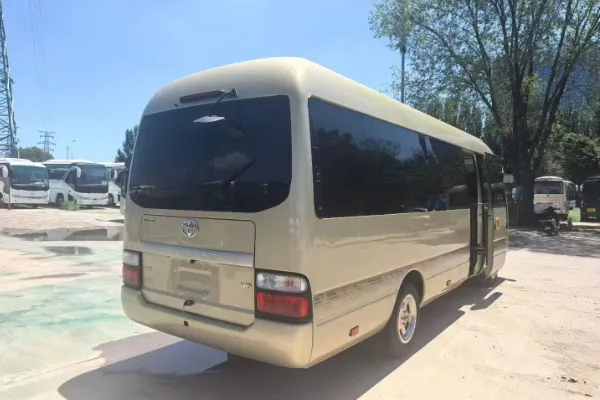
The Toyota Coaster 17 seater is the short-wheelbase version of Toyota’s body-on-frame light-duty coach — a benchmark small bus for staff transport, school, tour, and shuttle work across Africa, the Middle East, and Southeast Asia.
Amigo Truck does not manufacture Toyota vehicles. We source new and used Coasters, inspect them, prepare the export documentation, and ship them to your port. Every quotation is configured to your seat count, engine, drive side, model-year window, and destination.
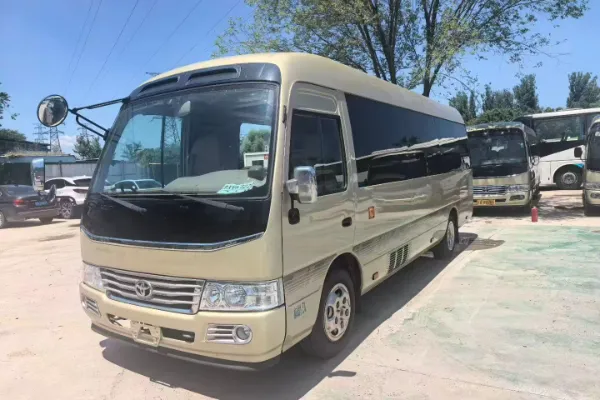
- 16–17 seats
- Short-wheelbase seating
- 4.2L 1HZ
- Durable diesel option
- Body-on-frame
- Ladder chassis, RWD
- 95 L
- Fuel tank
Typical export builds vary by engine, seat count, trim, and market. Confirm drive side, emission standard, and model-year rules before ordering.
Toyota Coaster 17 Seater Specifications
The figures below describe typical export builds. Individual units vary by engine, seat count, trim, and destination market, so every quotation is prepared per configuration.
| Specification | Toyota Coaster 17 Seater |
|---|---|
| Seating | 16–17 seats (short-wheelbase); 22/23/25 and 29/30 seats on longer builds |
| Engine — diesel | 4.2L 1HZ (~130 hp, naturally aspirated); 4.0L N04C (~150–175 hp); 2.8L 1GD-FTV turbo (~161–177 hp) |
| Engine — petrol | 2.7L 2TR-FE (~111 kW); 4.0L V6 1GR-FE (~232 kW) |
| Transmission | 5-speed manual / 6-speed manual / 6-speed automatic |
| Drivetrain | Rear-wheel drive, body-on-frame ladder chassis |
| Overall length | ~6,200 mm (short-wheelbase) to 7,725 mm (long-wheelbase) |
| Width | ~2,000–2,080 mm |
| Height | ~2,600–2,815 mm |
| Fuel tank | 95 L |
| Emission standard | Euro III / Euro IV / Euro V |
| Safety | ABS, and body construction suited to passenger transport; rear camera and stability control on higher trims |
Figures are drawn from Toyota South Africa’s Coaster range and Toyota Australia’s Coaster line. Treat this table as a reference point rather than a final build sheet.
01
Body-on-frame chassis
The Coaster’s ladder-frame chassis makes it heavier and more durable than a van-derived minibus, with better ride comfort over long daily passenger runs.
- Layout: rear-wheel drive, separate body on ladder frame.
- Use case: rough roads, heavy daily passenger work, long shifts.
02
Engine & fuel matching
Diesel options include the 4.2L 1HZ, 4.0L N04C, and 2.8L 1GD-FTV; petrol options include the 2.7L 2TR-FE and 4.0L V6 1GR-FE. Choose by fuel quality, route, and maintenance support.
- Uncertain fuel quality: the 1HZ or a petrol engine is the safer choice.
- Clean fuel and longer runs: modern diesel options can suit, subject to DPF care.
03
Seat count & wheelbase
Short-wheelbase units seat 16–17; standard builds seat 22–25; long-wheelbase builds seat 29–30. The 17-seater suits small shuttle, school, church, or tour groups.
- 17 seats: easier city manoeuvrability and lower operating cost.
- 23 seats: more capacity per trip on intercity or transfer work.
Get the Specification Sheet for Your Build
Send your seat count, drive side, fuel quality, model-year window, and destination port. Receive a configured offer, typically within about 24 hours.
17 Seats vs 23 Seats: Which Coaster Do You Need
Seat count is a specification decision before it is a price decision. The two configurations share the same engine range and durability; the difference is wheelbase, capacity, and operating cost.
| Factor | 17 Seats Short-wheelbase | 23 Seats More capacity |
|---|---|---|
| Best use | Small staff shuttle, school run, church or community bus, tour vehicle | Intercity staff movement, larger school, transfer operation |
| Manoeuvrability | Easier in city traffic | Longer wheelbase, more capacity per trip |
| Operating cost | Cheaper to run and simpler to fill to capacity | Higher capacity per trip; costs rise with size |
| Availability | More commonly sourced as a used unit or specific petrol short-wheelbase build | New Gulf export Coasters are mostly 22/23/30-seat diesel units |
| Engine range | Shared engine range | Shared engine range |
Right choice for modest groups
A 17-seat short-wheelbase Coaster suits urban routes, small staff shuttles, school runs, church or community buses, and tour groups.
Right choice for capacity
A 23-seater suits intercity staff movement, larger schools, or transfer work where one trip must carry more people.
Availability reality
New Gulf export Coasters are mostly 22/23/30-seat diesel units. A 17-seater is more commonly sourced as a used unit or a specific petrol short-wheelbase build.
Sourcing decision
If your operation truly needs 17 seats, we will find the right unit. If a 23-seater will do the job, it may be the faster and simpler order.
CONSIDER 17 SEATS
Small shuttle, school, church, community, or tour group; urban routes where manoeuvrability and lower operating cost matter.
CONSIDER 23 SEATS
Intercity staff movement, larger school, or transfer operation needing more capacity per trip.
Which Engine for Your Fuel Quality
The engine decision comes before the price decision. Match the engine to your fuel quality, route, and maintenance support.
01
4.2L 1HZ Diesel
The workhorse. A simple, naturally aspirated six-cylinder with a reputation for near-indestructible durability and tolerance of diesel sold in many African and Middle Eastern markets.
- Best forUncertain fuel quality, rough routes, conservative maintenance.
- Trade-offLower specific output; simple and proven.
02
Modern Diesels: N04C & 1GD-FTV
The 4.0L N04C is an efficient, refined Japan-market option. The 2.8L 1GD-FTV turbo diesel is efficient and modern, but carries a diesel particulate filter that needs clean fuel and regular longer runs to regenerate.
- Best forClean fuel, regular longer runs, modern service support.
- WatchHigh-sulfur diesel or stop-start shuttle routes can clog the DPF; injectors and fuel system are sensitive.
03
Petrol: 2.7L & 4.0L V6
The low-maintenance option for light-duty and short-route work. Petrol avoids the DPF entirely and lowers repair risk, at the cost of higher running fuel cost on heavy passenger loads.
- Best forLight-duty, short routes, low annual distance.
- Trade-offHigher fuel cost under heavy loads.
New vs Used: Price and Import Age Rules
Most buyers are deciding between a new unit and a used Japanese or Gulf import. The honest answer depends on your market’s import rules as much as on price.
-
New price band
A new Gulf export Coaster in the 22/23-seat diesel configuration runs roughly USD 57,500 to 67,100.
-
Used price band
Used petrol Coasters across the 17–29 seat range can run roughly USD 11,000 to 12,000. Used diesels are priced above that depending on condition and model year.
-
Kenya age rule
Kenya applies an 8-year rule, so in 2026 the oldest unit you can clear is around 2018.
-
Nigeria age rule
Nigeria applies a 10-year age limit and requires SONCAP certification, which pushes buyers toward 2018-and-newer units as well.

Get a Quote for Your Configuration
Reference points are not quotations. Model year, engine, condition, seat count, drive side, and destination port change the figure. We confirm the model year against your destination’s rules before you pay. Send your requirements for a configured offer, typically within about 24 hours.
Toyota Coaster vs Toyota HiAce vs Chinese Coaches
The Toyota Coaster sits in the middle of three choices. The right one depends on passenger count, route, and capital budget — not just the purchase price.
| Option | Best for | Trade-off |
|---|---|---|
| Toyota Coaster | Body-on-frame coach; durability, ride comfort, parts depth, and resale for heavy daily passenger work. | Higher purchase cost than HiAce; short-wheelbase 17-seaters are less common as new export units. |
| Toyota HiAce | Van-derived minibus; lower purchase cost and fuel efficiency for light shuttle work. | Less durable than the Coaster for heavy daily passenger work on rough roads. |
| Chinese coaches | New-vehicle price and modern specification at a lower entry cost, from King Long, Yutong, Ankai, and similar brands. | Resale value and parts depth may trail Toyota, depending on local support. |
Right-Hand Drive, Emission Standard, and Import Documentation
Three practical points decide whether the unit you receive is the unit you can actually operate and register.
Right-hand drive vs left-hand drive
The Toyota Coaster ships in both. Right-hand drive is standard for markets such as Kenya, Uganda, Tanzania, Zambia, and South Africa; left-hand drive is standard for the Gulf, Saudi Arabia, and the Philippines.
The drive side must be confirmed at order, and it is checked in the pre-shipment inspection so a wrong-side unit cannot ship by mistake.
Emission standard
The Coaster is supplied to the emission standard your destination requires — Euro III, Euro IV, or Euro V depending on the market. This is matched at the quotation stage, because a unit built for one standard may not be registerable under another country’s rules.
Export documentation
A cross-border Toyota Coaster order needs a certificate of origin, bill of lading, commercial invoice, and packing list, plus SONCAP for Nigeria. We prepare these as part of the export service, and you receive them before the unit ships.
The pre-shipment inspection evidence — photos, video, and a written report — is in your hands before anything is sealed.
Buying a Toyota Coaster Through an Export Partner
Buying overseas raises one question: what exactly are you getting, and how do you know the unit in the shipment is the one you approved? This is the process we run on every vehicle.
Consultation & Quotation
You tell us the seat count, drive side, fuel quality, destination port, and model-year window. We return a configured offer covering the bus, options, preparation, and transportation.
Price is quoted per configurationInspection
The unit is inspected before shipment. You receive photos, video, and a report covering the engine, transmission, body, brakes, lighting, drive side, ordered options, and documentation.
You see the unit before you payCustomization
Seat count, trim, drive side, and emission standard are confirmed to the destination market before shipment.
Built to your market, not a templateShipping
The bus ships by Ro-Ro or container depending on the vehicle and port, with tracking through to your destination.
Clear scope to your portToyota Coaster 17 Seater FAQ
Answers to common questions about price, HiAce comparison, seats, engines, right-hand drive, and import rules. Need help with your configuration? Contact our team.
1 How much does a Toyota Coaster 17 seater cost?
There is no fixed price, because model year, engine, seat count, drive side, and destination all change the figure. As a reference, a new Gulf export 22/23-seat diesel Coaster runs roughly USD 57,500 to 67,100, and used petrol Coasters in the 17–29 seat range can run roughly USD 11,000 to 12,000. Send your requirements for a configured quotation, typically within about 24 hours.
2 What is the difference between a Toyota Coaster and a Toyota HiAce?
The Coaster is a body-on-frame light-duty coach seating 17 to 30 passengers. The HiAce is a van-derived minibus seating 10 to 17 passengers. For heavy daily passenger work on rough roads, the Coaster wins on durability and ride comfort; for light shuttle work, the HiAce wins on cost and efficiency.
3 How many seats does a Toyota Coaster have?
Between 16 and 30 depending on the build. The short-wheelbase unit seats 16 to 17, the standard build 22 to 25, and the long-wheelbase build 29 to 30. The 17-seater is the short-wheelbase end of the range, sized for a small shuttle, school, church, or tour group.
4 Which Toyota Coaster engine is best for poor fuel quality?
The 4.2L 1HZ diesel is the most tolerant choice where fuel quality is uncertain — it is a simple, naturally aspirated engine with a strong durability record. The 2.8L 1GD-FTV turbo diesel is efficient but carries a diesel particulate filter that can clog on high-sulfur diesel or short routes. On bad diesel, the 1HZ — or a petrol engine — is the safer choice.
5 Is the Toyota Coaster available in right-hand drive?
Yes. Toyota builds the Coaster in both left-hand and right-hand drive. Right-hand drive is standard for markets such as Kenya, Uganda, Tanzania, Zambia, and South Africa. The drive side must be confirmed at order, and it is checked in the pre-shipment inspection.
6 Can I import a used Toyota Coaster to Kenya or Nigeria?
Yes, within each country’s age limit. Kenya applies an 8-year rule, so in 2026 the oldest unit you can clear is around 2018. Nigeria applies a 10-year age limit and requires SONCAP certification. We confirm the model year against your destination’s rules before you pay.
SPECIFICATION BEFORE PRICE
Conclusion
The Toyota Coaster 17 seater is a specification decision before it is a price decision. Seat count has to match your route, the engine has to match your fuel quality, and the model year has to fit your market’s import rules. Get those three decisions right, and the Coaster earns its keep from the first week.
Amigo Truck sources and inspects the unit, prepares the export documentation, and ships it to your port — with the drive side confirmed in writing and the inspection report in front of you before anything ships.
Send your seat count, drive side, fuel quality, model-year window, and
destination port. Configured quotation typically within about 24 hours.
Request a Quotation
Start with your specification.