
Toyota Coaster 23 Seater Bus Specs, Seats & Engines
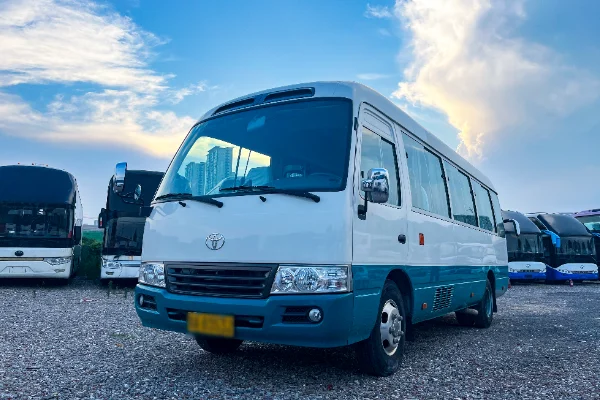
23 seats means 22 passengers and one driver.
The figure of 23 includes the person at the wheel — not obvious from the model name, most listings, or the quotations three suppliers send for the same vehicle. Get it wrong and you order a bus that seats one fewer paying passenger than your route needs.
The specification has the same problem. Under one model name, Toyota and its distributors sell a 4.2 L mechanical diesel, a 4.0 L common-rail diesel, a 2.8 L or 3.0 L common-rail diesel, and two petrol engines. Bodies come from Japan or from Toyota’s Chengdu plant, and several Chinese manufacturers sell lookalikes under the same name.
- 22 + 1
- Passengers + driver
- 2.8–4.2 L
- Diesel engine range
- Japan / Chengdu
- Body origin
- Lookalikes
- Chinese clones exist
One model name covers several engines, two body origins and Chinese lookalikes. Confirm the seat count, engine code and build origin on the specific unit before you buy.
Toyota Coaster 23 Seater Bus Specifications
Figures drawn from Toyota’s distributor sheet for the HZB70 series, the version most often exported with the 1HZ diesel. Figures vary by market and model year — confirm the individual unit.
| Specification | LWB, 23 Seats | SWB, 17–22 Seats |
|---|---|---|
| Length | 6,990 mm | ~6,250 mm |
| Width | 2,080 mm | 2,080 mm |
| Height | 2,635 mm | 2,635 mm |
| Wheelbase | 3,935 mm | 3,935 mm |
| Gross Vehicle Weight | 5,670 kg | 5,330 kg |
| Kerb Weight | 3,605–3,660 kg | 3,325–3,460 kg |
| Payload Allowance | ~2,010 kg | ~1,870 kg |
| Fuel Tank | 95 L | 95 L |
| Tyres | 215/70 R17.5 | 215/70 R17.5 |
Payload is the number that matters for luggage and a full load of passengers. Twenty-two adults at 80 kg is 1,760 kg before anyone brings a suitcase.
01
Engines — Diesel
One model name covers several diesel engines. The 1HZ 4.2 is the naturally aspirated workhorse for Gulf, Africa and Pacific export — slower and thirstier, but tolerant of variable fuel and repairable without a diagnostic computer.
- 1HZ: 4,164 cc inline-6, ~96 kW, 280–285 Nm, 5-speed manual.
- N04C: 4,000 cc inline-4, 100 kW / 353 Nm, 5-speed manual — South Africa 4.0D.
- 1GD-FTV: 2,754 cc inline-4, 110 kW / 420 Nm, 6-speed automatic — South Africa 2.8D GL.
- 3GD-FTV: 3,000 cc inline-4, automatic — Japan from January 2026.
02
Engines — Petrol & Chassis
Two petrol engines appear in export and domestic markets. Running gear is conventional throughout: double wishbone front suspension, leaf springs at the rear, ventilated discs at the front and drums at the rear.
- 2TR-FE: 2,698 cc inline-4, ~110 kW / 235 Nm, 5- or 6-speed manual — Gulf and Southeast Asia.
- 9GR: 4,000 cc petrol V6, ~151 kW, 5-speed manual — China domestic, FAW-built.
- Body: automatic folding centre door, front and rear air conditioning with heater.
03
Payload, Luggage & Speed
The 23-seat layout leaves approximately 2,010 kg of payload on the long wheelbase. Most markets limit top speed to about 100 km/h.
- Payload reality: 22 adults at 80 kg already use 1,760 kg.
- Luggage: budget the remaining ~250 kg before suitcases.
- Before you buy: confirm the seating drawing, engine code and payload on the individual unit.
Get the Specification Sheet for the Unit You Are Considering
Send the engine code and destination port. Receive a confirmed offer, typically within about 24 hours.
Which Engine Belongs in Your Coaster?
A Toyota Coaster 23 seater diesel bus is bought for its engine as much as its seats — and the engine is the specification most often left out of a listing. The right choice depends less on model year than on the fuel your market supplies and who repairs the vehicle.
| Factor | 1HZ 4.2 Diesel Mechanical Injection | Common-Rail Diesel N04C · 1GD · 3GD |
|---|---|---|
| Fuel Tolerance | Tolerates variable, high-sulphur fuel | Dislikes water, dirt and high sulphur |
| Repair Complexity | No ECU, no diagnostic laptop required | Needs diagnostics and specialist injector work |
| Reported Service Life | 400,000–500,000 km with ordinary maintenance | Long, but sensitive to fuel quality |
| Performance & Economy | Slow, ~12–15 L/100 km loaded | Stronger torque, quieter, more efficient |
| Repair Cost | Lower; independent workshops can handle it | Higher; pump and injector work is expensive |
The 1HZ 4.2 Diesel
A naturally aspirated inline-six with mechanical injection, no turbocharger and no engine control unit. That simplicity is why it survives: it tolerates fuel that would damage a common-rail engine, and can be repaired without a diagnostic laptop.
The Common-Rail Diesels
The N04C, 1GD and 3GD are more efficient, quieter and stronger on torque — the 1GD in the South African 2.8 D GL delivers 420 Nm from 1,400 rpm. The trade is sensitivity: injectors and pumps dislike water, dirt and high-sulphur fuel, and repairs cost far more.
The Petrol Options
The 2TR 2.7 is quiet and cheap to buy but expensive to run at 14–18 L/100 km; the 9GR 4.0 V6 in the FAW-built unit is thirstier again. Petrol Coasters suit low-mileage shuttle work and markets where diesel supply is unreliable — rarely intercity operators.
Emission Rules Decide Registration
Emission standards decide whether a used unit can be registered at all. Euro II units still move freely into some African markets and are refused by others. Confirm the rule at your destination before you choose the vehicle, not after it lands.
CHOOSE THE 1HZ
Markets with variable fuel and independent workshops, where repairability matters more than refinement and the vehicle rarely needs to hold speed on a grade.
CHOOSE COMMON-RAIL
Markets with clean fuel and a dealer network, where torque, quietness and fuel efficiency justify the higher repair cost if something goes wrong.
Where the 23 Seater Works — and Where It Does Not
The Toyota Coaster 23 seater is a route tool, not a universal bus. It earns its place on narrow access, paved roads and moderate loads — and struggles where luggage or gradients dominate.
01
Airport, School & Staff Transport
Short, scheduled runs where the 23-seat body fits narrow access roads and site entrances that a full-size coach cannot use.
- Airport transfers Suits moderate luggage on short runs.
- School & staff transport Fits narrow access and site gates.
- Payload check 22 adults at 80 kg already uses 1,760 kg of the ~2,010 kg allowance.
02
Intercity Shuttle & Tourism
Paved-road shuttle work and small-group touring, where the driver also acts as guide and the route does not demand a full-size coach.
- Intercity shuttle Suited to paved roads and moderate distances.
- Tourism Works where the driver doubles as guide.
- Pace 100 km/h limiter sets the pace on long highway legs.
03
Where It Struggles
Three limits are built into the design. Know them before you put the bus on a route it cannot serve well.
- Luggage-heavy runs Rear bay is small once the bench is fitted.
- Steep gradients at gross weight Especially slow with the 1HZ engine.
- Drive layout Rear-wheel drive only — not an all-weather 4×4.
What Drives the Price of a Toyota Coaster 23 Seater Bus?
There is no published export price. A used Toyota Coaster 23 seater in this class is priced on six things, and any quotation you receive should reflect all six.
-
Year, Generation & Engine Family
A 2024 Japanese unit and a 2012 unit share a name and little else. The 1HZ carries a premium in Africa because it is repairable; common-rail units cost more new and less to run.
-
Steering Side & Trim
Left-hand drive suits most of Africa and Latin America; right-hand drive serves East Africa, Southeast Asia and the Pacific — the wrong side is a stranded asset. Luxury and executive trims with reclining seats and carpet carry a real premium over the standard PVC-trim school specification.
-
Emission Standard
A Euro IV unit may be worth less than a Euro II unit in one market and more in another. The tier decides whether the bus can be registered at your port, so confirm the destination rule before you compare prices.
-
Condition, Documents & Market Reference
Rust, engine hours and air-conditioning health outweigh mileage, and a complete service history is worth paying for. Used export units commonly trade between USD 13,000 and 20,000; a new FAW-built petrol unit sits around USD 73,000 FOB.
Get a Quote for the Unit You Are Considering
Retail prices in the Gulf run from AED 217,000 to AED 248,000, and South African list prices from R899,900 to about R1.2 million. Those are market references, not our quotation. Send the steering side, engine family and destination port for a per-unit quote.
Buying and Importing a Used Toyota Coaster
A used Coaster is one of the more predictable second-hand vehicles to buy — provided somebody actually looks underneath it before the balance is paid.
What Fails on a Used Coaster
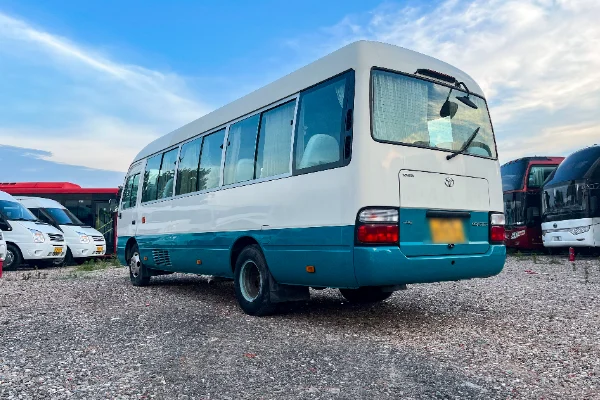
These four items account for most of the money spent after delivery. Inspect them at operating temperature, not at idle.
- Rust at spring hangers, sills, underfloor, wheel arches and roof gutters
- Cooling system: radiator core, hoses, water pump and coolant condition
- 1HZ injection pump and injectors: hard starting, white smoke, uneven idle
- Automatic centre door rollers and air conditioning under load
Documents, Seat Count & Shipping
Check that the seat count on the registration matches the physical layout, and that the engine number on the plate matches the engine. A mismatch is a registration problem at destination, not a negotiation point.
- Documents
- Commercial invoice, bill of lading, certificate of origin, packing list, plus the inspection report and the emission paperwork your market requires.
- Shipping
- Coasters move by container, flat rack or RoRo depending on the route. Transit time is route-dependent and confirmed with your quotation.
Getting a Toyota Coaster to Your Port, and Keeping It There.
Choose the shipping method, confirm the document set, and plan parts before the bus leaves — not after it lands.
Container or Ro-Ro
A 6,990 mm Coaster normally ships as one unit per 40 ft high-cube container, or on a Ro-Ro vessel when several vehicles move together.
Confirm the method before you plan deliveryDocuments & Destination Rules
Bill of lading, certificate of origin, commercial invoice and packing list. Confirm destination requirements early — some markets add pre-shipment inspection, age limits or emission rules.
Checked before the order is placed1HZ Parts Are Widely Stocked
The 1HZ shares its heritage with the Land Cruiser, which is why many operators choose the Coaster. Consumables are widely stocked outside the Toyota network; common-rail parts are less universal.
Repairable beyond the dealer networkTell Us If Parts Arrive Slowly
If parts arrive slowly in your market, say so before we specify. Container loading protects the body and lets parts travel with the unit. More detail sits in shipping and delivery support.
Planned before the bus leavesToyota Coaster 23 Seater Bus FAQ
Answers to common questions about seating, production, engines for African conditions, pricing, importing from China, spotting copies, and fuel consumption. Need help with a specific unit? Contact our team.
1 Does the 23 seater include the driver?
Yes. A Toyota Coaster 23 seater has 22 passenger seats plus the driver — six single seats, six double seats, and a four-seat rear bench. Some market specification sheets count the front passenger instead, which leaves 21 paying seats. Confirm the seating drawing.
2 Is the Toyota Coaster still in production?
Yes. Hino builds it in Japan, and FAW Toyota builds a version in Chengdu — the only Coaster plant outside Japan. The Japanese model received a 3.0 L diesel and disc brakes in January 2026, and order books closed shortly afterwards because demand exceeded supply.
3 Which engine is best for African conditions?
The 1HZ 4.2 diesel, in most cases. It is slower and thirstier than a common-rail engine, but it tolerates variable fuel and can be repaired without a diagnostic computer. If your market has clean fuel and a Toyota dealer, the 1GD is the better vehicle.
4 How much does a Toyota Coaster 23 seater bus cost?
Used export units commonly trade between USD 13,000 and USD 20,000 depending on year, engine and condition. A new FAW-built petrol unit is listed around USD 73,000 FOB. Retail prices in the Gulf and South Africa run higher. Request a quotation per unit — the specification changes the price more than the year does.
5 Can I import a Toyota Coaster from China?
Yes, in two forms: a new FAW-built petrol unit, or a used Japanese or Gulf-specification diesel unit resold by a Chinese exporter. A new diesel Coaster cannot be bought from a Chinese factory, because Toyota does not build one there.
6 How do I tell a genuine Coaster from a Chinese copy?
Check the model code, the engine family, the badging, the glass and the price. Genuine codes are HZB70, HZB60 or GRB53, and genuine engines are Toyota units. A new 23-seat “Coaster” at half the market price is not a Coaster.
7 What is the fuel consumption?
The 1HZ uses roughly 12 to 15 L per 100 km loaded. The 2.7 petrol uses 14 to 18 L. Toyota publishes no official figure for the 1HZ version, so treat any specific number as an estimate from real use.
SEATS, FUEL, DRIVE SIDE, RULES
Request Your Toyota Coaster Quotation
Four answers decide the right Coaster for your route: how many paying seats you need, which fuel your market supplies, whether you need left- or right-hand drive, and what the destination rules allow. Send those four and we will tell you which version is available and what it costs to land.
We will also tell you plainly if the unit you want does
not exist in the specification you asked for. That
conversation is cheaper before the deposit than after
the container is sealed.
Request a Quotation
Start with your four answers.