
YUTONG ZK6107 44 Seater Bus 10.5 m Coach
44 seats is a layout, not a factory figure.
A 10.5 m coach approved for 24 to 51 seats. The 44-seat version is a 2+2 cabin with a chosen seat pitch, and in most export builds no centre door.
The model number covers a legacy Euro II to Euro V platform and a current export variant sold under different badging in different markets. Two coaches advertised as 44 seaters can differ by half a metre of body length, a whole emission standard, and tens of thousands of dollars in landed cost.
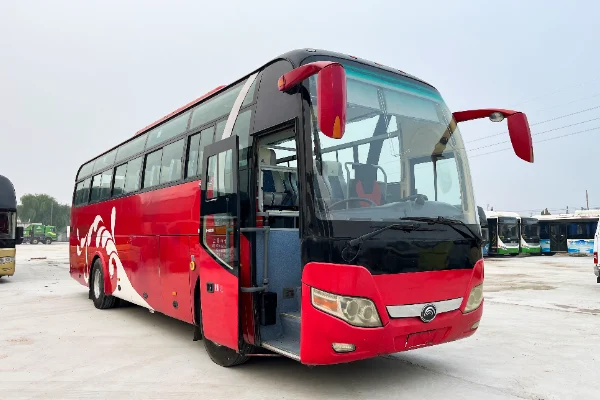
- 10.5 m
- Overall length
- 24–51
- Approved seat range
- 44
- Common 2+2 layout
- Euro II–V
- Emission platforms
The same model number covers a legacy Euro II to Euro V platform and a current export variant sold under different badging. Confirm the body length, emission standard and actual layout before comparing prices — 44 seats alone does not describe a bus.
YUTONG ZK6107 44 Seater Bus Specifications
Figures drawn from Chinese type-approval records and published catalogue data. They are ranges, not a single build sheet — confirm the exact figures against the unit you are buying.
| Specification | Figure |
|---|---|
| Overall Length | 10,490 mm · HQ 10,640 mm |
| Overall Width | 2,500 mm |
| Overall Height | 3,450–3,780 mm, by roof, A/C and gas tanks |
| Wheelbase | 5,250 mm · HQ 5,200 mm |
| Gross Vehicle Weight | 15,000–16,500 kg |
| Kerb Weight | 10,900–12,700 kg |
| Fuel Tank | 240–300 L |
| Luggage Volume | 5.0–6.5 m³ |
| Tyres | 11R22.5, six wheels |
Dimensions and weights vary by roof, air conditioning, gas tanks and seat count. Verify the individual unit before you commit.
01
Engine & Driveline
Most builds use a six-speed manual; the current ZK6107HQ offers a ZF six-speed automatic. Drive is 4×2 through a conventional rear axle. Emission runs from Euro II on the oldest units to Euro V on the newest, and the standard is stamped on the documentation — check it before you fall in love with a price.
- YC6A260-40 / YC6L260-42: 191 kW / 260 hp — the common intercity diesel.
- WP7.270E40: 199 kW / 270 hp — stronger hill performance.
- YC6J220-42: 162 kW / 220 hp — flat commuter routes only.
- Natural gas: YC6G260N-50, YC6L280N-52, WP7NG270E50, WP7NG210E50 — Euro V CNG and LNG.
02
Seating, Body & Luggage
Approved capacity is 24 to 51 seats, with some older variants to 60. The common export layout is 45+1+1. A 44-seat coach is a 2+2 build with a centre aisle and, in most builds, no centre door.
- 44 seats: a layout you specify, not a factory standard.
- Luggage: 5.0–6.5 m³, by build.
- Before you buy: measure the bay if your contract involves checked baggage.
03
Running Gear & Fuel Use
Suspension is leaf spring or air spring by build, and brakes are air with drum or disc depending on the build. Top speed is 100 km/h, with some export builds at 120 km/h.
- YC6A260-40: 16.6 L/100 km on the combined Chinese test cycle.
- Other rated variants: 20.4–22.4 L/100 km.
- Budget on: the low twenties for loaded intercity work, not the best published number.
Get the Specification Sheet for the Unit You Are Considering
Send the build year and destination port. Receive a confirmed offer, typically within about 24 hours.
Choosing the Right ZK6107 for Your Route
A coach specification is a route decision before it is a price decision. These four choices do most of the work.
01
Engine Size
The 220 hp options suit flat commuter and staff work where the coach rarely runs fully loaded at speed. For intercity routes with grades, specify 260 hp or above.
- 220 hp Flat commuter and staff routes.
- 260 hp or above Intercity routes with grades and full loads.
- Why it matters Holding fourth gear versus crawling in third while the gauge climbs.
02
Transmission, Retarder & Braking
A six-speed manual with a well-matched final drive is reliable and cheap to repair. On a used unit, what matters more is whether it has an engine brake or retarder.
- Long descents A loaded 15 t coach without one relies entirely on service brakes.
- Brake fade A real risk on mountain and hill routes.
- If your route has descents Specify the retarder or plan around it.
03
Suspension & Ride
Leaf springs are simple, durable and firm. Air suspension softens the ride and levels the body under load, at the cost of more components to maintain.
- Paved intercity Either leaf springs or air suspension is acceptable.
- Long unpaved approaches Air suspension earns its keep in comfort and reduced body fatigue.
- Maintenance Air adds components — check local support.
04
Emission, Drive Side & Livery
This is the choice that most often goes wrong. Several markets refuse Euro III outright; others require Euro IV or above. A cheap Euro III coach that cannot clear customs is not cheap.
- Destination rules Tell us the country and port — we confirm what the border accepts.
- Right-hand drive RHD builds exist and are common in parts of Africa and South Asia.
- Doors, trim & livery Specified at build or refurbishment; some cannot be changed later.
What Drives the Price of a YUTONG ZK6107 44 Seater Bus?
We do not publish a price for a model number, because the model number does not determine the price. When you find a ZK6107 listed at an unusually low figure, one of these factors is almost always the reason.
-
Year & Mileage
A 2014 unit with 500,000 km and a 2019 unit with 200,000 km are different purchases, whatever the badge says. Build year and verified odometer set the baseline before anything else is discussed.
-
Emission Standard
Euro V units cost more and clear more borders. Euro II and Euro III units are cheaper and increasingly hard to import. The tier decides whether the bus can be registered at your port.
-
Engine, Driveline & Interior
A 260 hp Yuchai with a retarder outsells a 220 hp build in most markets, and the price reflects it. A 44-seat tourist interior with recliners and a sound system is worth more than a 51-seat commuter fit-out in the same body.
-
Condition, Shipping & Destination
Accident repair, corrosion and a missing service record all move the number. Ro-Ro to a port with a direct service is cheaper than breakbulk to a port without one, and the landed cost — not the FOB figure — is what you actually pay.
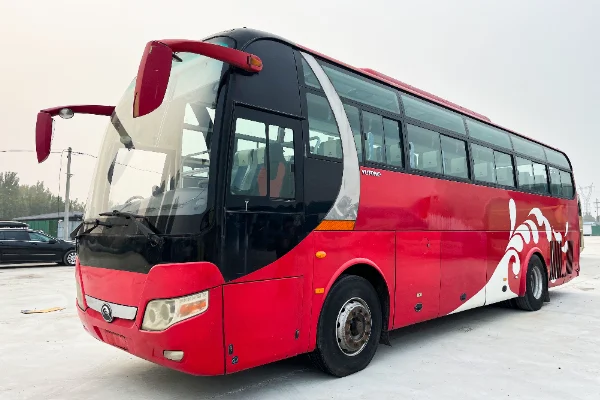
Get a Quote for the Unit You Are Considering
For context rather than a quotation: used 10.5 m coaches in this class generally change hands in the low-to-mid tens of thousands of US dollars FOB, with refurbished and newer units above that band. Treat any figure in a listing as a starting point for a conversation about a specific unit. Send your route and seat count and we will tell you which build and year make sense for the money — including the options not worth paying for.
Keeping a YUTONG ZK6107 on the Road
YUTONG is the largest Chinese bus manufacturer, and pattern parts for the ZK6107 are stocked by specialists across Latin America, Africa, the Middle East and Europe.
Parts That Are Catalogue Items
Door locks, brake components, Telma contactors, cooling parts and engine components are catalogue items rather than special orders. That is what keeps a ZK6107 serviceable outside China.
- Door locks & body hardware
- Brake components & linings
- Telma contactors & retarder parts
- Cooling parts & hoses
- Engine components & filters
Two Steps That Reduce Downtime
Both are cheap against the unit price and save weeks later. The risk is not the engine — it is a small part that no one locally stocks.
- Order a consumables kit with the unit
- Filters, belts, hoses, brake linings and a clutch kit, sized to your first year of operation.
- Identify the local supply route first
- Ask which part numbers are common in your market and which are not, and check that your workshop can source them. After-sales support covers parts sourcing and technical questions after delivery.
Buying and Shipping a YUTONG ZK6107 from China
Confirm the unit before shipment, agree the document set before the order is placed, then plan transport for your destination port.
Pre-Shipment Inspection
Every unit is inspected before shipment, with photos, video and a written report supplied before the balance is paid. The scope covers the chassis and body, corrosion at wheel arches and luggage bay floor, seat frames, air conditioning and electrical systems.
Reviewed before you payWhere the Money Goes
Fleet studies of YUTONG coaches put brakes, generator, clutch and cooling at the top of unscheduled repairs. The inspection concentrates there: linings, drums, air valves and retarder; clutch slip and shift quality; radiator, hoses and fan drive; charging system.
The four items that fail firstDocuments You Should Receive
Bill of lading, certificate of origin, commercial invoice and packing list, plus the inspection report and the vehicle documentation that supports the emission standard and build year. If a seller cannot produce the emission paperwork, treat the stated standard as unverified.
Paperwork before the vessel sailsShipping Method
A 10.5 m coach does not fit a standard container. Ro-Ro is the normal method to ports with a direct service, and breakbulk is the alternative where Ro-Ro is unavailable or the schedule does not work.
Confirmed against your portYUTONG ZK6107 44 Seater Bus FAQ
Answers to common questions about seating, production status, engines, fuel use, luggage space, the C10 comparison, right-hand drive and spare parts. Need help with a specific unit? Contact our team.
1 How many seats does a YUTONG ZK6107 have?
Between 24 and 51 depending on the variant and layout, with some older builds approved for up to 60. A 44-seat coach is a specific 2+2 build, not a factory standard.
2 Is the YUTONG ZK6107 still in production?
The classic H-generation coaches are a legacy platform, and at least one variant is marked discontinued in Chinese records. A current ZK6107HQ is still listed as new in some markets, so ask for the build year rather than a yes or no.
3 What engine is in a YUTONG ZK6107?
Most units carry a Yuchai YC6A260-40 at 191 kW, a Yuchai YC6L260-42, or a Weichai WP7.270E40. Natural gas versions use the YC6G260N-50, YC6L280N-52 or WP7NG270E50.
4 What is the fuel consumption of a YUTONG ZK6107?
The YC6A260-40 records 16.6 L/100 km on the combined Chinese test cycle, and other rated variants sit between 20.4 and 22.4 L/100 km. Expect the low twenties in loaded intercity work.
5 How much luggage space does a 44-seat coach have?
Between 5.0 and 6.5 m³ depending on the build, with the HA tourist variant at the top of the range. Measure the bay if your contract involves checked baggage.
6 What is the difference between the ZK6107 and the YUTONG C10?
The ZK6107 is a 10.49 m coach approved for 24 to 51 seats. YUTONG Australia’s C10 is 9,985 mm with 43+1 seats and a Euro VI Cummins, so it carries a similar passenger count in a shorter, denser body.
7 Can I get a right-hand-drive ZK6107?
Yes, right-hand-drive builds exist and are common in parts of Africa and South Asia. Confirm the drive side in writing on the specific unit, because it cannot be changed after build.
8 Are spare parts available for the ZK6107?
Yes. Pattern parts are widely stocked outside China, and the main consumables are catalogue items. Order a first-year kit with the unit and check the local supply route before delivery.
VARIANT, LAYOUT, EMISSION
Request Your YUTONG ZK6107 Quotation
Send your route, seat count and destination port. We will confirm what is available, send the specification and photographs of the actual unit, and hold the shipment until you have the inspection report in hand.
Three decisions shape a 44-seat ZK6107 purchase: which
variant you are buying, how the 44 seats are laid out,
and which emission standard your destination accepts.
Get those right and the price conversation becomes
simple. Get them wrong and a cheap coach becomes an
expensive one at the port.
Request a Quotation
Start with your route, seat count and port.