
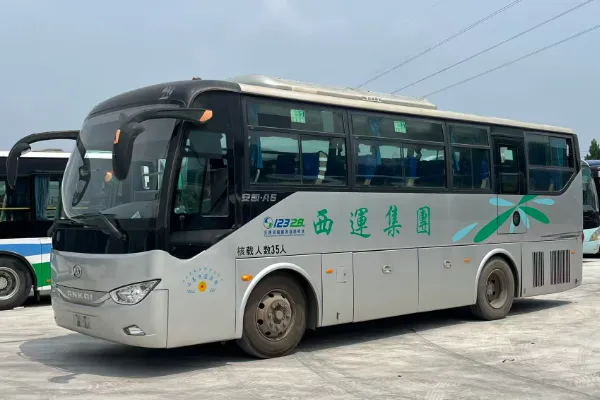
ANKAI 6909 Bus 9m Mid-Size Coach
A 9-meter coach sized for intercity feeder, staff, and commuter routes.
The ANKAI 6909 — model code HFF6909 in the A6 series — is a 9-meter mid-size coach with 24 to 40 seats and Yuchai or Weichai diesel engines matched to your market’s emission standard.
Built for routes where a 12-meter coach is more bus than the job needs: lower fuel burn, a tighter turning circle, and a lower gross vehicle weight. Every unit is inspected before shipment and quoted to your configuration.
- 8,990 mm
- Overall length
- 24–40
- Seating capacity
- 245 HP
- Engine power
- 100 km/h
- Top speed
Typical export build: approximately 13,400 kg GVW, 24–40 seats. Specifications vary by emission variant and seating layout. Confirm local fuel quality and registration rules before ordering.
ANKAI 6909 Bus Specifications
The figures below describe a typical export build. Individual units vary by emission variant, seating layout, and destination-market requirement — every quotation is prepared per configuration.
| Specification | Typical Export Build |
|---|---|
| Overall Length | 8,990 mm |
| Width | 2,500 mm |
| Height | 3,405 mm (3,285 mm without roof A/C) |
| Wheelbase | 4,300 mm |
| Front / Rear Overhang | 1,900 / 2,790 mm |
| Gross Vehicle Weight | 13,400 kg (Euro V) / 12,900 kg (China VI) |
| Curb Weight | 9,250–9,500 kg |
| Seating | 24–40 seats (37+1 and 39+1+1 common) |
| Engine | Yuchai YC6J245-50, Weichai WP7.270E53, Yuchai YCS06270-62 (China VI) |
| Emission Standard | Euro III / Euro IV / Euro V / China VI |
| Transmission | Manual (QJ805) |
| Suspension | Leaf spring (air suspension optional on China VI) |
| Brakes | Dual-circuit air brakes with ABS, automatic gap adjustment |
| Steering | Power steering |
| Tyres | 10R22.5 |
| Fuel Tank | 200 L |
| Top Speed | 100 km/h |
Typical values only. Confirm the final configuration, seating layout, and compliance in your quotation.
01
Engine & Drivetrain
The 6909 runs on Yuchai or Weichai diesel engines paired with a QJ805 manual transmission. The typical export build uses the Yuchai YC6J245-50 (180 kW / ~245 hp, 890 N·m) or the Weichai WP7.270E53 (about 270 hp).
- Power options: Yuchai YC6J245-50, Weichai WP7.270E53, or Yuchai YCS06270-62 on China VI builds.
- Gearbox: QJ805 manual — simple, serviceable, and well-supported in export markets.
02
Dimensions & Weight
At 8,990 mm long with a 4,300 mm wheelbase, the 6909 is sized to work city streets, feeder roads, and tight terminals that a 12-meter coach struggles with. GVW is about 13,400 kg on the Euro V build, or 12,900 kg on China VI.
- Overall dimensions: 8,990 × 2,500 × 3,405 mm (3,285 mm without roof A/C).
- Body construction: semi-monocoque — the appropriate construction for a mid-size coach, giving good rigidity without the weight of a full 12-meter build.
03
Emission & Configuration
The 6909 is available in Euro III, Euro IV, Euro V, and China VI standards. The right choice depends on local fuel quality, not the badge on the engine — a China VI unit needs the cleaner diesel that standard assumes.
- Seating layouts: 24–40 passengers, with 37+1 and 39+1+1 the most common builds.
- Suspension options: leaf spring as standard, with air suspension available on China VI builds.
Get the Specification Sheet for Your Build
Send your route, seat count, and destination port. Receive a configured offer, typically within about 24 hours.
ANKAI 6909 vs Yutong vs King Long 9m Coach
Most importers choosing a mid-size Chinese coach are really deciding between three brands: ANKAI, Yutong, and King Long. At the 9-meter size the choice is real, and it should be made on build quality, parts support, and your route — not on a catalogue photo.
| Factor | ANKAI 6909 Mid-Size Coach | Yutong / King Long 9m Coaches |
|---|---|---|
| Body Construction | Semi-monocoque coach body | Monocoque / semi-monocoque |
| Engineering Heritage | 1993 Kässbohrer (Setra) technology cooperation | Large-volume coach manufacturers |
| Engine Options | Yuchai, Weichai diesel | Yuchai, Weichai diesel |
| Emission Standards | Euro III–V, China VI | Euro III–V, China VI |
| Parts Network | Available — confirm lead times | Deeper local network in many markets |
| Price Position | Comparable range | Comparable range |
Build Quality
ANKAI has genuine coach-engineering lineage — its 1993 Kässbohrer cooperation made it the first in Asia to build a full-load-bearing coach body. The HFF6909 uses a semi-monocoque body that gives good rigidity without the weight of a full 12-meter build.
Scale & Parts
Yutong and King Long export in larger volumes, which in some African and Latin American markets translates into a deeper local parts picture. ANKAI parts are available, but confirm lead times for your country before you specify.
Engine & Emission
All three offer Yuchai and Weichai diesel options across Euro III–V and China VI, so the engine choice is less of a separator than the body, the build quality, and the parts network.
Price Position
A new ANKAI 6909 sits in a comparable range to a new Yutong or King Long 9-meter coach, with the difference reflecting build quality rather than the badge.
CONSIDER ANKAI
When build quality and ride matter most for a mid-size fleet, and coach-engineering heritage is a deciding factor for your route.
CONSIDER YUTONG / KING LONG
When a deeper local parts network is the deciding factor, and faster access to spares outweighs other considerations.
Seating, Route Type, and Emission Standard
Seating and emission are specification decisions that follow from the route — not afterthoughts bolted on at the end.
01
Seating Layout
The 6909 seats 24 to 40 passengers. A 37+1 layout with more legroom suits intercity and staff routes; a 39+1+1 layout squeezes more revenue seats onto a commuter or school run.
- 37+1 layout More legroom for intercity and staff routes.
- 39+1+1 layout Maximum revenue seats on commuter runs.
- Tell us the route Average journey length and fare structure.
02
Route Type
Match the body and seating to what you are moving. A 37+1 intercity build works point-to-point town routes; a 39+1+1 commuter build suits daily staff or school transport.
- Intercity feeder 37+1 with more legroom for longer journeys.
- Staff & school 39+1+1 for daily high-seat-count runs.
- Tourist & charter 37+1 with air suspension for ride quality.
03
Emission Standard
The emission standard has to match the diesel available in your market. A China VI unit with modern after-treatment needs the fuel quality that standard assumes — run it on high-sulfur diesel and the after-treatment clogs.
- Euro III / Euro IV The more serviceable choice where fuel quality limits after-treatment.
- Euro V The common export build for markets running Euro V-compatible diesel.
- China VI Adds air suspension and driver-assistance features — needs cleaner fuel.
Emission Variants: Which HFF6909 You Are Pricing
The “ANKAI 6909” label covers several emission-era variants. The right one depends on the fuel quality and registration rules in your market.
-
HFF6909KD1E5B (Euro V)
The common export build, powered by the Yuchai YC6J245-50 (180 kW, roughly 245 hp, 890 N·m) or the Weichai WP7.270E53 (about 270 hp). This is the unit most importers specify for markets running Euro V-compatible diesel.
-
HFF6909KD1E6B (China VI)
The newer build with the Yuchai YCS06270-62 (199 kW, 6,234 mL) and a lower combined fuel consumption around 18.6 L/100 km. It also adds options like air suspension, intelligent start-stop, and driver-assistance features. It needs the cleaner diesel that China VI assumes — not the right spec for every market.
-
HFF6909KD1E4B (Euro IV) & Euro III
Earlier variants, still specified where the destination accepts Euro III or Euro IV and where fuel quality limits after-treatment reliability. The engine and after-treatment change with each variant — that choice belongs to your destination country and fuel quality.
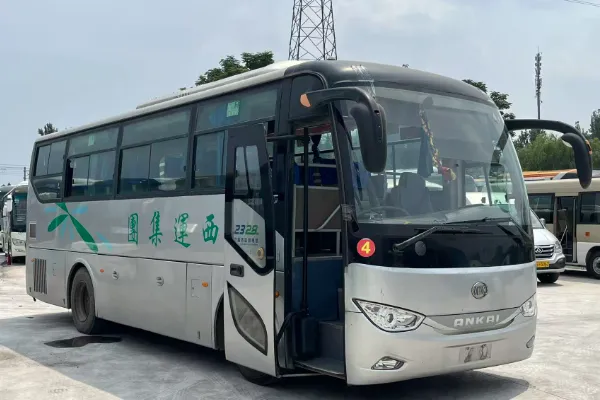
Get a Quote for Your Configuration
Reference pricing: new ANKAI 6909 buses list in the region of USD 40,000–62,857 before shipping, depending on the emission variant and seating layout. Your figure depends on the variant, layout, emission standard, and destination port. Send your route, seat count, and destination port for a configured quotation, typically within about 24 hours.
Buying and Shipping an ANKAI 6909 Bus from China
Buying a passenger bus through a China-based exporter carries the same question as buying a truck: what exactly are you getting, and how do you know the unit in the shipment is the one you approved?
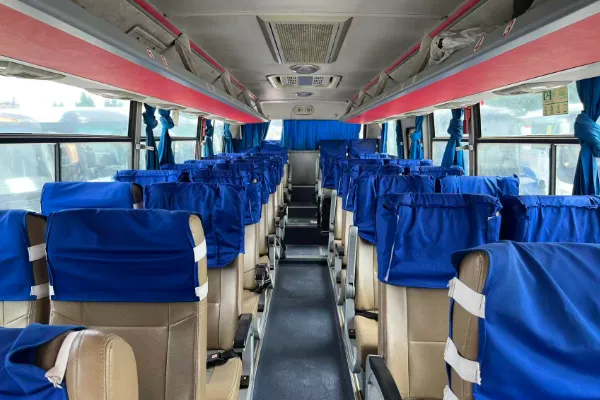
You See the Unit Before You Pay
The single biggest fear in cross-border bus buying is receiving a different unit than the one you inspected. That does not happen here — every ANKAI 6909 bus passes a pre-shipment inspection, and the evidence is in your hands before the unit is sealed.
- Engine & transmission
- Axles & brakes
- Body & chassis
- Lighting & ordered options
- Export documentation
Shipping & Export Paperwork
A mid-size coach typically ships by Ro-Ro or breakbulk, depending on the vehicle and port. We confirm the expected timeline with your quotation rather than promising a fixed date.
- Documents
- Commercial invoice, bill of lading, certificate of origin, packing list, and required compliance paperwork.
- Transit Time
- Route-dependent. The expected timeline is confirmed with your quotation.
New vs Used
Used Chinese 9-meter coaches commonly list well below new pricing, while a new ANKAI 6909 sits in the region of USD 40,000–62,857 before shipping, depending on the emission variant and seating layout. We supply both new and used, inspected to the same standard, so the decision is made on your capital budget and route.
Why Choose a 9-Meter Coach Over a 12-Meter Bus?
The first decision is not brand — it is size. A 9-meter coach and a 12-meter coach are different vehicles for different routes, and buying the wrong size costs you money every month in fuel and maintenance.
Fuel Consumption
A lighter 9-meter unit with a smaller Yuchai or Weichai engine simply burns less diesel than a 12-meter coach on the same route. On a route that does not fill a 12-meter bus, that difference is pure operating cost saved.
Lower fuel burn per tripTurning Circle & Maneuverability
At 8,990 mm and a 4,300 mm wheelbase, the ANKAI 6909 works city streets, feeder roads, and tight terminals that a 12-meter coach struggles with.
Fits tight streets and terminalsGross Vehicle Weight
At about 13,400 kg GVW against 17,500 kg or more for a 12-meter coach, the 9-meter unit carries a lower registration, axle, and road-wear profile in many markets.
Lower registration burdenRight-Sizing the Fleet
A 24–40 seat coach matches commuter, staff, and school routes that never need 45+ seats. When a route genuinely fills 45 to 55 seats every trip, step up to a 12-meter ANKAI coach instead.
Sized to the route, not the badgeANKAI 6909 Bus FAQ
Answers to common questions about pricing, seating, emission standards, and shipping. Need help with your configuration? Contact our team.
1 How much does an ANKAI 6909 bus cost?
There is no fixed price, because the emission variant, seating layout, and destination port all change the figure. As a reference, new ANKAI 6909 buses list in the region of USD 40,000–62,857 before shipping, while used 9-meter coaches run much lower. Your quotation is prepared per configuration — send your route, seat count, and destination port for a figure, typically within about 24 hours.
2 How many seats does an ANKAI 6909 bus have?
Depending on the layout, the ANKAI 6909 seats from 24 to 40 passengers. The common configurations are 37+1 and 39+1+1. The right count depends on your route and fare structure — a 37+1 layout suits comfort-led intercity work, while a 39+1+1 layout maximises seats on a commuter or school run.
3 What is the difference between the ANKAI 6909 and a 12-meter ANKAI coach?
The ANKAI 6909 is a 9-meter mid-size coach with 24–40 seats; a 12-meter ANKAI is a full-size coach with 45–55 seats. The 9-meter unit burns less fuel, turns tighter, and carries a lower gross vehicle weight, which makes it right for intercity feeder, staff, and commuter routes. The 12-meter unit is the choice for long-distance, high-capacity routes.
4 What emission standards are available on the ANKAI 6909 bus?
The ANKAI 6909 is offered in Euro III, Euro IV, Euro V, and China VI (National VI) standards depending on the variant. The right standard depends on your local fuel quality — a China VI unit needs the cleaner diesel that standard assumes, so a Euro III or Euro V build is often the more serviceable choice.
5 Are ANKAI bus spare parts available outside China?
Yes, but availability varies by country, so lead times should be confirmed before you specify. ANKAI parts are supplied through export channels, and Amigo Truck provides original spare parts and after-sales support after delivery. For markets where Yutong or King Long have a deeper local network, that difference can be the deciding factor.
6 How long does it take to ship an ANKAI bus from China?
Transit time varies by route and shipping method — a mid-size coach typically ships by Ro-Ro or breakbulk. We confirm the expected timeline with your quotation rather than promising a fixed date.
CONFIGURED FOR YOUR ROUTE
Request Your ANKAI 6909 Quotation
Send your route, seat count, destination port, and local fuel quality. Receive a configured quotation, typically within about 24 hours.
Review your bus on video before shipment,
with export paperwork prepared for your destination.
Request a Quotation
Start with your route and seat count.