
KOMATSU PC450
45-TON CRAWLER EXCAVATOR
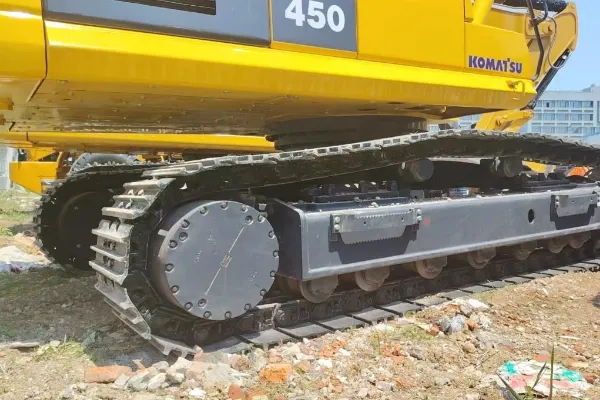
Inspection photos, video, and report before payment
USED EQUIPMENT · VERIFIED CONDITION
Komatsu PC450 Excavator
A 45-Ton Digger for Mining, Quarrying & Mass Excavation
A 45-tonne-class crawler excavator from Komatsu for mining, quarrying, and mass excavation — the largest model in the Komatsu line and a production machine built to load haul trucks. In the export market it is almost always sourced as a used machine.
- 45-Ton Class
- Crawler excavator
- Largest Model
- In the Komatsu line
- Six-Figure Repair
- Undercarriage & hydraulics
- Condition Rules
- Inspect before you pay
Reference specifications from the supplied overview. Confirm the serial number, engine, attachments, and actual condition in your unit-specific quotation.
Komatsu PC450 Excavator Specifications
The table below gives representative specifications for the Komatsu PC450. Because used machines vary with age, hours, and maintenance, the exact figures are confirmed per unit against the machine you are buying, not ordered from a fixed sheet.
Operating Weight, Engine, and Bucket
The PC450 runs at roughly 44.5 to 46 tonnes operating weight, which is what puts it in the 45-tonne class. The engine is a Komatsu SAA6D125E inline-six diesel in the 340 to 360 HP range — a proven power unit with a deep parts network across the used market, which matters more than the headline rating. On a production machine that earns by the hour, an engine that can be serviced in the field is worth more than a few extra horsepower.
Bucket capacity runs roughly 2.0 to 2.5 m³ depending on the attachment and the material. That is the number that separates a 45-tonne machine from a 40-tonne one in practice: the bigger bucket fills a haul truck in fewer passes, and the extra breakout force digs through the hard, abrasive ground that mining and quarry work throws at it. The right bucket is matched to your material — a rock bucket with a heavy-duty shell for shot rock, a general-purpose bucket for looser spoil.
Dig Depth, Undercarriage, and Stability
The PC450 digs to roughly 8,000 mm, enough for deep quarry benches, bulk excavation, and loading from depth without constant repositioning. The crawler undercarriage — with the LC long-carriage variant common on this class — is the detail that keeps the machine stable as the loads grow: the longer track frame spreads the weight, so the excavator lifts and swings a full bucket without lifting the rear off the ground.
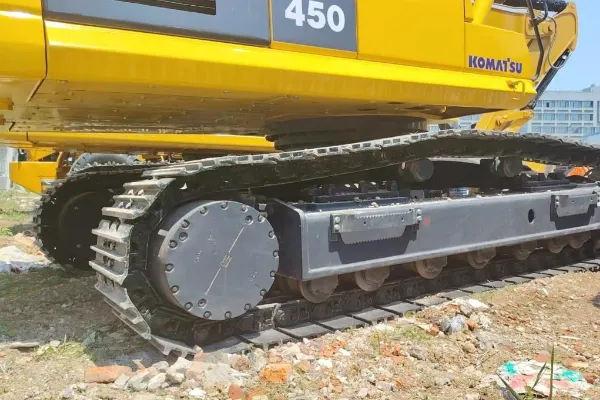
Steel tracks are standard on a machine of this size, because the ground it works on — rock, spoil, and hard-packed haul roads — would tear rubber tracks apart. Track condition and the undercarriage are two of the biggest factors in a used machine’s remaining life, which is exactly why the next two sections matter.
Technical Specifications
| Specification | 45-tonne class (confirm per unit) |
|---|---|
| Operating weight | roughly 44.5–46 t |
| Engine | Komatsu SAA6D125E diesel, roughly 340–360 HP |
| Bucket capacity | roughly 2.0–2.5 m³ |
| Max dig depth | roughly 8,000 mm |
| Undercarriage | crawler (LC long-carriage variant common) |
| Tracks | steel |
| Hydraulic system | axial piston pumps, pilot controls |
Confirm the specifications of the actual unit.
Figures vary with configuration, region, and model year, and marketplace listings may conflict. Use this table as a reference—not a serial-specific specification sheet. Verify the engine, attachments, and measurements before buying.
Need a specification sheet for a particular machine? Send the serial number or your requirements. We typically respond with a unit-specific offer within about 24 hours.
Request a QuotationWhat a 45-Ton Komatsu PC450 Is Good For
Built for mining, quarrying, and mass excavation. Sized to load haul trucks and keep production moving.
What the Komatsu PC450 Excavator Is
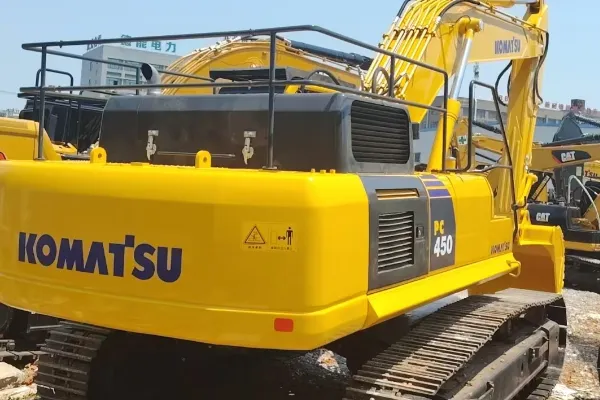
A 45-tonne-class crawler excavator built by Komatsu — one of the two dominant premium excavator brands in the world. It sits at the heavy end of the line, built for production, not general construction.
BRAND POSITIONING
Premium Brand, Largest in the Line
Built by Komatsu — the Japanese manufacturer that, alongside Caterpillar, dominates the premium excavator market. It is the largest excavator in Amigo Truck’s Komatsu line, sitting above the 13-tonne PC130, 22-tonne PC220, and 40-tonne PC400LC.
- One of the two dominant premium brands.
- Largest in the Komatsu line.
- The step up from the 40-tonne PC400LC.
Built for
Heavy production and mass excavation, rather than
general construction.
MODEL NAMING
What “PC450” and the Dash-Series Mean
The “PC” prefix is Komatsu’s crawler-excavator naming, and the “450” is the size designation — substantially bigger and heavier than a PC220. The dash-series generation (e.g., “-7” or “-8”) varies by build year and market.
- “PC” = crawler excavator.
- “450” = size class.
- Dash-series varies by build year and market.
Watch for
Confirm the exact generation, hours, and configuration
per unit rather than against a fixed sheet.
SIZE CLASS & VALUE
The Honest Heavy End
A machine this size digs deeper, breaks out harder ground, and carries a bucket large enough to load a haul truck in a few passes. For mass excavation and truck loading, the PC450 is the step up that pays for itself in cycle time.
- Digs deeper and breaks out harder ground.
- Loads haul trucks in fewer passes.
- Pays for itself in reduced cycle time.
Watch for
Matching the machine to your production target, not just
buying the biggest unit available.
Inspect the Actual Unit, Not Just a Listing Photo
Review photos, video, and a written inspection report of the exact machine before shipment.
PC400LC vs PC450 When to step up to 45 tonnes
The most common question we get is whether the PC450 is worth the step up from the 40-tonne PC400LC. The honest answer is that it depends on the production target, not on the model name.
Comparing the 40-Tonne and 45-Tonne Classes
The PC450 steps up from the PC400LC with a larger bucket, more breakout force, and slightly deeper reach. Both are production machines, but the 45-tonne class is built to keep larger haul trucks loaded in the hardest ground.
| Specification | Komatsu PC400LC 40-tonne class | Komatsu PC450 45-tonne class |
|---|---|---|
| Role | Heavy earthmoving, quarrying | Mining, mass excavation |
| Bucket | roughly 1.9–2.3 m³ | roughly 2.0–2.5 m³ |
| Dig depth | roughly 7,700 mm | roughly 8,000 mm |
| Best fit | Quarry benches, heavy construction | High-production loading, hard material |
Choose the PC400LC when your work is heavy earthmoving and quarrying at a solid production pace, and the 40-tonne size is already enough for your haul trucks. Step up to the PC450 when the material is harder, the benching is deeper, or you need the bigger bucket and extra breakout force to keep the trucks loaded — the extra capacity pays for itself in cycle time.
SIZE CLASS UPGRADE
PC400LC
PC450
40-Tonne to 45-Tonne
When the Extra Capacity Pays for Itself
Moving up to the PC450 is not about buying the biggest machine; it is about matching the machine to your haul fleet and material. The larger bucket and extra breakout force fill trucks in fewer passes, reducing cycle time in hard rock and deep benches.
Tell us your material, hourly production target, and the size of your haul trucks, and we will tell you straight whether the PC400LC or the PC450 is the right fit for your operation.
Buying a Used Komatsu PC450
This is the section most listings leave out, and on a 45-tonne Komatsu it is the most important one. A premium brand attracts two kinds of trouble — gray-market and re-badged units — and on a machine this size, a missed fault in the undercarriage or hydraulics is a six-figure repair in your first season.
SERIAL NUMBER CHECK
Verify Genuine Komatsu
Every genuine Komatsu carries a serial number stamped into the frame and printed on the machine plate, and the two must match each other and the documentation. A mismatch, a re-stamped plate, or a fresh coat of paint over the frame stamp is a red flag.
Gray-Market & Re-Badged Risks
A gray-market Komatsu is a genuine machine built for one region and imported into another without the proper documentation or correct emission configuration. A re-badged unit is often an older or smaller machine dressed up to carry a premium name.
- Verify the serial number on plate, frame, and papers.
- Engine hours vs. documented service history.
- Undercarriage: track wear, sprockets, rollers, idlers.
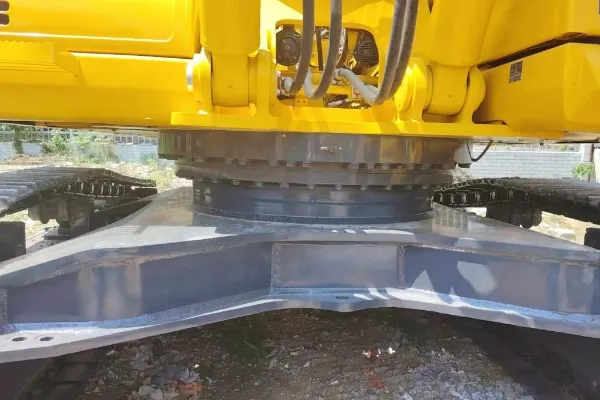
- Hydraulics: leaks, cylinder rod scoring, pin/bushing play.
Undercarriage & hydraulics carry the biggest risk.
On a 45-tonne machine, an undercarriage replacement is a major job, and the hydraulic system is the most expensive repair on any excavator. Insist on a pressure test and a walkaround, because they reveal wear a photo cannot.
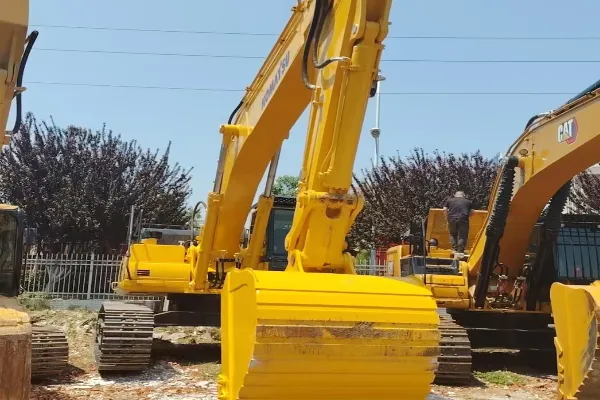
See the Machine Before You Pay
Buy a Komatsu only with the serial number, the documentation, and the machine’s history in front of you. Send us the serial number and destination port to review the inspection report together.
Komatsu PC450 vs a 40-tonne Cat
Buyers weighing a Komatsu PC450 often set it against a Caterpillar 340D2L, because both are premium 40–45-tonne production machines. The decision comes down to brand preference, local parts support, and which machine you can verify is genuine.
Komatsu PC450
The slightly larger, heavier machine, with more digging force and a bigger bucket for the hardest material.
- Class: 45-tonne
- Brand: Japanese
- Role: Mining, mass excavation
- Best fit: Heavy production, hard material
Key Strength
Cat 340D2L
A proven 40-tonne production machine with Caterpillar’s massive dealer and parts network behind it.
- Class & Brand
- 40-tonne / American
- Role
- Mining, quarrying, bulk earthmoving
- Best fit
- High-production operations
Buy What You Can Service and Verify
Both hold strong resale value, and both are premium brands that demand genuine-machine verification. The honest advice is to buy the one you can service locally and verify before you pay — brand loyalty is worth less than parts on the ground.
FREQUENTLY ASKED QUESTIONS
Komatsu PC450 Excavator FAQ
Answers about specifications, used pricing, authenticity, and size class comparison.
Ask About a Specific Unit1 What is the Komatsu PC450 excavator?
The Komatsu PC450 excavator is a 45-tonne-class crawler excavator from Komatsu, used for mining, quarrying, mass excavation, and heavy earthmoving. It is a production machine sized to load haul trucks, normally bought as a used machine on the export market.
2 How much does a Komatsu PC450 excavator cost?
There is no fixed price, because a used machine is priced by its age, engine hours, undercarriage condition, attachments, and preparation, plus freight to your destination port — and a premium Komatsu carries a premium over a comparable value brand. Price is quoted per machine and per route — request a quotation with your material, production target, and destination, and we will come back with a concrete figure.
3 What is the difference between the Komatsu PC400LC and the PC450?
The PC400LC is a 40-tonne machine for heavy earthmoving and quarrying, while the PC450 is a 45-tonne machine with more digging force, deeper reach, and a bigger bucket for mining and mass excavation. Step up to the PC450 when the material is harder or you need the extra capacity to keep your haul trucks loaded.
4 How do I tell if a used Komatsu excavator is genuine?
Check that the serial number on the machine plate matches the one stamped into the frame and the serial number on the documentation. A mismatch, a re-stamped plate, or a gray-market unit without proper import documentation is a red flag. Amigo Truck verifies the serial number on every Komatsu before it ships.
5 What size excavator do I need for mining and quarrying?
For mining and quarrying, a 40-tonne to 45-tonne machine such as the Komatsu PC450 is the workhorse class — big enough to bench hard rock and load haul trucks, without the cost of an even larger unit. Choose the exact size by your material, your haul trucks, and your hourly production target.
6 Can I buy a Komatsu PC450 excavator from China?
Yes. Amigo Truck supplies the Komatsu PC450 as a used machine with serial-number verification, 100% pre-shipment inspection, export documentation, shipping to your destination port, and genuine-parts support after delivery. Start with a quotation request and your project details.
VERIFY & INSPECT
Get a Verified Komatsu PC450, Inspected Before It Ships
The Komatsu PC450 excavator is a production decision before it is a price decision. Confirm the 45-tonne size is the right step, verify the machine is a genuine Komatsu, and get the undercarriage and hydraulic condition right — and the rest follows. On a premium used machine, that means seeing the serial number and the unit on video before anything ships.
- Confirm 45-tonne size
- Verify genuine Komatsu
- Inspect undercarriage & hydraulics
Amigo Truck has supplied heavy equipment and trucks to more than 100 countries over 15+ years, serving over 5,000 international customers. Share your project details and destination port.
A Quote for a Specific Unit
Serial number, photos, video, and inspection report
Quotation typically within about 24 hours