
MAN 4×2 Tractor Unit
Single-drive-axle prime movers, 330–640 HP.
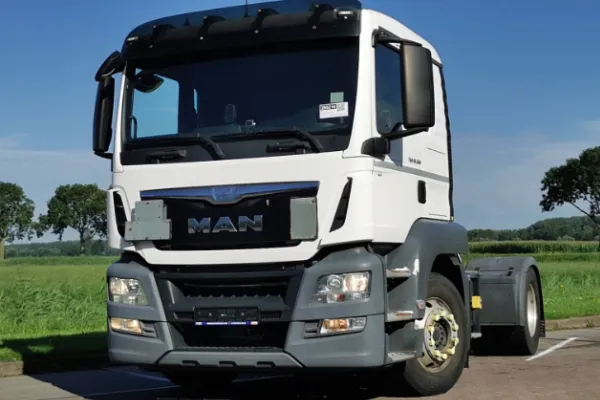
Premium German tractor heads in two ranges — the TGX for long-haul line work and the TGS for regional distribution. Both run MAN six-cylinder engines and MAN TipMatic, on a lighter chassis that burns less fuel and leaves more GVW for payload.
Every unit is configured to your route, fuel quality, and destination market, then inspected before shipment and quoted to your specification.
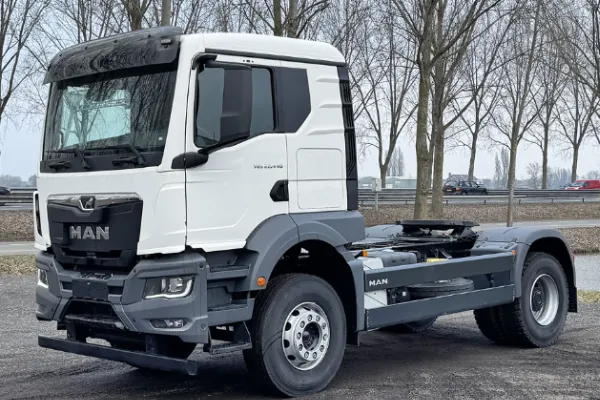
- 330–640 HP
- Engine output range
- 4×2
- Drive configuration
- ~44–50 t
- Gross combination weight
- TGX / TGS
- Model lines
Typical export builds at about 18,000–21,000 kg GVW. Specifications vary by engine, cab, and axle ratio. Confirm the final configuration in your quotation.
MAN 4×2 Tractor Unit Specifications
The figures below describe typical export builds. Individual units vary by engine, axle ratio, and destination-market requirement, which is why every quotation is prepared per configuration.
| Attribute | MAN TGX 4×2 | MAN TGS 4×2 |
|---|---|---|
| Intended role | Long-haul and international line haul | Regional distribution, short-haul, and light construction |
| Cab |
Wide “G” cabs (~2,440 mm) Flat-floor GX high-roof option |
Narrower cabs (~2,240 mm) |
| Engine |
D26 (330–540 HP) D38 (540–640 HP) |
D15 / D26 (330–510 HP) |
| Transmission | MAN TipMatic automated manual | MAN TipMatic automated manual |
| Gross vehicle weight | ~18,000–21,000 kg | ~18,000–19,000 kg |
| Gross combination weight | Up to ~44,000–46,000 kg | Up to ~44,000–50,000 kg |
| Front axle | Single-leaf parabolic springs for lighter, more direct steering | Conventional leaf springs |
01
Engine & Driveline
The TGX runs the D26 from 330 to 540 HP and the larger D38 from 540 to 640 HP. The TGS uses the D15 and D26 at 330 to 510 HP. Both lines use the MAN TipMatic automated manual gearbox.
- Power ceiling: D38 up to 640 HP on the TGX; D26 up to 510 HP on the TGS.
- Gearbox: MAN TipMatic automated manual across both lines.
02
Cab & Comfort
The TGX carries the wide G cab at about 2,440 mm, with a flat-floor GX high-roof option for two-driver, multi-day work. The TGS uses narrower cabs at about 2,240 mm.
- TGX cab: built for long-haul crews who live in the truck for days.
- TGS cab: lighter and cheaper, suited to shorter regional routes.
03
Weight, Axles & Towing
TGX GVW runs about 18,000–21,000 kg with GCW up to about 44,000–46,000 kg. TGS GVW is about 18,000–19,000 kg, with GCW up to about 44,000–50,000 kg.
- Front axle: single-leaf parabolic springs on the TGX; conventional leaf springs on the TGS.
- Drive layout: one rear drive axle on both lines, saving weight over a 6×4.
Get the Specification Sheet for Your Build
Send your route and payload. Receive a configured offer, typically within about 24 hours.
MAN TGX vs TGS: Which 4×2 Fits Your Route
The first decision is which MAN line to buy, and it is decided by how far you run and how the truck is driven. The TGX is the long-haul tractor; the TGS is the narrower regional and distribution workhorse.
| Factor | MAN TGX 4×2 Long-Haul Line Haul | MAN TGS 4×2 Regional & Distribution |
|---|---|---|
| Cab Width | ~2,440 mm, flat-floor GX high-roof option | ~2,240 mm |
| Engine Ceiling | D38 up to 640 HP | D26 up to 510 HP |
| Typical Duty | Long-haul and international line haul | Regional distribution, short-haul, light construction |
| Gross Vehicle Weight | ~18,000–21,000 kg | ~18,000–19,000 kg |
| Best Fit | Two-driver, multi-day corridors | A premium truck on shorter regional routes |
Cab & Living Space
The TGX’s wider G cab and GX flat-floor option suit crews who spend days on the road. The TGS trades that space for a narrower, lighter cab.
Power Ceiling
The D38 in the TGX carries the heaviest loads and the steepest grades at highway speed. The TGS tops out at the D26’s 510 HP.
Route Fit
A long paved corridor that runs most days points to the TGX. Shorter regional routes where a wide long-haul cab is not worth the extra cost point to the TGS.
Weight & Cost
The TGS is lighter and cheaper than the TGX. Choose the TGX when the route and the load genuinely need the extra power and cab.
CONSIDER THE TGX
Long paved corridors, two-driver operations, and heavy towing where 640 HP and a full-size cab pay for themselves.
CONSIDER THE TGS
Regional distribution and single-trailer freight, where 510 HP is enough and lower weight and cost matter more.
4×2 vs 6×4 Tractor Unit: The Real Trade-Off
The drive configuration is decided by your route and payload, not by the price tag.
01
Where the 4×2 Wins
On paved roads with a standard semi-trailer, the single drive axle is almost always the more economical unit.
- Fuel economy Roughly 10–15% better on highway work.
- Wear Less tyre and brake consumption than a 6×4.
- Payload More gross vehicle weight left for the load.
02
When the 6×4 Earns Its Place
The trade-off is traction and towing headroom. Choose the 6×4 when the route or the load genuinely needs the grip.
- Traction A second drive axle keeps the truck moving on poor or hilly roads.
- Towing headroom Raises the legal towing mass for heavy combinations.
- Road trains Built for heavy combination work.
03
Making the Choice
Start with the route and the payload, then confirm the configuration. Do not default to a 6×4 out of habit.
- Start with the route Paved, unpaved, flat, or hilly changes the answer.
- Then the load Trailer type and legal towing mass set the ceiling.
- Confirm in the quotation Axle ratio and cab are specified per unit.
MAN 4×2 vs Chinese Tractor Trucks: Total Cost of Ownership
This is the comparison most importers actually face: a premium European MAN against a Chinese tractor from SINOTRUK, HOWO, or SHACMAN at a lower purchase price.
-
Upfront Cost
The Chinese tractor wins. A MAN 4×2 carries a premium, and that gap matters when capital is tight.
-
Service Network
MAN wins. Its dealer and parts network is established in markets such as South Africa, Nigeria, and the Middle East, where a Chinese brand may rely on thinner local support.
-
Parts Cost
The Chinese brand wins on part price. MAN genuine parts are more expensive, even where they are readily available.
-
Resale Value & Comfort
MAN wins. A well-maintained premium tractor holds value better and resells more easily — and the cab matters when a driver runs it every day.
Get a Quote for Your Configuration
Neither truck is universally better. Amigo Truck supplies both, so the recommendation is made on your route, fuel quality, and budget — not on what we happen to stock.
Emission Standard, Market Compliance, and Parts
The emission standard you choose has to match the diesel available in your market, not the badge on the engine. That decision belongs to your destination country, and it is one of the configuration points we adjust per market.
Emission Standard
A Euro VI MAN 4×2 with selective catalytic reduction (SCR) needs low-sulfur fuel. Run it on high-sulfur diesel and the after-treatment clogs and the engine derates.
In regions with high-sulfur fuel, a Euro V or earlier build is often the more serviceable choice.
Market Compliance
Tell us the country and the regulation that applies, and we will configure the emission standard, axle ratio, and cab to match.
This is the kind of market-specific decision covered in our vehicle customization guidance — and where a one-size-fits-all listing falls short.
Parts & Lead Times
MAN has a genuine advantage in MAN-served regions, but no premium truck is immune to parts lead times.
Our spare parts support is built around that risk: before you specify, we advise on what to stock for your operating conditions.
Buying and Shipping a MAN 4×2 from China
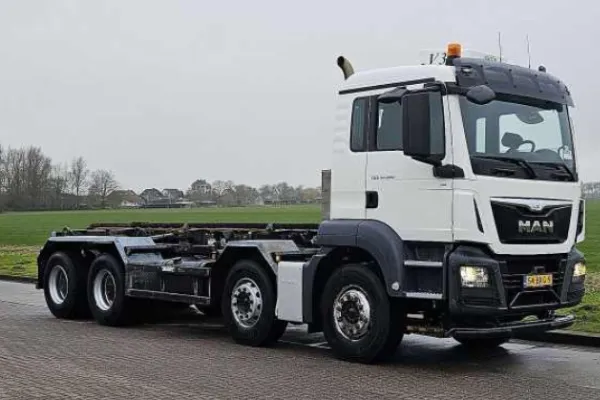
MAN is a German brand, not a Chinese one, so be clear on how the sourcing works. Amigo Truck supplies MAN tractor units as part of a multi-brand range, sourced new or as used ex-fleet units and put through the same export process as every other vehicle we ship.
The Five-Stage Process
From your first enquiry to the vessel sailing, every MAN 4×2 passes the same five stages.
- Consultation — route, payload, port, fuel quality
- Customized quotation — vehicle, options, preparation, transport
- Inspection — engine, transmission, axles, cab, fifth wheel
- Customization — axle ratio, emission standard, cab, signage
- Shipping — container, Ro-Ro, or breakbulk, with tracking
Shipping Method & Transit
How the unit moves depends on the vehicle and the destination port. Transit time varies by route and shipping schedule, so we confirm the expected timeline with your quotation.
- Shipping options
- Ro-Ro, container, or breakbulk, selected per vehicle and port. See our truck shipping service.
- Transit time
- Route-dependent. The expected timeline is confirmed with your quotation rather than promised as a fixed date.
- Price
- Quoted per configuration — model, engine, axle ratio, emission standard, cab, condition, and destination all change the figure.
You See the Unit Before You Pay
The single biggest fear in cross-border truck buying is receiving a different unit than the one you inspected. Nothing ships until the inspection report is in your hands.
Pre-Shipment Inspection
Engine, transmission, axles, cab, fifth wheel, brakes, lighting, ordered options, and documentation are all checked and reported.
Photos, video, and a written report before paymentMulti-Brand Sourcing
MAN sits alongside SINOTRUK, HOWO, and SHACMAN in our range, so the recommendation follows your route and budget rather than our stock.
Advice, not inventoryConfigured Quotation
Every offer covers the vehicle, options, preparation, and transportation — prepared per configuration, not copied from a template.
Typically within about 24 hours, with no hidden line itemsParts & After-Sales
Before you specify, we advise on what to stock for your operating conditions and how to keep the fleet moving after delivery.
Support beyond the shipmentMAN 4×2 Tractor Unit FAQ
Answers to common questions about pricing, model choice, drive configuration, and sourcing. Need help with your configuration? Contact our team.
1 How much does a MAN 4×2 tractor unit cost?
There is no fixed price, because the model, engine, axle ratio, emission standard, cab, condition, and destination port all change the figure. Send your route, payload, and destination port, and you receive a configured quotation — typically within about 24 hours — covering vehicle, options, preparation, and transportation.
2 What is the difference between the MAN TGX and TGS?
The TGX is MAN’s long-haul tractor with a wider cab (about 2,440 mm), a flat-floor GX high-roof option, and the larger D38 engine up to 640 HP. The TGS is the narrower-cab regional and distribution tractor, topping out at the D26’s 510 HP.
3 Is a 4×2 or 6×4 tractor unit better for long-haul work?
On paved roads, the 4×2 is usually the better choice — it is lighter, uses roughly 10–15% less fuel, and frees more gross vehicle weight for payload. The 6×4 earns its place on poor or hilly roads and heavy road-train duty, where the extra drive axle provides the needed traction and towing headroom.
4 Should I buy a MAN or a Chinese tractor truck?
It depends on your budget and market. MAN wins on service network, resale value, and driver comfort; Chinese brands such as SINOTRUK, HOWO, and SHACMAN win on upfront cost and parts price. We supply both and recommend on your route, fuel quality, and budget rather than on what we stock.
5 What emission standards are available on a MAN 4×2?
MAN 4×2 units are commonly offered at Euro V and Euro VI, with earlier standards available on used units. The right standard depends on your local fuel quality — a Euro VI engine with SCR needs low-sulfur diesel.
6 Can I buy a used MAN 4×2 tractor unit from China?
Yes. Used ex-fleet MAN units are sourced and put through the same pre-shipment inspection as new vehicles, so you see the actual unit and its condition before you pay.
SPECIFICATION BEFORE PRICE
Request Your MAN 4×2 Tractor Unit Quotation
Match the line, drive configuration, engine, and emission standard to your route and fuel quality, and you get a prime mover that earns on fuel economy, uptime, and resale value. Send your route, payload, and destination port, and we will return a configured quotation — typically within about 24 hours.
Consultation, customized quotation, inspection,
customization, and shipping handled as one process.
Request a Quotation
Start with your route and payload.