
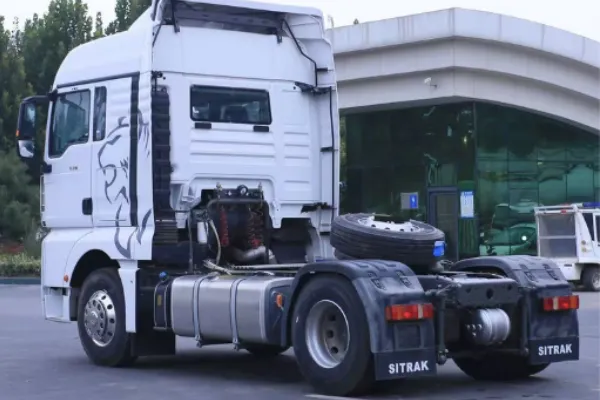
SITRAK C7H Tractor Truck
MAN-technology power for long-haul freight corridors.
SINOTRUK’s premium prime mover, offered in 4×2 and 6×4 with a MAN-derived MC11 or MC13 engine rated from 310 to 540 HP and a ZF or Sinotruk transmission behind it.
Built for line-haul work on paved corridors, where a truck earns on fuel economy, uptime, and driver comfort rather than on sheer hauling grunt.
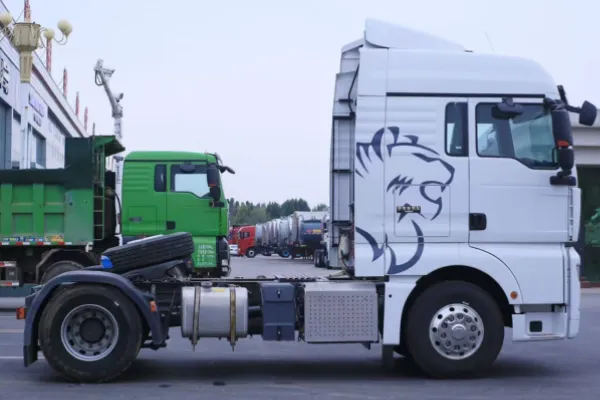
- 310–540 HP
- Engine power range
- ~2,300 N·m
- Peak torque (MC13)
- 4×2 / 6×4
- Drive configuration
- ~40,000 kg
- Max towing mass
Typical export figures: roughly 18,000 kg GVW for the 4×2 and 25,000 kg for the 6×4, with a towing mass up to about 40,000 kg. Specifications vary by build — confirm the final configuration in your quotation.
SITRAK C7H Tractor Truck Specifications
The figures below describe a typical export build. Individual units vary by engine, axle ratio, and destination-market requirement — which is why every quotation is prepared per configuration.
| Specification | C7H 4×2 | C7H 6×4 |
|---|---|---|
| Drive configuration | 4×2 — single drive axle | 6×4 — twin drive axles |
| Engine | MAN-technology MC11, inline-six turbocharged diesel | MAN-technology MC11 / MC13 |
| Power range | 310–460 HP | 400–540 HP |
| Torque | ~1,600–1,800 N·m | ~1,900–2,300 N·m |
| Transmission |
ZF16S1850 / ZF16S2230TO Optional ZF TraXon AMT |
ZF16S2230TO / ZF16S2530TO / HW19712 Optional AMT |
| Rear axle ratio | ~3.36 | ~3.82; optional 4.57 / 5.46 |
| Gross vehicle weight | ~18,000 kg | ~25,000 kg |
| Towing mass | ~34,700–40,000 kg | ~40,000 kg |
| Emission standard | Euro III–Euro V | Euro III–Euro VI |
| Cab |
C7H-P / C7H-M single bunk; C7H-H high-roof double bunk |
C7H-P / C7H-M / C7H-H |
| Tyres | 12R22.5 / 295/80R22.5 / 315/80R22.5 | 12.00R20 / 12R22.5 / 315/80R22.5 |
| Fifth wheel | 50# / 90# Jost | 50# / 90# Jost |
Reference figures only. The exact build on your unit depends on the engine, axle ratio, and cab you specify.
01
Where the Data Comes From
These specifications come from SINOTRUK SITRAK and dealer data for the C7H line. Treat the table as a reference point, not a final build sheet.
02
Confirmed Unit by Unit
The exact figures on your truck depend on the engine, axle ratio, and cab you specify. Every quotation is prepared per configuration rather than copied from a template.
03
Matched to Your Market
Emission standard, axle ratio, and cab are adjusted to the destination market. Tell us the country and the regulation that applies, and we configure the build to match.
Get the Specification Sheet for Your Build
Send your route, payload, and destination port. Receive a configured offer, typically within about 24 hours.
The MAN-Technology Powertrain Explained
SITRAK exists because SINOTRUK built a premium truck on German engineering. The C7H’s MC11 and MC13 engines are developed from MAN D26 technology, and that lineage is the single biggest reason a buyer chooses SITRAK over a standard HOWO.
Why the Lineage Matters
01The MC11 and MC13 are developed from MAN D26 technology. The reason to choose SITRAK over a standard HOWO is not the badge — it is what the drivetrain does over a million kilometres of sustained highway work.
Built for the long haulB10 Life & Service Intervals
02The MC11 and MC13 carry a B10 life of up to 1.5 million km — at least 90% of engines are designed to reach that distance before a major overhaul. In long-haul operation, that number translates directly into how long the asset earns before a rebuild.
The honest trade-off is the service interval: around 50,000 km between oil changes, shorter than the 70,000–90,000 km of a comparable European unit.
Plan maintenance around a shorter cycleFuel Consumption on the Road
03Real-world fleet data puts the SITRAK C7H at roughly 28 L/100 km in long-haul operation — about 1 L/100 km more than a comparable MAN truck on the same route.
The 4×2 runs 10–15% more efficiently than the 6×4 on highway work because it carries one fewer drive axle.
Fuel economy decides the running cost4×2 vs 6×4: Which SITRAK C7H Fits Your Route
The first specification decision is the drive configuration, and it is decided by your route and payload — not by the price tag.
01
The 4×2 SITRAK C7H
The choice for regional and long-haul distribution on good roads. One drive axle means lower tare weight, lower fuel consumption, and lower tyre and brake wear.
- Route fit Container and general-freight trailers on paved corridors.
- Efficiency Runs 10–15% more economically than the 6×4 on highway work.
- Condition Best when the route is asphalt all the way and payload sits within legal axle limits.
02
The 6×4 SITRAK C7H
Adds a second drive axle for traction and a higher legal towing mass — typically up to 40,000 kg.
- Route fit Heavier loads, hilly terrain, or stretches of poor road.
- Traction The extra driven wheels keep the truck moving when grip is the constraint.
- Trade-off That second drive axle costs roughly 10–15% at the pump.
SITRAK C7H vs HOWO T7H
Both trucks come from SINOTRUK, but they sit at different levels and suit different budgets. The C7H is the premium line; the T7H is the economical workhorse built on the older HOWO A7 platform.
| Factor | HOWO T7H Economical Workhorse | SITRAK C7H Premium MAN Technology |
|---|---|---|
| Powertrain | MAN-technology engines, more often paired with Sinotruk HW-series gearboxes | MAN D26-derived engines with ZF transmissions as standard |
| Positioning | Economical workhorse on the older HOWO A7 platform | Premium line — stronger on cab comfort, noise, and long-haul refinement |
| Cab comfort | Single and double-bunk cabs, with less refinement | C7H-H high-roof double-bunk cab built for two-driver long-haul operations |
| Price | Lower purchase price | Higher spec, justified where the route is long and the duty cycle is heavy |
Engine & Gearbox
The C7H runs MAN D26-derived engines with ZF transmissions as standard. The T7H uses MAN-technology engines too, but pairs them more often with Sinotruk’s own HW-series gearbox.
Cab & Refinement
The C7H-H high-roof double-bunk cab is built for two-driver long-haul operations. The T7H offers single and double-bunk cabs, but with less refinement.
Purchase Price
The T7H carries a lower purchase price. The C7H’s higher spec is justified where the route is long, the duty cycle is heavy, and fuel economy compounds over the asset’s life.
Route & Duty Cycle
Long paved corridors and most-days-on-the-road duty favour the C7H. Price-led, shorter, or mixed duty makes the T7H worth comparing.
CONSIDER THE T7H
Price-led purchasing, shorter routes, or a mixed duty cycle where the truck is not on the road most days.
CONSIDER THE C7H
Long paved corridors where the truck runs most days, and fuel economy and driver comfort compound over the asset’s life.
Where the SITRAK C7H Fits — and Where It Doesn’t
Being honest about fit matters more than listing features, because the wrong truck on the wrong job is the most expensive mistake an importer can make.
01
Where It Fits
The C7H is at its best on long-haul paved corridors — routes like the Lagos–Abuja–Kano corridor in Nigeria, or long regional freight lanes in East Africa and the Middle East.
- Running cost Fuel economy, uptime, and driver comfort decide the cost per kilometre.
- Driveline durability Fleets report the MAN-technology driveline holding up well over hundreds of thousands of kilometres.
02
Where It Doesn’t Fit
The C7H is not the first choice for off-road tipper or quarry duty. In those applications, total cost of ownership is higher than a HOWO or a dedicated dump truck.
- Parts cost MC-series parts and diagnostics cost more to run than a HOWO platform.
- Downtime risk The chassis is not optimised for rough-road cycle work.
- Better tool If the job is moving rock out of a pit, step over to the dump truck range.
03
The Honest Trade-offs
Three things about the C7H deserve plain treatment before you commit.
- Earlier builds Documented corrosion and wiring-harness weaknesses; SINOTRUK’s 2025 update addressed this with galvanised cabs, thicker paint, and revised wiring.
- Service interval Around 50,000 km — shorter than European rivals, so maintenance planning matters.
- Parts network Availability depends entirely on your local network.
Emission Standard, Market Compliance, and Parts
The emission standard you choose has to match the diesel available in your market — not the badge on the engine.
Match the Engine to the Fuel
A Euro V or Euro VI C7H with selective catalytic reduction (SCR) needs low-sulfur fuel. Run it on high-sulfur diesel and the after-treatment clogs and the engine derates.
In regions with high-sulfur fuel, an earlier Euro III build with simpler injection is often the more serviceable, more reliable choice.
Configured Per Market
That decision belongs to your destination country and fuel quality, and it is one of the configuration points we adjust per market. Tell us the country and the regulation that applies, and we will configure the emission standard, axle ratio, and cab to match.
This is the kind of market-specific decision covered in our vehicle customization guidance, and it is where a one-size-fits-all listing falls short.
Buying and Shipping a SITRAK C7H from China
Buying a tractor unit thousands of kilometres away carries real risk — the money, the unit, the paperwork, and the delivery. The process below is how that risk gets taken out of the transaction.
The Five-Stage Process
- Consultation — you tell us the route, payload, destination port, and fuel quality.
- Customized quotation — we return a configured offer covering the vehicle, options, preparation, and transportation.
- Inspection — the unit is inspected before shipment, with photos, video, and a written report in your hands.
- Customization — axle ratio, emission standard, cab, and equipment confirmed to the destination market.
- Shipping — container, Ro-Ro, or breakbulk depending on the vehicle and port, with tracking through to your destination.
You See the Unit Before You Pay
The single biggest fear in cross-border truck buying is receiving a different unit than the one you inspected. That does not happen here — every C7H passes a pre-shipment inspection, and the evidence is in your hands before the container is sealed.
- Engine & transmission
- Axles & brakes
- Cab & fifth wheel
- Lighting & ordered options
- Export documentation
Shipping Method, Transit & Price
A tractor unit can ship by Ro-Ro, in a container, or on a breakbulk vessel. Transit time varies by route and shipping schedule, so we confirm the expected timeline with your quotation rather than promising a fixed date.
- Pricing
- No fixed price. Engine, transmission, axle ratio, emission standard, cab, and destination all change the figure — so every unit is quoted per configuration.
- Turnaround
- Send your route, payload, and destination port, and you receive a configured quotation — typically within about 24 hours.
SITRAK C7H Tractor Truck FAQ
Answers to common questions about configuration, cost, reliability, emissions, and shipping. Need help with your build? Contact our team.
1 How much does a SITRAK C7H tractor truck cost?
There is no fixed price, because the engine, transmission, axle ratio, emission standard, cab, and destination port all change the figure. Send your route, payload, and destination port, and you receive a configured quotation — typically within about 24 hours — covering vehicle, options, preparation, and transportation.
2 What is the difference between the SITRAK C7H 4×2 and 6×4?
The 4×2 has one drive axle, lower tare weight, and better fuel economy on paved roads. The 6×4 adds a second drive axle for more traction and a higher towing mass, up to roughly 40,000 kg, at the cost of about 10–15% more fuel.
3 Is the SITRAK C7H reliable for long-haul work?
Yes, when maintained on schedule. Fleets report the MAN-technology driveline holding up well over hundreds of thousands of kilometres. The trade-offs to plan for are a ~50,000 km service interval and parts availability, which depends on your local network.
4 What emission standards are available on the SITRAK C7H?
The C7H is offered from Euro III through Euro VI depending on the configuration and destination. The right standard depends on your local fuel quality — a Euro V or VI unit needs low-sulfur diesel.
5 How long does it take to ship a SITRAK C7H from China?
Transit time varies by route and shipping method — Ro-Ro, container, or breakbulk. We confirm the expected timeline with your quotation rather than promising a fixed date.
6 Should I buy a new or used SITRAK C7H?
New suits a long-life fleet asset; used suits a lower capital outlay for faster payback. Both go through the same pre-shipment inspection, so you see the actual unit and its condition before you pay. See our spare parts support for what your local workshop will need.
CONFIGURED FOR YOUR ROUTE
Conclusion
The SITRAK C7H tractor truck is a specification decision before it is a price decision. Match the drive configuration, engine, axle ratio, and emission standard to your route and fuel quality, and you get a long-haul prime mover that earns on fuel economy and uptime. Choose the wrong configuration — a Euro V engine on high-sulfur fuel, or a 6×4 where a 4×2 would do — and you pay for the mistake every kilometre.
Amigo Truck handles consultation, customized quotation, inspection, customization, and shipping as one process, with the inspection report in front of you before anything ships.
Send your route, payload, and destination port, and we will
return a configured quotation — typically within about
24 hours.
Request a Quotation
Start with your specification.